Hope for Southeast Europe
In a few days, the EU’s enlargement strategy will be published. In the countries of Southeast Europe, there is hope – rightly so – for new impetus towards EU accession. A commentary by Karl von Habsburg.
In 2003, as has often been mentioned in this blog, the EU opened up a clear accession perspective for the countries of Southeast Europe – referred to as the Western Balkans in EU jargon, and the Eastern Adriatic in London – with the Thessaloniki Summit. Macedonia, for example, gained candidate status in 2005, yet a concrete date for the start of accession negotiations has not yet been set. One reason for this is a blockade by Greece, which seeks to prevent Macedonia from officially using the state name Macedonia. Despite billions in financial aid flowing to Greece, the EU has not exerted sufficient pressure to dissuade the country from its blocking stance. However, in recent weeks, there has been a noticeable rapprochement between Greece and Macedonia, leading many observers to hope that the name dispute can soon be resolved. From an Austrian perspective, it must be said that we are talking about countries in our direct neighbourhood, many of which also have significant historical ties with Austria. Therefore, there is great hope in the region that concrete steps towards enlargement will be taken in the second half of 2018, during Austria’s Presidency of the Council of the EU. The “Western Balkans” will also be one of the key priorities of this Council Presidency.
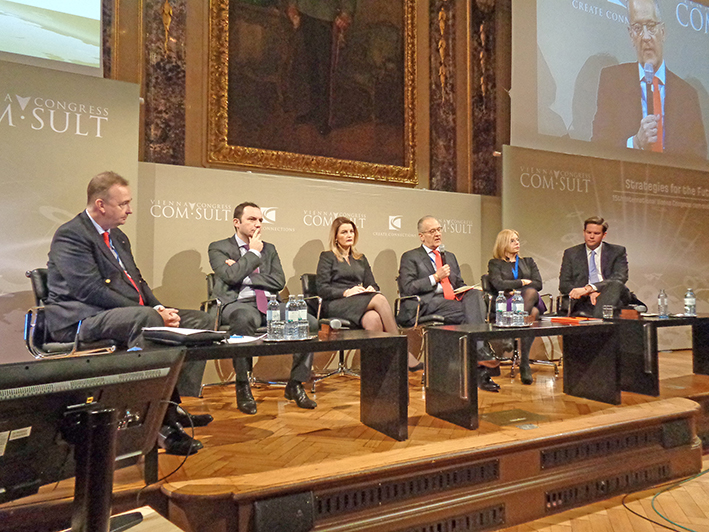
The question of EU enlargement and a concrete perspective for the countries of Southeast Europe also played a significant role at the Com.Sult Conference, held in Vienna earlier this week. Politicians and experts from the region expressed hope that 2018, partly due to the EU Commission’s new enlargement strategy to be published next week, will significantly open the door towards the EU. Public statements by the responsible EU Commissioner Johannes Hahn (an Austrian), in which he named 2025 as a possible date for accession for at least some countries, clearly fuel this hope. They also expect concrete dates for the commencement of accession negotiations.
Here, the Commission – naturally, only with the Council’s approval – could draw on an experience from the major enlargement round of 2004. After the fall of the Iron Curtain, the door was open for the European countries of the former Eastern Bloc, and accession negotiations were opened with almost all of them. This spurred the zeal of individual countries to achieve the best possible results in the negotiation process through competition. At the same time, the countries also had the opportunity to make comparisons. And the EU also had this comparative possibility. Each country was to be judged on its own progress, but it was clear that accession was open to all.
A similar path could now be chosen for the countries of former Yugoslavia – excluding Slovenia and Croatia, which are already in the EU – and Albania. The idea of negotiating individual chapters jointly has also been expressed. Those chapters concerning the rule of law were mentioned in this context. This is clearly a prerequisite for EU accession. And it is also a decisive point for overcoming many problems in these countries, where old structures have not yet been entirely overcome.
One must not forget the economic interdependence of the Southeast European countries with the EU member states. Austria, in particular, plays a special role here with close economic exchange. This means that, for the economic process, enlargement has already been anticipated. This argument should also convince those who still prioritise the problems. An open market benefits all sides, thus solving some problems for the Balkan countries, and simultaneously contributing to the economic development of EU countries. Prosperity is not created through isolation, but through vigorous trade.
From a security policy perspective, there is no reasonable alternative to the accession of the Southeast European countries to the EU. The longer the EU hesitates here, the more non-European powers will attempt to intensify their influence in the region. This, however, can only lead to a weakening of Europe as a whole, and thus not be in the interest of the EU countries.
The article is also published on Karl von Habsburg’s website.
The featured image is from the Southeast Europe discussion at the Com.Sult Conference. From left: Karl von Habsburg; Bujar Osmani, Deputy Prime Minister for European Affairs, Macedonia; Dhurata Hoxha, Minister for European Integration, Kosovo; Ivan Vejvoda, Permanent Fellow, Institute for Human Sciences, formerly with the German Marshall Fund; Hedvig Morvai, Executive Director at European Fund for the Balkans; and MEP and Chairman of the Austrian-Kosovar Friendship Society Lukas Mandl.



