Italy in Europe: What the Election May Bring
Italy is searching for clarity. Nevertheless, the general election on 4 March already possesses a factor of stability: Europe. An analysis by Luca Marconcini.
With a new electoral system, the Italian people will elect a new parliament next Sunday, 4 March. The electoral law passed by parliament in 2017 stipulates that two-thirds of the seats are distributed according to proportional representation and one-third according to a first-past-the-post system in regional constituencies. An exception to this is the regional constituency of Trentino-South Tyrol, where two-thirds of the representatives are elected by majority vote. This is grounded in the Italian Constitution, according to Article 6 of which it is the state’s duty to protect linguistic minorities within the national territory through specific provisions. Effective parliamentary representation for South Tyrol in Rome serves not only to implement the autonomy statute of this region lying in the heart of Europe, but above all to strengthen the positive relations between two important European states such as Austria and Italy.
One week before the election, the situation appears undecided. Three major blocs are running for a share in government. The centre-left coalition led by the Democratic Party (PD), the Five Star Movement, and the centre-right coalition are wrestling for a majority in both chambers of the Italian Parliament.
An absolute majority is achieved with a 40 per cent share of the vote in both chambers. According to preliminary forecasts, the Five Star Movement would emerge as the strongest party on Sunday, with just under 28 per cent of the vote and as yet no declared coalition partner for a future government formation. It is highly probable that the strongest party in parliament will lead the opposition.
With an attributed vote share of almost 27 per cent, the coalition around Renzi’s Partito Democratico seems far from an absolute majority. The loss of confidence since the European election victory less than 4 years ago, when the young party leader Renzi led the PD to over 40 per cent, is cause for concern.
Things are getting exciting on the centre-right for two reasons. Firstly, the coalition formed by Berlusconi is very likely to be attributed an absolute majority of seats in both chambers. Secondly, there could be a neck-and-neck race within this coalition between Berlusconi’s Forza Italia and the Lega. However, it is not yet time to claim that, in the event of a lead for the allies of the French Front National within the centre-right coalition, there will be a government under the leadership of party leader Salvini in Italy.
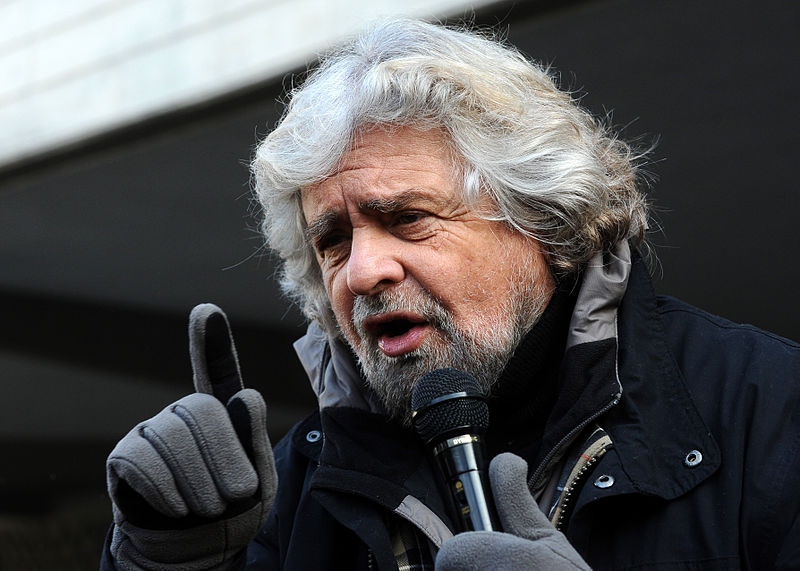
Although his achievements seem controversial, he has undoubtedly shaken up Italy’s party landscape: Beppe Grillo.
By Niccolò Caranti – Own work, CC BY-SA 3.0, https://commons.wikimedia.org/w/index.php?curid=23246728
On the one hand, Italy is looking for clarity and stability at the ballot box; on the other, a pro-European orientation of all parties is clearly discernible in this election campaign. After many years dominated by announcements of an exit from the monetary union, the movement around the comedian Grillo is preparing for a possible government participation through a pro-European turn and advocacy for a Europe close to its citizens. Anti-European slogans are also no longer heard as often in the newly nationally branded Lega, especially after the electoral battle of its French sister party. All the major parties in this campaign agree on one European issue: the reduction of illegal migration via the Mediterranean route.
The citizens of Italy will elect their parliamentary representation on Sunday, and only then can the parties attempt to give the country a stable and assertive government. All scenarios still seem open and there may well be surprises, whereby a clearly pro-European orientation of the next government can perhaps be regarded as the only constant. A swift formation of a government after the election would be necessary for the continuation of the reform path in Italy and would strengthen its role in Europe.

Luca Marconcini comes from Northern Italy and lives in Vienna.
https://twitter.com/lukamarc



