Karl von Habsburg: 100 Years of Paneuropa
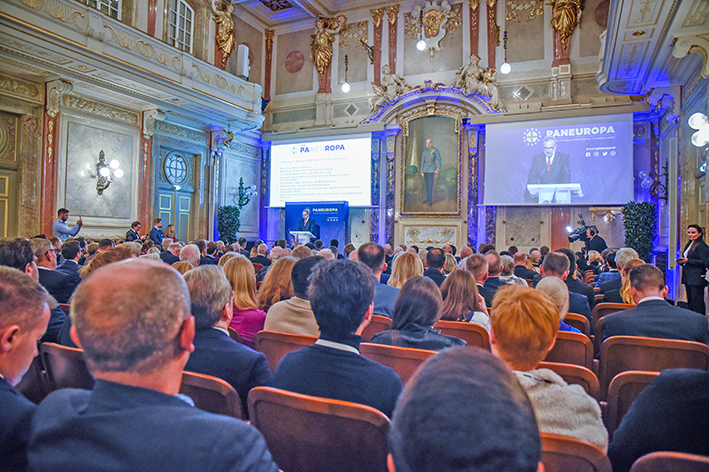
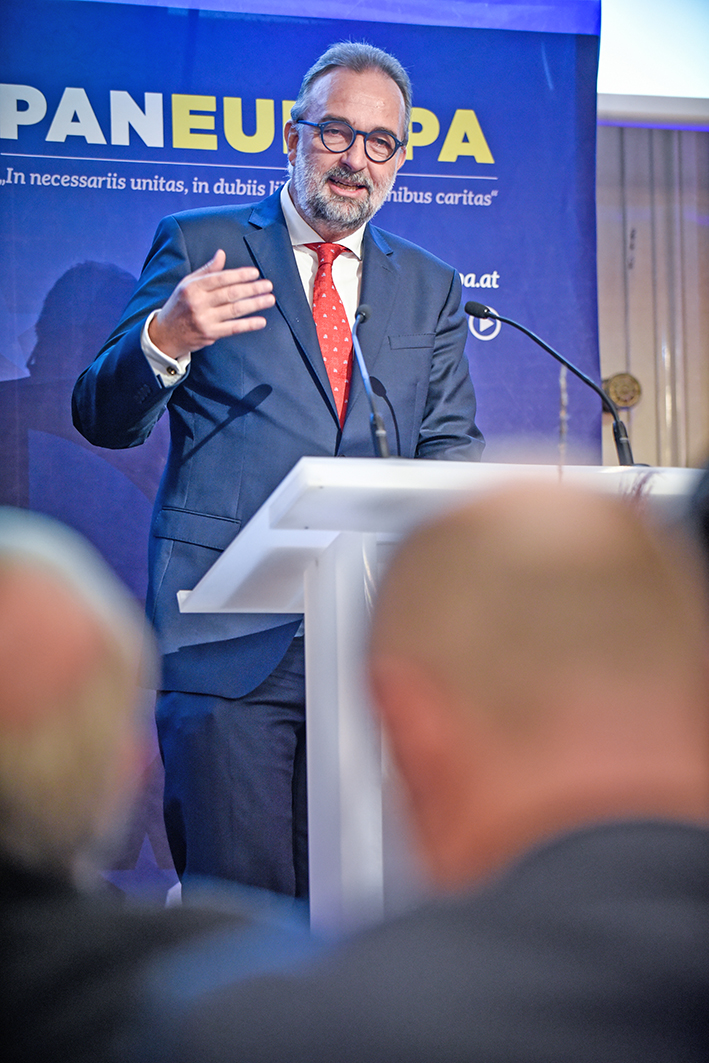
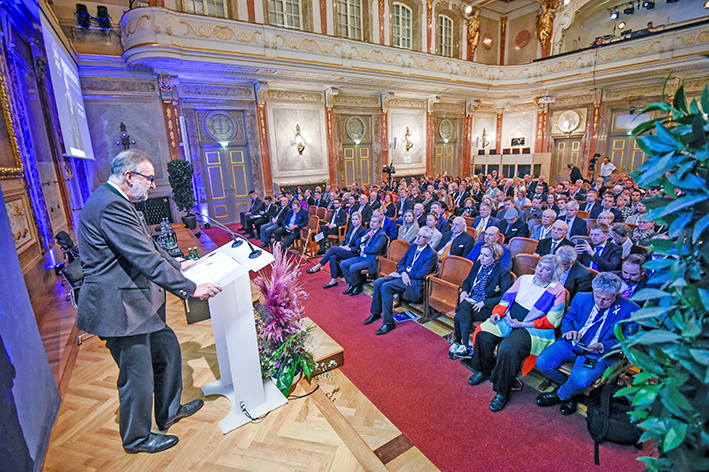
In his speech at the centenary congress ‘100 Years of Paneuropa’, Karl von Habsburg, President of the Paneuropean Movement Austria, called for a reflection on the original fundamental idea of European unification, pleaded for massive support for Ukraine, and for the recognition of the Holodomor as genocide. He also advocated for a regime change in Russia and Belarus, and reiterated his call for a European foreign policy. The speech was delivered on 18 November 2022.
Ladies and Gentlemen, esteemed Paneuropean friends!
Yesterday, exactly on the 100th anniversary of the publication of the article ‘Paneuropa. A Proposal’, we began the three-day congress ‘100 Years of Paneuropa’ with a festive event. Incidentally, 17 November was also the birthday of Richard Coudenhove-Kalergi, the founder of the Paneuropean Union, if we calculate the date according to his country of birth, Japan. Today, in expert discussions, we have already spoken about the history of the organisation, about the necessary enlargement policy towards Southeast Europe, and about Russia’s brutal war of annihilation against Ukraine. Tomorrow, we will discuss Europe between regionalism and geopolitics, the necessity of a European foreign and security policy, and the identity of Europe. On Sunday, we will conclude this congress with a Holy Mass on the 110th birthday of my father, Otto von Habsburg. The congress is thus embedded within the birthdays of the organisation’s first two presidents.
A birthday, or rather, an anniversary, is of course a good occasion to celebrate, but above all, it is an excellent opportunity to reflect on what the task of such an organisation still is today, whether its programme is still relevant, and what priorities it will need to set in the coming years. When we mark such an anniversary with a congress like this, it is not about resting on our laurels for achievements made by generations before us, but about laying the foundation for future political work. Let me put it in the words of my father, who wrote in one of his books: our task is not to be heirs, but to become ancestors.
If we look back at the time when the Paneuropean Union was founded, we will recognise alarming parallels with our present day. Richard Coudenhove-Kalergi developed the Paneuropean idea from a clear motive. He wanted to secure peace for Europe – we were then shortly after the end of the First World War – and he wanted to ensure that Europe would not become a plaything of non-European powers. He clearly recognised the danger emanating from Russia, then the Soviet Union. And he clearly recognised the danger emanating from nationalism and national egoisms. He wanted to secure a role for Europe in world politics, not in the sense of a return to the old order, but in the sense of a force for peace.
His message was not sufficiently heard at the time. Europe had to experience another, even more brutal Second World War, which also led to a division of the continent into a free West and an East totally dominated by Moscow. Only the great turning point of 1989/1990 gave the peoples of Central and Eastern Europe the opportunity to shake off the Soviet regime and regain their freedom. Finally, in 1991, the Soviet Union was dissolved, and countries like Ukraine, which had suffered for centuries under Russian rule in the eastern part of the country, were also able to achieve their independence.
In the West, the illusion arose that freedom had now triumphed, and wars would no longer occur in Europe. The CSCE Final Act, the Charter of Paris for a New Europe, and various other agreements had created frameworks that were supposed to secure this peace and freedom for Europe.
In security policy, Europe pursued a course that massively reduced all military capabilities for defence. On the one hand, to reap the peace dividend and invest money in welfare state redistribution programmes, and on the other hand, because it was believed that there would be a warning period of approximately ten years before any wars.
Yet, already in the shadow of the turning point and the end of the USSR, the Serbian tyrant Slobodan Milošević began his wars against the peoples of former Yugoslavia in the Balkans with his dream of a Greater Serbia. Strictly speaking, Europe should have heeded this wake-up call. But people preferred to continue living in the illusion that eternal peace had now broken out. They preferred to pocket the peace dividend and neglected their own security policy.
The Russian attack on Georgia in 2008, the occupation and annexation of Crimea, the war in eastern Ukraine, were evidently still not recognised by European politicians as clear signs that the dream of eternal peace is unfortunately just an illusion. Instead of developing new concepts for dealing with a threat from Moscow, dependence on Russian gas increased. Concepts for diversifying suppliers were politically overturned at the highest level. Austria and Germany were particularly susceptible to the allure of cheap gas from Russia. This also allowed them to convince themselves that the transition to so-called alternative energy sources would proceed without any problems.
In part, the concept of change through trade was still relied upon. It sounds logical, after all: people who trade with each other usually do not shoot at each other. The policy of change through trade is also based on the so-called interdependence theory. This approach assumes that states become so intertwined in a web of agreements through mutual dependencies – interdependencies – that, firstly, all sides benefit, and secondly, a war between these states would no longer be possible. One of the foundations of this interdependence theory, however, is a rational mode of action by political actors. War is expensive and destroys prosperity-enhancing trade relations. So, anyone who acts rationally (reasonably) prefers to trade with their neighbour rather than smash their head in. Because you can no longer trade with a dead neighbour.
This rational mode of action could evidently be assumed for the totalitarian USSR, but it no longer applies to Vladimir Putin’s rule. Power in the USSR rested on the three pillars of the Party, the KGB, and the Red Army. It was a balance of power in which the failure of one rationally acting pillar was supposed to be compensated by the other pillars. Putin’s Russia, however, is based on a fusion of the KGB, renamed FSB, with organised crime. Russia today is a mafia state, where the old KGB officer and later FSB chief Vladimir Putin is simultaneously the boss of all oligarchs who must pay him tribute. The actions of this system follow the logic and rationality of criminal organisations: violence to expand one’s own power. In Lenin’s sense, for Putin, gas is the rope with which he will hang the capitalists who previously did not sell him the rope, but bought it from him.
Once European states are dependent on Russian gas, and citizens, accustomed to the welfare state, are used to the cheap raw material, it is naturally easy to build pressure and stir up fear of a cold winter.
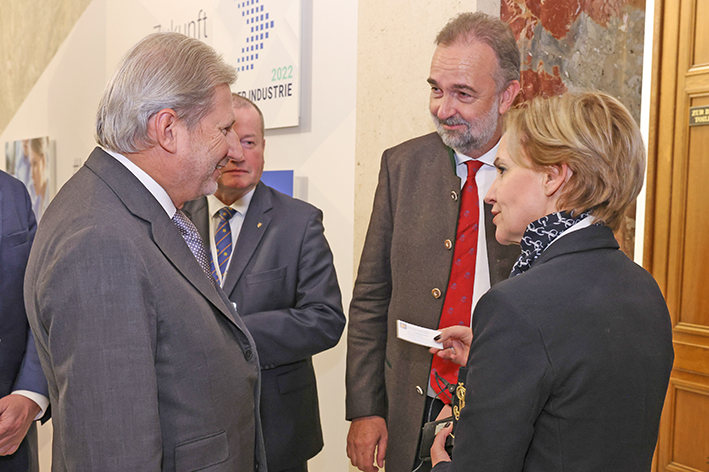
Karl von Habsburg with Gergana Passy, President of the Paneuropean Movement Bulgaria and former European Minister of the country, and EU Commissioner Johannes Hahn.
Added to this are populists of all stripes who try to stir up sentiment against the sanctions. The fact that it was Putin, not Europe, who turned off the gas tap, is gladly overlooked by these demagogues.
Ladies and Gentlemen, dear Paneuropean friends!
Today, 100 years after the founding of the Paneuropean Union, we in Europe are once again confronted with a war that many believe has nothing to do with us. In reality, however, the war of annihilation that Russia is waging against Ukraine is a brutal attack against everything Europe stands for.
It is an attack on Europe, on our way of life, on democracy, freedom, human rights, the rule of law, and the market economy. It is a war that Eastern despotism has unleashed against Western democracy. Putin despises the European way of life. Despite all the criticism that we occasionally level at European politics – and I emphasise: must level – no European can have an interest in submitting to Putin’s despotism. Not even the wealthy Russians who send their children to schools and universities in the West want that.
Of course, sanctions cannot end the war. Economic sanctions cannot do that. But the sanctions against the Putin system are having an effect in Russia. The goal of the sanctions must be to make the war unaffordable for Russia. The goal of a European policy must be to support Ukraine so massively, and that primarily means supporting it with military equipment, that it can thereby force Russia to the negotiating table.
The Paneuropean Union adopted a position paper on this at a presidium meeting in Zagreb, from which I would like to quote a few core ideas:
We need a clear definition of the war aim, i.e., the restoration of Ukraine’s territorial integrity.
We must create the legal prerequisites to use Russian assets frozen in the West for the reconstruction of Ukraine.
We must also demand appropriate reparations from Russia to repair the damage in Ukraine. However, I am also thinking specifically of reparations for refugees, the amount of which should be based on the salaries of Russian mercenaries.
We need to support civil society in Russia, which advocates for a democratic and rule-of-law development of the country.
Naturally, we must advocate for a regime change in Moscow. I am always surprised when there are opinions that one cannot demand such a regime change. How credible is this Putin regime still? Putin has practically broken all treaties created since the CSCE Final Act to establish a peaceful future. Would any of you sit down at the negotiating table with someone who has lied to and deceived you for at least two decades, and broken all agreements?
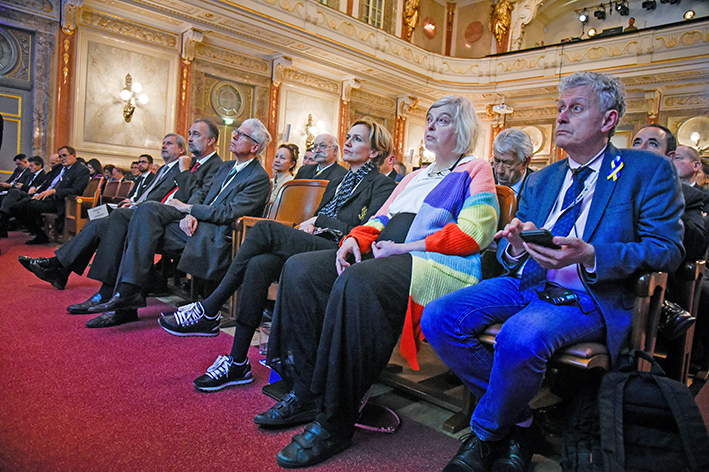
Centenary Congress ‘100 Years of Paneuropa’ at the House of Industry, 18 November 2022
All of this clearly means that the International Criminal Court must prepare proceedings against Putin and his system.
I also very clearly support the demand to recognise the Holodomor, the famine war instigated by Stalin against Ukraine, as genocide. This attempt to destroy everything Ukrainian took place 90 years ago. When we look at Ukraine today and see how the Russian leadership is deliberately trying to destroy all of the country’s infrastructure, that too is an attempt to wipe out everything Ukrainian.
At the same time, this is intended to put Europe under pressure. Because from a destroyed country where people can no longer heat their homes in winter because the energy infrastructure is destroyed, there will be further refugee movements into the EU. We all know how sensitively the issue of refugees is discussed here and how it is again instrumentalised by populists. And precisely for this reason, it will be our task to continue to ensure that Europe does everything possible to support Ukraine. It is somewhat shameful that this Russian war of annihilation had to happen before Ukraine was granted candidate status for EU membership. It was a long-standing demand of the Paneuropean Union to develop the old neighbourhood policy, which excluded EU membership, into an accession policy.
Ladies and Gentlemen, I spoke earlier of a necessary regime change in Moscow. The same applies, in my view, to Belarus. A regime like Lukashenko’s does not belong in Europe. Europe must be a continent of freedom. For this, Belarusians took to the streets; for this, tens of thousands of them were transported to labour camps where they are brutally mistreated by the regime.
Dear Paneuropean friends!
100 years after the founding of the Paneuropean Union, there is still much to be done for this tradition-rich organisation. When I use the term ‘tradition-rich’ here, it is also because I associate tradition with a definition that I unfortunately no longer remember where I picked it up: ‘Tradition is the capital of the wisdom of many generations.’
As Paneuropeans, we can look back with pride on much that has already been achieved, but we must develop this further in the spirit of the task quoted at the beginning, to become ancestors.
Today, we are confronted with a new form of national egoism in many respects. The best example of this is the enlargement policy towards Southeast Europe. In 2003, almost 20 years ago, these countries were offered the prospect of accession. And despite all the criticism we must level at nationalistic tones in these countries, an assessment we make today shows that much remains to be done here. Individual states repeatedly block progress.
Let us recall the accession of Spain, Portugal, and Greece to the EU, or then the EC. In all three countries, military governments were in power before the integration process. It was then the governments of the EC countries that made a political decision to begin the accession process with these states. Greece joined the European Community in 1981, followed by Spain and Portugal in 1986. The Commission, as guardian of the treaties, at the time spoke out against the start of accession negotiations because, in its opinion, the countries were not ready for it. The political decision in the Council, i.e., the representation of the member countries, was: we want to bring democracy and the rule of law to these countries. That is why we want to integrate them. This objective, this political ideal, also applied after 1989, after the end of the Iron Curtain, to the subsequent accession process for several of the former Eastern Bloc countries.
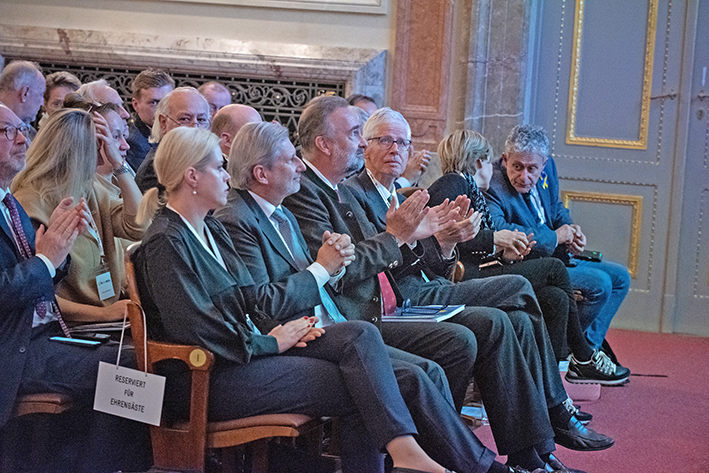
When I look at the current blockades against enlargement, I strongly get the impression that this European idea has been buried in the chancellories of Europe. Yesterday, we had the honour of listening to a speech by the President of Kosovo. The country is the last in Europe whose citizens require a visa for the EU. No country has been given as many conditions as Kosovo to achieve visa liberalisation. The Republic of Kosovo has fulfilled all conditions, that is beyond doubt. And individual heads of state, who like to deliver grand European speeches and interpret the country they represent as founding states of the EU, are not ashamed to repeatedly block this visa liberalisation with flimsy excuses.
This also concerns Europe’s credibility as a geopolitical actor! If we do not want to become a plaything of non-European powers, to refer back to a founding idea of the Paneuropean Union, then we must also be capable of pursuing reliable policies. The rule of law also means that binding commitments, once the required conditions have been met, are upheld.
In politics, there is no vacuum. The blocking policy of individual EU countries against enlargement creates space for other non-European powers. It is no secret that Russia and also China have very strong interests in the Balkans, and the role of Turkey should not be underestimated either.
Enlargement policy is part of European foreign policy. And here I return to the original Paneuropean idea. I often have the impression that, in view of various crises, many of which are self-inflicted due to a policy of procrastination in addressing problems, the actual goal of European unification has been lost sight of. The goal of European unification was not a uniform tax policy, especially given the extremely high tax rates that are characteristic of many EU countries today. Nor was the goal an all-regulating, redistributive welfare state that interferes in more and more areas of daily life.
The goal was to create a zone of freedom, security, and law! We must clearly re-emphasise this!
The essence of the liberal rule of law is precisely not the state enforcement of a particular vision of happiness and welfare. The task of the liberal rule of law is to guarantee law and freedom!
An ideology that follows the primacy of politics claims the right to regulate everything, indeed to be able to regulate everything. However, the more politics does this, the deeper the conflict with the law becomes. This conflict is becoming increasingly sharp because it is less and less often principles of the rule of law – i.e., the supremacy of law – that govern, but rather power relations. This conflict will ultimately harm Europe in the long term.
We are now strongly feeling the effects of this misguided policy, which believes it can regulate and control everything. Over the past 50 or more years, we have developed a welfare state that claimed to be able to relieve people of more and more worries. This was not only the fault of politicians who could gather votes in this way. It was also a consequence of citizens’ complacency. Who doesn’t dream of a carefree life in which the state takes care of everything?
Ultimately, we have reached a state where everyone believes the state must implement precisely their ideas of freedom. It is logical that this leads to a political conflict of objectives that no government (and no opposition) can resolve.
Therefore, my esteemed Paneuropean friends, in European politics we need to refocus on the core elements of the Paneuropean concept. A zone of freedom, security, and law can only be created and secured permanently if we achieve a European foreign and security policy. The challenges we face, and I have mentioned Russia’s war of annihilation against Ukraine, which is also an attack on the European community of values, as well as the necessary enlargement policy, should make this necessity of a European foreign and security policy clear to everyone.
This is precisely about the question of sovereignty, which many national egoists so readily speak about. Because sovereignty, ladies and gentlemen, in this specific case means the ability to act and shape. A European foreign policy would bring a clear added value in terms of potential compared to a purely national state policy. To be more precise: European foreign policy does not just mean coordinating the foreign policy of 27 member countries through the High Representative for the Common Foreign and Security Policy (who is also one of the Vice-Presidents of the European Commission), where individual countries can block a European statement on important issues such as human rights policy in China, or sanctions against KGB agent Patriarch Kirill. Instead, it means an EU Foreign Ministry with a Foreign Minister (or a female Foreign Minister) at its head.
For this, we need a core European constitution that enshrines precisely this foreign policy competence for the European Union. A point, incidentally, that would also meet all subsidiarity requirements. Just as every foreign minister is currently subject to the parliamentary control of their country, an EU foreign minister would be subject to the parliamentary control of the European Parliament, directly elected by the citizens of the EU.
I am aware that this will not be easy. I have already addressed national egoisms on many issues.
But we are here at a celebratory event marking the 100th anniversary of the founding of the Paneuropean Union. Who could have imagined in 1922 that we would have a European Union today? With all the weaknesses that still exist. Who could have imagined in 1979, when the USSR invaded Afghanistan, that ten years later the Iron Curtain would fall? Who could have imagined on the evening of 24 February 2022, when Russia had already fully launched its war of annihilation against Ukraine, that in November 2022 Kherson, the only regional capital conquered by Russia at the time, would be liberated by Ukraine? Who could have imagined in 2014, after the annexation of Crimea, that the EU would react to the Russian invasion of Ukraine at the end of February 2022 with such determination as we have seen?
Ladies and Gentlemen, dear Paneuropean friends!
It will be our task as Paneuropeans to advance this idea of a genuine European foreign and security policy wherever we can contribute to the European discussion.
The good arguments are on our side.



