Karl von Habsburg calls for the “Soul of Europe” to be uncovered
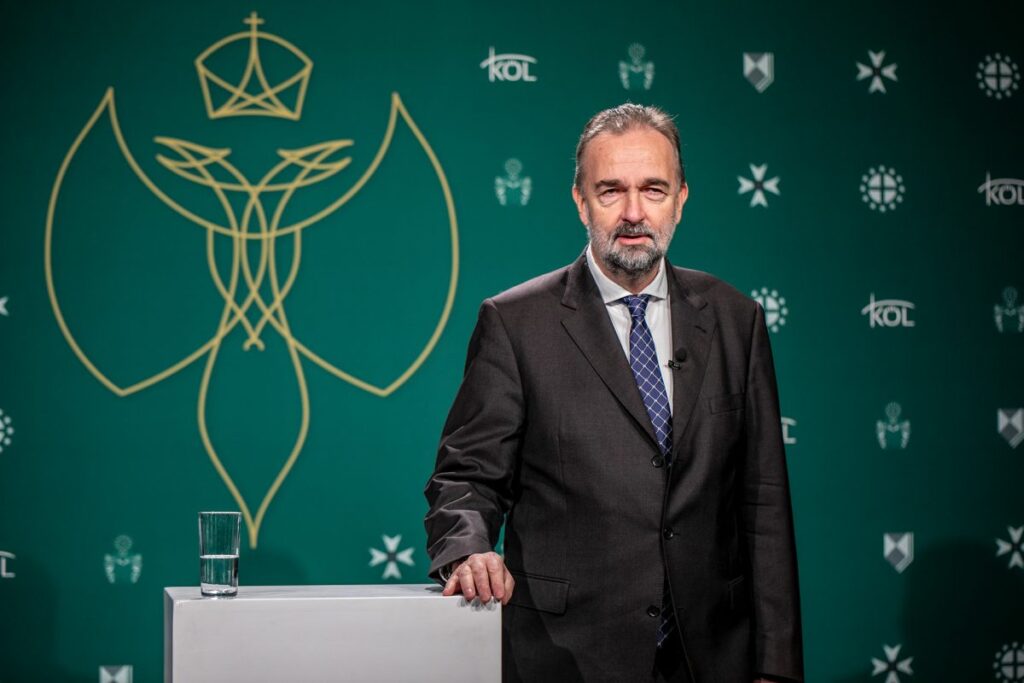
Personal freedom and the rule of law are the foundations of European identity; the EU needs a European foreign policy to serve as the basis for a constitutional treaty; Lukashenko should be charged with crimes against humanity. “Speech on the Future of Europe” by Karl von Habsburg, delivered on 11 January 2022.
When we had to hold the Speech on the Future of Europe as an online event a year ago today due to the COVID situation, those of us in the team preparing the event were still optimistic that this year would see a real event with personal attendance. When infection rates began to rise significantly again in October last year, we took the decision to hold the event online again this year. Naturally, I too would have preferred it if we could have discussed the impressions and content of the speech in person over a glass of wine afterwards, but special circumstances require special solutions. They require a certain willingness to react to the given situation while still not losing sight of the goal.
The aim of this Speech on the Future of Europe, which I will deliver every year on 11 January, is to address European policy issues fundamentally on the one hand, but also to discuss them in the context of current challenges on the other. Furthermore, concrete political ideas for shaping European policy should always be put forward, and we must continue to work on their implementation.
Ladies and gentlemen, dear friends!
The current situation is, among other things, still characterised by a virus. When I say this, it is not because I want to give a lecture on viruses – I wouldn’t be able to do that – but because the challenges with which this virus called COVID-19 in all its mutations has confronted us have a European dimension. Strictly speaking, the challenges with which the virus has confronted European politics should have strengthened Europe, the European Union, and European integration. If we assess the situation today, almost two years after the start of this pandemic, we must conclude that unfortunately the opposite is the case, and that divisive tendencies are greater today than they were before.
Let us look back. In February 2020, the European Commission drew attention to the problem and proposed a common approach. The EU has no competence in health matters, so the Commission could not act itself, but could only try to implement coordination measures.
The reaction from the member states was unanimous: we have everything under control, we can handle the situation. We also remember what happened next: not only were lockdowns imposed, but attempts were also made to snatch necessary equipment from one another. In the end, we had almost closed borders for two years, which in turn caused further disruptions in industry, for example. It was only in the procurement of vaccines that the decision was made to act together.
The crisis should strengthen Europe
Yet all the prerequisites were there to strengthen Europe through this crisis. Around ten years ago, a paper on European defence was published which mentioned a pandemic originating in Asia as a possible threat scenario. So, we could have been prepared. The principle of solidarity exists in the European treaties. Few people will probably know this: there is even an EU Commissioner for Crisis Management.
So, instruments were available to respond to this global challenge at a European level. Moreover, no national interests were affected; rather, all citizens of the European Union, and even politicians, were directly affected. The European dimension was therefore clearly present.
The decisive question in a crisis is always how one reacts to it. Does one accept the challenge – in this specific case a global challenge that is not limited to health policy but also has geopolitical and economic aspects – and react together, or does one dig up old political patterns and retreat into the apparent security of the nation state?
How one reacts, how politics reacts, is a question of political foresight. It is a question of political leadership, a question of the European idea. I have the strong impression that we have buried this European idea in the state chancelleries of Europe and also among the leadership at EU level, and instead pursue a policy with soulless ideological concepts that, in the best case, has a time horizon until the next election, but normally is characterised by the dates of press conferences.
We must therefore ask ourselves what constitutes the soul of Europe, and we must resume this struggle for the soul of Europe.
Ladies and gentlemen, it is obvious that there is such a thing as a soul of Europe; it has been addressed repeatedly by politicians, who have demanded that Europe must be given a soul.
Former EU Commission President Jacques Delors spoke of this, saying that one cannot love a single market alone. Ursula von der Leyen, the current President of the Commission, referred to the soul of Europe in her State of the Union address in September 2021. The speech was even entitled “Strengthening the Soul of our Union”. In contrast to Delors, she seems to assume that this soul exists and does not first have to be created. And she quoted Robert Schuman, one of the founding fathers of the European Union after the Second World War: I quote: “Europe needs a soul, an ideal, and the political will to serve this ideal.” End of quote.
Politics needs clear objectives
In one sentence, Robert Schuman thus precisely described what politics means: following an ideal, an objective. Politics is more than just the redistribution of welfare benefits to satisfy one’s own electorate. Today’s politicians like to use the term resilience. However, the welfare state is the exact opposite of resilience. Politics needs a strategic guiding principle. Many today would speak of a narrative. To achieve this, however, one must also be clear about what the original idea of European integration was, and on what basis of values this idea of a European Union should be built.
After 1945, it was certainly the longing for peace in Europe. Two world wars, which had their roots in nationalism and totalitarian ideologies, not only caused massive damage in Europe – human and economic – but also divided the continent with an Iron Curtain. The old enmity between France and Germany had to be overcome in order to stabilise a peace order in the West and to escape the danger of a hot war growing out of the Cold War. This founding idea of today’s European Union was so successful that it not only achieved this goal of securing peace within the community, but also developed so much appeal that the countries of Central and Eastern Europe sought to join this community after the end of Soviet rule. If one looks with open eyes at the South-East European region, or at countries like Ukraine or Georgia, one will also recognise joining the EU as a political goal there. Only a wrong policy by the EU and its member countries could destroy this wish.
But we must be honest with ourselves: dear friends, the narrative of securing peace has lost its appeal. This is partly due to the fact that the EU had neither the instruments to oppose Slobodan Milosevic’s bands of murderers, nor found a means to halt Vladimir Putin’s efforts to restore the territory of the Soviet Union. On the other hand, the narrative of securing peace is becoming increasingly implausible for a young generation that has seen no more war within the EU. Peace is there; it is taken for granted, just like a holiday trip or a smartphone.
We are now in the year 2022. 100 years ago, an organisation was founded in Vienna that is still considered the origin of the idea of European integration: the Paneuropean Union. On 17 November 1922, Richard Coudenhove-Kalergi published his appeal “Paneuropa. A Proposal” in the Neue Freie Presse. He had already published this appeal two days earlier in the Vossische Zeitung in Berlin. Therefore, a jubilee congress of the Paneuropean Union will take place in Vienna from 17 to 20 November 2022.
100 Years of Paneuropa
The jubilee congress for 100 years of Paneuropa will open the door to the future of the Paneuropean idea and European integration with a proud look at the history of the organisation. After a review of the development of the Paneuropean Union, the focus will be on discussing important Paneuropean topics for the further shaping of European integration: European foreign policy, European security policy, European economic policy, the single market, identity, and the soul of Europe.
Ladies and gentlemen, I would like to cordially invite you today. Naturally, we are optimistic that we will have the COVID situation under control by then to such an extent that this event can take place in person.
Let us take a look at the origins of this Paneuropean Union and also at the historical background that shaped Richard Coudenhove-Kalergi. He was born in Japan. His father Heinrich was the Austrian envoy to the Japanese imperial court. Richard came to Europe as a child, to his family’s castle in Ronsperg, Bohemia. Coming from Japan, he was probably able to see Europe as a whole. It was his father’s home, while Asia was his mother’s home. Richard grew up in a supranational state, the Habsburg Monarchy, which also strongly shaped his thinking. It is probably impossible to assign him to a single nation. The family had roots all over Europe, from Greece to the Netherlands and Bohemia, and through his mother as far as distant Asia. At that time, there was still such a thing as a European order. It was European powers that determined world politics.
Undisputedly, the Christian worldview shaped life and culture in Europe. Coudenhove described Europe as a community of destiny, “founded on monogamy and family, on private property, on common customs and festivals, on the same religion, the same tradition, the same concepts of honour and morality, the same prejudices”. Even with private property, we can no longer be sure whether this still generally applies today due to the exorbitant tax burden.
This European order was destroyed after the First World War. De facto, it was the intervention of a non-European power, the USA, that brought the war in the West to an end. 1918 brought the downfall of the empires that were directly or indirectly connected to Europe. Four of these empires were destroyed as a direct result of the war; the British Empire continued to exist but was already heading towards its end. However, many dictatorships and totalitarian systems emerged on the soil of these former empires.
In Central Europe, a cultural area that had grown over centuries was dismembered. Nationalism took the helm. Small nation states emerged. But none of the new nation states could fulfil the claim of being a nation state – that is, a state consisting only of members of a single nation. Every new state had its ethnic groups that belonged to a different language community than the majority population.
However, not only was a cultural area dismembered, but also an economic area. Every single state tried to solve its problems through isolationist policies, through protectionism and nationalism. They tried to export the problems but in reality only made them worse.
Coudenhove-Kalergi tried to learn the lessons from this situation. Although 100 years later, I often have doubts as to whether people today are still prepared to heed these lessons. The first reactions to the COVID crisis, which I described at the beginning, are in any case a good reason for these doubts.
Geopolitical approach in the Paneuropean idea
The Paneuropean concept follows a geopolitical approach. The goal then was not the standardisation of the highest possible tax rates or a Europe-wide redistributive welfare state, but the redrafting of a European order. Not in the sense of a – probably even then – unrealistic return to the old order, but in the sense of a structure that would restore Europe as a unit of action in world politics and not make it a plaything of non-European powers.
Therefore, at the centre of his considerations were, firstly, a European foreign policy – so as not to be dominated by others on the stage of world politics; secondly, a European security policy – so as not to be dependent on others in this matter and thus dominated, or drawn into a new intra-European war; and thirdly, the removal of all intra-European customs barriers. Today, this would be called a free internal market, i.e. Europe as a free trade zone. Added to this even then was the consideration of a common currency, which in Coudenhove’s concept was based on the gold standard still in existence at the time, and a European federal court, i.e. what we have today as the European Court of Justice.
The freedom of citizens, individual responsibility, and a state that limits itself to setting the framework conditions in the sense of a rule of law were a further basis of his considerations for European integration at that time.
Ladies and gentlemen, dear friends!
If we look at the situation in Europe today, 100 years later – even if there are already 27 states forming a European Union – we will find that this approach is still valid and we must work on the realisation of this idea. We have the four fundamental freedoms – freedom of movement for services, capital, persons, and goods – but we still have to fight against national egoisms and protectionist measures within the EU. And I am not even referring here to the restrictions such as border closures due to the pandemic.
Protectionism harms Europe
Various member states were extremely inventive in restricting the freedom to provide services, for example. Ultimately, a Services Directive was even passed to allow protectionist measures in various areas, contrary to the freedom to provide services, which strictly speaking has constitutional status. Or think of the Posting of Workers Directive, which also brings protectionism. So there is still a lot to be done here to enable a genuine free internal market.
One does not have to be a trained economist to formulate a fundamental truth of the economy: free trade is always better than protectionism; it secures prosperity and thus provides the basis for all the other comforts of our lives.
The geopolitical approach is also still valid. In the Cold War, Moscow determined the foreign policy of the eastern half of the continent in a totalitarian manner; for the free western part, the partner USA was the determining power. Without wishing to offend anyone in Paris, Berlin, or Madrid, even today it is the case that decisions on major global political challenges are not made in the capitals of Europe, but still in Washington and Moscow, as well as in totalitarily governed China. Europe lies on the periphery of various conflict zones. Think of the Middle East, but also think of the eastern border of the EU, where we have a zone of instability due to hybrid attacks – and there is no other way to describe the instrumentalisation of refugees by the totalitarian Lukashenko regime – from Minsk but also Moscow, which only a united EU can counter.
It is extremely short-sighted when individual EU countries believe they can build a special relationship with Russia that is in contradiction to European interests. Even if such a policy might seem to bring a small advantage for such a country at first glance, in the medium term this country will be used by Moscow to divide the EU. A divided EU, however, can efficiently counter neither the old divide et impera policy nor Moscow’s new hybrid policy. And thus, even that small country that thought it could gain an advantage loses its protection through a strong policy of the European Union, thereby harming itself.
China attempts to redefine human rights
It is also shameful to see how often China has already succeeded in dividing the European Union on human rights issues. This is not about what is generally defined as interference in internal affairs, i.e. direct criticism of Chinese human rights policy towards the Uyghurs, for example, but about the fact that China is trying to redefine human rights altogether in the sense of its own communist ideology and power interests.
The conclusion from this – and I know you are not hearing this demand from me for the first time – can therefore only be: Europe, the European Union, needs a European foreign policy. Precisely in this question of foreign and security policy, European sovereignty is needed.
Sovereignty, ladies and gentlemen, means in this specific case the ability to act and to shape. European policy would bring a clear added value in terms of potential compared to a purely nation-state policy. To specify further: European foreign policy does not just mean coordination of the foreign policy of 27 member countries by the High Representative for the Common Foreign and Security Policy (who is also one of the Vice-Presidents of the European Commission), where individual countries can block a European statement on important issues such as human rights policy in China, but an EU Foreign Ministry with a Foreign Minister at its head.
For this, we need a core of a European constitution in which precisely this foreign policy competence for the European Union is enshrined. A point, incidentally, that would also meet all the requirements of subsidiarity. Just as every foreign minister is now subject to the parliamentary control of his country, an EU foreign minister would be subject to the parliamentary control of the European Parliament, directly elected by the citizens of the EU.
Of course, it is not enough to create a post to conduct real foreign policy. To do this, one must also show the willingness to define European interests. In some areas, this is already succeeding due to current challenges. I am thinking of the protection of borders, the defence against direct or hybrid threats, the commitment to human rights, or the concrete enlargement policy of the European Union.
Necessary decolonisation of Russia
I would not formulate feminism as a goal of foreign policy. We do not want Sergey Lavrov and Vladimir Putin to laugh themselves to death; rather, our goal must be to support Russia on its path of decolonisation towards a peaceful, democratic state under the rule of law, with which we can live in a genuine partnership.
It must be clear to all of us that this step towards a European foreign policy will not be so easy. It will still take a lot of persuasion to be able to actually position Europe in terms of foreign policy. I return to the Schuman quote: this is an objective, an ideal that needs the political will to serve this ideal.
The fact that such an objective sounds utopian should not stop us from advocating for it. For only those who have political objectives will also make policy.
I have already mentioned the Paneuropean Union. One of the slogans for which this organisation has become known is: “Paneuropa is all of Europe.” When my father Otto von Habsburg became Vice-President of the Paneuropean Union in 1957 and began to repeat this slogan in his speeches again and again, Europe had not even experienced the first peak of the Cold War. Overcoming the highly militarised Iron Curtain not only sounded utopian back then, but also led some to the view that anyone demanding such a thing could not be in their right mind.
Let us think of a Willy Brandt, who received the Nobel Peace Prize for his policy of change through rapprochement, and who as late as 1988 described the belief in German reunification as one of the life-lies of the Federal Republic of Germany. The “yesterday’s men” of Paneuropa, as we were often called, not only banked on the reunification of Germany but even believed in a unification of Europe.
Dear friends – we still do so today. We still take the slogan “Paneuropa is all of Europe” very seriously, because every European country has a right to belong to this European integration. I am thinking specifically of the countries of South-East Europe, which lie like a non-EU island in the midst of EU countries and are the target area for the influence of non-European powers taking advantage of the EU’s weakness. But I am also thinking of Moldova or countries like Ukraine and Georgia, all three of which are partially occupied by Russian soldiers and their mercenaries. I am thinking of a country like Belarus, where a long-term ruler has established a totalitarian regime after an obvious election loss, in which arbitrary arrests, torture, and also murder are unfortunately a reality.
A European foreign policy cannot look away there. A European foreign policy must tighten sanctions so that Moscow and Beijing decide to let Lukashenko fall. Freedom and human dignity are part of the European soul, the European identity. To abandon them for whatever flimsy reasons in the case of Belarus would be in contradiction to Europeanism. I also advocate for charging the Lukashenko regime at the International Criminal Court for crimes against humanity.
The same determination, incidentally, also applies to the support of Ukraine as a guideline for a European foreign policy.
EU enlargement is a highly political issue
Of course, the question of EU enlargement is a highly political issue. It is a betrayal of the idea of European integration when individual countries that already belong to the EU then misuse this membership for a blockade. Regardless of whether it is about the start of accession negotiations or visa-free travel for the citizens of Kosovo.
Let us think back to the admission of Spain, Portugal, and Greece. In all three countries, military governments were in power before the integration process. It was the governments of the EC countries at the time that made a political decision to begin the accession process with these states. Greece joined the European Community in 1981; Spain and Portugal followed in 1986. The Commission, as guardian of the treaties, spoke out against the start of accession negotiations at the time because, in its opinion, the countries were not ready for it. The political decision in the Council, i.e. the representation of the member countries, was: we want to bring democracy and the rule of law to these countries. That is why we want to integrate them. This objective, this political ideal, also applied after 1989, after the end of the Iron Curtain, for the accession process then beginning for several of the former Eastern Bloc countries.
When I look at today’s blockades against enlargement, I must repeat a sentence here that I already mentioned at the beginning in connection with COVID policy: “I have the strong impression that we have buried this European idea in the state chancelleries of Europe.”
Ladies and gentlemen: When I say the European idea is buried, it means that it exists, the European idea. There is the European identity, there is the European soul. We just have to dig this idea up again, make it visible again. A very central element of this is the freedom and individual responsibility of citizens, as well as the principle of the rule of law.
Precisely this principle of the rule of law is often distorted today at the European level. Without wishing to go into the details of the disputes between various member states of the EU or between member states of the EU on the one hand, and the Commission and Parliament on the other: in the background, this is about questions of power and ideological concepts.
The rule of law protects law and freedom, not ideologies
The conflict is also not one between Western and Central Europe, even if it is now being stylised by some as a new split between East and West. This narrative is driven by ideologues who present themselves as victims of an oppression of Eastern Europe by Western Europe, in order to build the story that they are the only (and also the last) ones who defend the true values of Europe. In fact, it is a conflict between two statist, paternalistic ideologies, where one applies statism at the level of the nation state, the other at the level of the supranational EU. Both ideologies are characterised by a primacy of politics, not by a primacy of law.
It is therefore a conflict between ideologies that ultimately undermine the rule of law and want to impose their ideological view on it.
The essence of the liberal state under the rule of law is precisely not the state enforcement of a certain concept of happiness and welfare. The task of the liberal state under the rule of law is to guarantee law and freedom!
An ideology that follows the primacy of politics claims for itself the right to regulate everything, indeed to be able to regulate everything. However, the more politics does this, the deeper the conflict with the law becomes. This conflict is becoming increasingly sharp because principles of the rule of law – i.e. the rule of law – govern less and less frequently, and power relations more and more. In the long term, this conflict has a detrimental effect on Europe.
Incidentally, we are also noticing the effects of this wrong policy, which believes it can regulate and control everything, now in the COVID pandemic. In the past 50 years or more, we have developed a welfare state that has pretended to be able to take more and more worries away from people. This was not only the fault of the politicians who were able to collect votes in this way. It was also a consequence of the convenience of the citizens. Who does not dream of a carefree life in which the state takes everything off one’s hands.
In the end, we have reached a state in which everyone thinks the state must implement exactly their concept of freedom. It is logical that this leads to a political conflict of objectives that no government (and no opposition) can solve anymore. The economist Felix Somary, who has unfortunately almost been forgotten, already described this in his “20 Social Laws of Inverse Proportions”. In law number 4, he says: “The more functions a state assumes, the harder its administration is to control.” And he adds in law number 5: “The larger and more versatile the state, the more powerless the people.”
Loss of trust in politics
A massive loss of trust in politics is the result. That is then the hour of the populists.
Ladies and gentlemen!
It will therefore be necessary to talk about a redimensioning of the state, about deregulation and a reduction in the density of regulation. Ladies and gentlemen: The European tradition also offers us a very sensible instrument for this, namely subsidiarity.
Since the Maastricht Treaty, it has been part of the European treaties, where Article 5 of the EC Treaty states: I quote: “In areas which do not fall within its exclusive competence, the Community shall act, in accordance with the principle of subsidiarity, only if and in so far as the objectives of the proposed action cannot be sufficiently achieved by the Member States and can therefore, by reason of the scale or effects of the proposed action, be better achieved by the Community.” End of quote.
However, this definition only inadequately reflects subsidiarity. Firstly, because it only aims at the relationship between the EU and member states; secondly, because it reduces subsidiarity to a kind of delimitation of competences, according to which member countries lift competences to the European level. In fact, however, subsidiarity is significantly more, namely a natural principle of order that includes the principle “in dubiis libertas”. There does not have to be a legal regulation for everything (no matter at what level), because there is such a thing as freedom, initiative, and individual responsibility.
Pope Pius XI was more precise in his definition in his encyclical “Quadragesimo anno”, in which he defines the “social-philosophical principle” (subsidiarity), which is “not to be shaken or questioned”: I quote again: “just as it is gravely wrong to take from individuals what they can accomplish by their own initiative and industry and give it to the community, so also it is an injustice and at the same time a grave evil and disturbance of right order to assign to a greater and higher association what lesser and subordinate organisations can do. For every social activity ought of its very nature to furnish help to the members of the body social, and never destroy and absorb them.” End of quote.
Pope Pius XI argues that by observing this principle, the respective units of society function much better than if the state power interferes in all areas: He specifies: Quote: “the more faithfully this principle of ‘subsidiarity’ is followed, and a hierarchical order maintained among the various organisations, the more excellent will be the social authority and efficiency, and the happier and more prosperous the condition of the State.” End of quote.
Subsidiarity and the happy state
In other words: Catholic social teaching gives us a very clear guideline here for resolving the political conflict of objectives described above, which arises in the welfare state because the state interferes in too many areas of life in a regulatory manner.
Ladies and gentlemen, dear friends!
It does not surprise us that this solution comes from the Christian tradition. Inevitably, as soon as we begin to clear away the rubble that has buried the soul of Europe, we will come across the Christian roots of Europe, the Judeo-Christian tradition.
Let me summarise this once again in the words of my father: “The Christian faith made the growth and strengthening of Europe possible. The concept of human dignity and the development of human rights are unthinkable without Christianity and its Jewish roots. Even if it is often claimed that human rights were only formulated by the Enlightenment, it must be pointed out that the Enlightenment thinkers also found their philosophical basis in charity and the scholasticism of the monks of the Middle Ages. If faith disappears, other idols take the place of the Almighty. Man is oriented towards transcendence. In place of God, nothing will rarely step, but rather substitute idols or substitute ideologies that dangerously promise man paradise on earth. A look at the world map shows: without a spirit of its own, this Europe is condemned to disappear. Sustainable political forces are only created by an idea, for this is the soul – also of continents. Europe was, as long as it was Christian.”
Christianity is a foundation of Europe
In the text I have summarised here, he then goes on to write that the decline began the moment this consciousness began to fade.
But we have not gathered here – even if only virtually – to mourn the decline of Europe, but to shape its future. Therefore, I ask you: help to uncover the soul of Europe again!
Ladies and gentlemen, dear friends!
Allow me to conclude with a remark on the urgently needed social reunification. You are surely wondering what I mean by that? In my view, this is an absolutely priority task for politics. For although I am optimistic that we will increasingly get the pandemic under control medically and return to a normal life step by step, the deep rift that runs through families, communities, states, and also through the EU due to the extreme social polarisation regarding COVID will not be mended so quickly.
Anger and hatred block the view of solutions
To achieve this, a basic prerequisite is that we disarm verbally and emotionally. Politics must lead by example and place responsibility for social cohesion above electoral tactical considerations. But in society, too, the camps facing each other so bitterly will have to take a step towards one another. For anger and hatred always block the view of solutions – and also of the roots of Europe, our values.
Other language versions: Français (French) | Українська (Ukrainian)



