Kosovo, Europe’s Youngest State – Ten Years of Independence
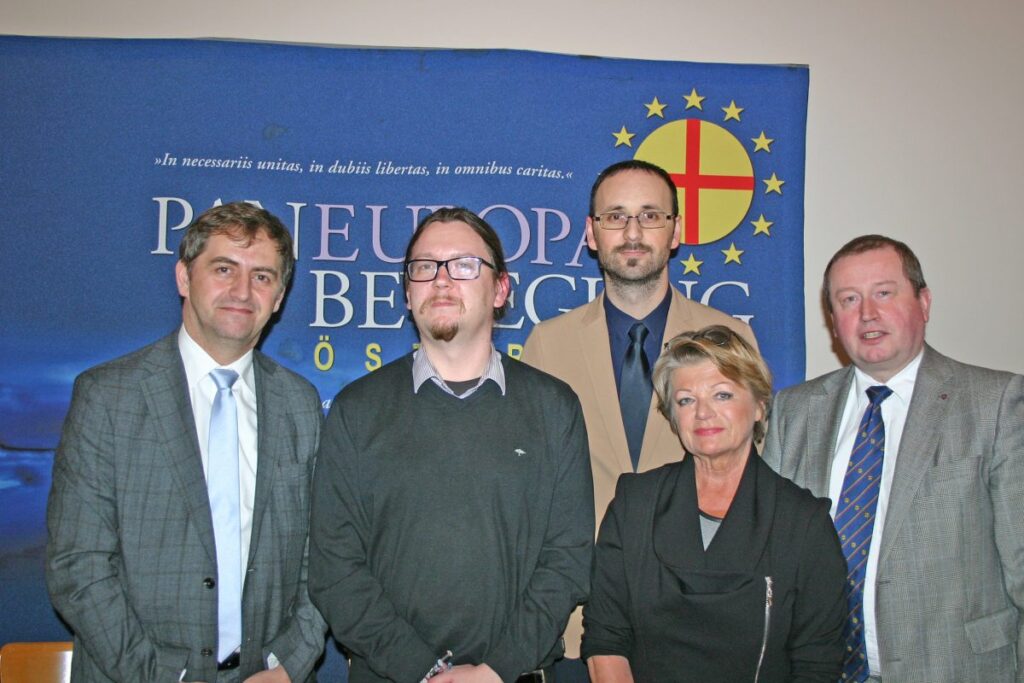
Kosovo’s declaration of independence on 17 February 2008, almost ten years ago, prompted the Paneuropa Movement Austria to invite Mag. Sami Ukelli, Ambassador of the Republic of Kosovo in Vienna, for a discussion on 7 February.
Kosovo’s declaration of independence was the penultimate act in the dissolution of Yugoslavia. In 2006, Montenegro also separated from its state union with Serbia. This was preceded by a brutal and bloody war, which began in Slovenia in 1991, following the country’s declaration of independence. In Serbia, Slobodan Milošević, an old communist who played the nationalist card to the full, ultimately lost everything in his attempt to keep Yugoslavia under Serbian rule.
The Ambassador began his lecture by thanking the Paneuropa Movement, which has clearly and consistently advocated for both Kosovo’s independence and the enlargement of the EU. He described the former Yugoslavia as a construct consisting of eight parts: six constituent republics and two autonomous provinces, with the autonomous provinces having the same rights as the republics. However, even before the war, there was systematic oppression of Albanians. In 1989, the Milošević regime abolished autonomy.
Austria Supports Kosovo
The then President of the League of Kosovo, Ibrahim Rugova (who was awarded the Coudenhove-Kalergi European Prize in 2004), was invited to Vienna in 1992, where he spoke about the situation in his homeland at a lecture in the House of Industry. This marked the first time the issue of Kosovo gained international attention. The then Austrian Foreign Minister, Dr. Alois Mock, was among the first supporters of the Kosovars.
The more the Serbian regime escalated the conflict, the stronger the KLA, the Kosovo Liberation Army, became. Only a NATO intervention ended the expulsions and the war, which had cost 12,000 lives in one year.
As Ambassador Ukelli further reported, a UN resolution in 1999 led to a mandate for peacekeeping forces and a UN administration. Originally intended for three years, the mandate was extended. After six years, status negotiations began, led internationally by Martti Ahtisaari. The Austrian diplomat Albert Rohan was also involved. A contact group of several states developed guidelines for Kosovo’s future. All ethnic groups in the country were to participate in the talks; neither a partition of Kosovo nor a merger with another country was permitted. Despite an agreement, no solution was reached, as Sami Ukelli put it. Both Serbia and Russia left the contact group.
Finally, on 17 February 2008, Kosovo declared its independence. The state adopted a modern constitution. The country’s ethnic groups are represented by the six stars on its flag. In 2010, an international ruling confirmed that Kosovo’s declaration of independence did not violate international law. To this day, the country is still not a UN member, as Russia has repeatedly threatened to veto any such application. Today, 115 states have recognised Kosovo, and there are over 200 bilateral agreements.
EU Western Balkans Strategy
The event with Ambassador Sami Ukelli took place one day after the presentation of the so-called Western Balkans Strategy by the EU Commission. The Ambassador also emphasised his country’s European perspective, making it clear that every country must meet the accession criteria. To illustrate the scale of this hoped-for EU enlargement, Ukelli drew a comparison of population figures. The entire region of the so-called Western Balkan states has approximately 18 million inhabitants. This is fewer inhabitants than in Romania. It is clear to these countries that bilateral problems must be resolved for EU accession. Therefore, there is also regional cooperation, for example, in transport infrastructure. However, the EU’s Western Balkans Strategy also stipulates that none of the countries should hinder the accession of another country.
Kosovo, Ukelli noted, also has the particular problem that its citizens require a visa to travel to the EU. The country must meet 95 criteria for visa liberalisation, whereas other countries only had 70. The last outstanding criterion is a border agreement with Montenegro, the ratification of which has so far failed due to a party conflict within the country.
Reliable Partner for Stability and Peace
In his assessment after ten years of independence, Ambassador Ukelli stated that much had been achieved during this period, but that daily challenges still needed to be overcome. He described the Republic of Kosovo as a ‘reliable partner for stability and peace in the region.’
Photo, from left: Ambassador Sami Ukelli, Charles Steiner (Managing Vice-President of Paneuropa Youth Austria), Faruk Ajeti (Second Secretary of the Embassy of the Republic of Kosovo), Elisabeth Ulm (Vice-President of the Paneuropa Movement Austria), Rainhard Kloucek (Secretary-General of the Paneuropa Movement Austria).



