Macron, Europe’s Divider
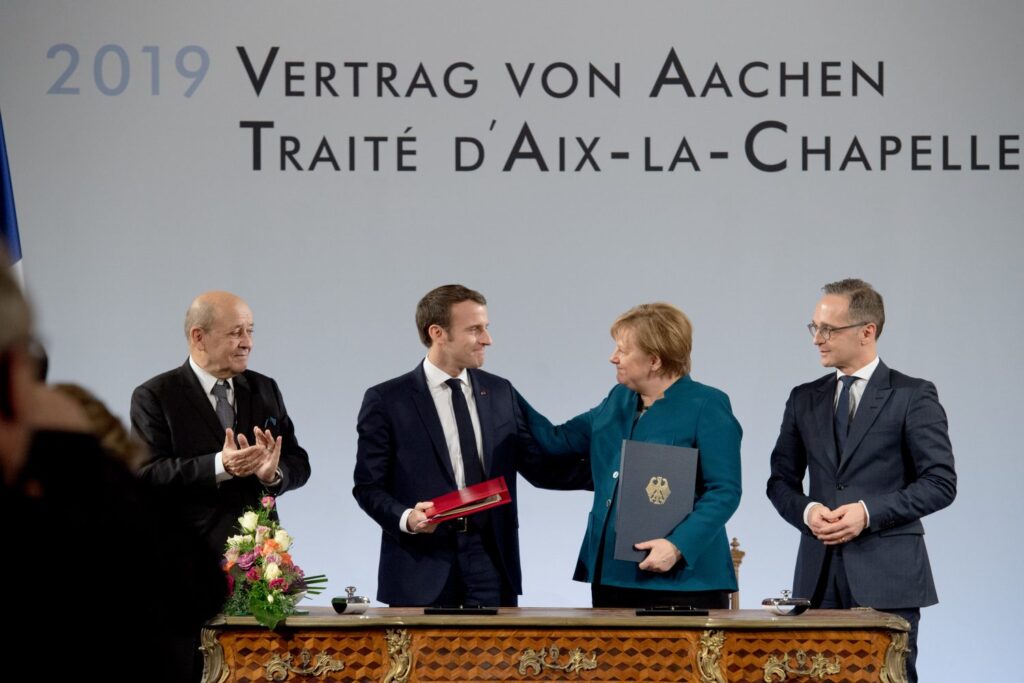
At home, he is under pressure from the far-right and far-left, and the middle class is dissatisfied. So Macron does what all ‘good’ populists do: he disparages other states. Within a few weeks, the Charlemagne Prize laureate insults several European states. This is undignified, says Stefan Haböck, International Officer of the Paneuropean Movement Austria.
President Macron gave an interview to the magazine Valeurs Actuelles. In it, he stated that he preferred legal migrants from Guinea or Ivory Coast to the ‘clandestine networks of Bulgarians and Ukrainians’. An interesting statement, to say the least, which reveals much about a French President’s worldview.
Considering that France, which must secure its synagogues, churches, and mosques with military presence, is plagued by gangs far more problematic than Ukrainian ones, the statement concerning Ukrainians and Bulgarians warrants scrutiny. The statement highlights two issues that frequently lead to massive resentment within Europe.
Firstly, the arrogance of the French President, known at home as ‘Le Jupiter’. Secondly, the complete disinterest and condescending treatment of Eastern states by some Western countries. We shall not speak of ‘larger/smaller’ here, for Ukraine, at approximately 625,000 km², is larger than France.
The Charlemagne Prize Laureate in Splitting Mode
Macron’s condescending manner has already caused quite a stir in his own country. But that is for the French to decide. The way he brings European partners into a negative light is remarkable. ‘Look, the criminal East of Europe,’ he seems to say. And with this, he aims to send a clear signal to the political fringes in France. Le Pen is leading in the polls, and the far-left Melenchon is also in double digits. Macron is not popular; he won the presidential election by positioning himself as ‘pro-European against the far-right’, a tactic previously used by Chirac. But the ‘pro-European’ stance is over. The Charlemagne Prize laureate is in splitting mode. The entire Balkan policy is blocked as long as 27 other states do not follow France’s ideas.
This leads us to point number two: France’s disinterest in a cooperative and compromise-oriented Europe.
France traditionally has little connection to Central and Eastern Europe. Its colonial past played out distinctly in the Mediterranean, Africa, and the Middle East. In Europe, there is only the Franco-German axis. As a major state in Europe, it still feels bound by the geopolitics of ‘the great powers’. Macron thrives when he confronts Trump, cheers at football matches in Russia, and visits China. Most recently, Qatar, owner of the Paris Saint-Germain football club, has become one of the Grande Nation’s close partners. While he now meets the Chinese President for the umpteenth time, he has not found time to visit Poland during his more than two years in office. The reason given was the rule of law situation there. In March 2019, Macron said that young people should not demonstrate for climate protection in France, but rather in Poland.
Only in October did the President directly oppose the European Commission, the 27 other states in the Council, the European Parliament, and the entire diplomatic service dealing with the issue, when he blocked the start of talks with North Macedonia. This small country, with fewer inhabitants than Paris, changed its name and bowed to blackmail from Greece, only to then hear a ‘non’ from Paris. A severe blow for all reform-oriented groups in the Balkans. An expert from the region put it this way: ‘France destroyed 10 years of building trust in the Balkans in one hour.’
That governments sometimes lash out is not good, but it happens. States often disagree on many substantive issues.
Populist, Not Statesman
However, the quality of Europe should be its ability to compromise and respect one another. This is the success model of a united Europe. Constantly signalling publicly to other (Eastern) European partners what one thinks of them is more than bad style and unsuitable for overcoming the already existing division between Western and Eastern Europe.
A populist does and says what gains him sympathy every day. A statesman does and says what is necessary at the right moment, even if it brings him opposition. Macron had the chance to become a statesman.
C Featured image: European Union 2019



