Man, Freedom, and the State
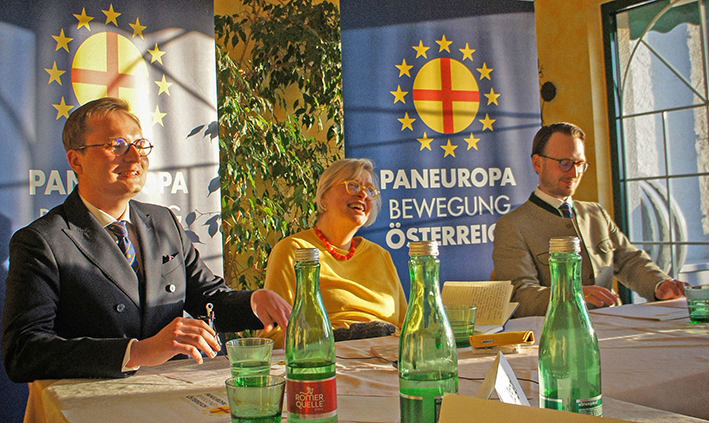
Under the title “Otto von Habsburg: Man, Freedom, and the State”, Georg Lundström-Halbgebauer delivered a keynote speech as part of the Paneuropa Youth Austria seminar from 7-9 March 2025 in Salzburg. The lecture is documented here.
“Among the gifts that God has bestowed upon humanity, freedom is particularly endangered today. Political systems must therefore primarily be geared towards preserving it.”
With these words, Otto von Habsburg was, as so often, ahead of his time. Indeed, freedom is the constitutive element through which our human existence becomes fully possible. Without freedom, there is no responsibility. And thus, without freedom, there is no society in the true sense. Precisely this freedom is currently once again noticeably under pressure, both internally and externally. Russia is waging a hybrid war against Europe, supported by nationalists and populists in Europe, from the German AfD, the French Rassemblement National, the Hungarian Fidesz, to Vučić’s SNS and Fico’s SMER, and even the Austrian FPÖ, which stands in direct tradition of the NSDAP. The USA is not only turning away from Europe, but, it seems, also from the increasingly fragile rules-based international order. And in the not-so-distant East, socialist China no longer hides its strength but acts with increasing self-confidence.
But what exactly do we mean when we speak of freedom?
It is worth looking at the Austrian Federal Constitution, whose elegance and beauty Federal President Alexander Van der Bellen praised in view of the 2019 government crisis. One of its cornerstones is the liberal principle, which sets limits for the state and completely or partially exempts certain areas of life from state regulation, thereby guaranteeing individuals freedom from the state. This is essential. For even a democratic legislator can abolish freedom. Orbán’s model of illiberal democracy serves as a cautionary example here. It is also worth looking at the biography of the incumbent Federal President, whose father, a Russian nobleman of Dutch descent, fought against the Bolsheviks as an officer in the White Army and was forced to flee after the defeat. The family eventually settled in Austria, where Van der Bellen used his freedom to participate politically at a time when the eastern stage of the European theatre was still firmly closed by the Iron Curtain. These two dimensions, negative freedom from unwanted things and positive freedom to desired things, are contained by the freedom of the other; protected by the hand of the state.
Richard Count Coudenhove-Kalergi once wrote: “The European ideal is freedom – European history is a single slow struggle for personal, spiritual, national, and social freedom. Europe will exist as long as it continues this struggle; as soon as it abandons this ideal and becomes untrue to its mission, it loses its soul, its meaning, its existence.” As Paneuropeans, it is therefore our mandate, our mission, indeed our calling, to fight for this Europe, for this freedom. Our Ukrainian friends have been doing this since 2014, weapon in hand, in the trenches, and risking life and limb. Whether we continue our support now and help them stand up to the aggressor is a test that will show how serious Europe is about freedom, and thus about its own existence. We must wage the fight for freedom with intellectual and economic means. However, it is no less serious. It is not for nothing that Austria has the concept of comprehensive national defence: war and peace are decided long before weapons speak.
The USA appears to be trying to maintain its hegemony by sacrificing the principles that made it possible in the first place. In the end, they will probably lose both: dominance and freedom. Russia and China openly act as enemies of freedom. Their populations are oppressed, opposition is imprisoned or murdered, and undesirable ethnic minorities are forcibly resettled and re-educated in camps. And yet, Europe can counter these raging giants: in 2023, the EU was the world’s second-largest economy with 18.6 trillion USD (i.e., 18,600 billion). However, if things continue as they are, we will be overtaken by China as early as 2027. Yet, a strong economy is the basis from which we can defend freedom.
At this point, I may once again quote Otto von Habsburg, who wrote: “The defence of freedom lies with those people who, through their activities, especially as small and independent entities, are firmly rooted in the soil. These, in turn, can only develop where there is a healthy concept of property. From this perspective, it has an eminently social function. It is the root of a free society. If it is destroyed, it buries freedom under its ruins. The most important [of] economic and material human rights is the freedom to acquire, retain, and inherit property. It is the expression of the will to underpin freedom through material independence.”
Otto von Habsburg warned shortly before the turn of the millennium that culture and economy were in danger of being stifled by bureaucracy. Now, in response to the Draghi Report and the increasingly serious economic and geopolitical situation, the European Commission has presented a roadmap with the Clean Industrial Deal on how Europe can assert itself as an economic power. The realisation that it is urgently necessary to reduce bureaucracy, simplify rules, and accelerate approval procedures is absolutely correct. Abolishing laws and removing shackles from citizens is certainly the order of the day. Whether those responsible for excessive bureaucracy can curb it, some may doubt. But I want to be optimistic.
Europe is not just an economic community. And Europe is certainly not a military alliance. Europe is a community of values, a community of history, a community of culture. This was already stated in the preamble to the Treaty establishing the European Economic Community and is reiterated in the Treaty on European Union. It states that the signatories have resolved to “continue the process of creating an ever closer Union among the peoples of Europe, in which decisions are taken as closely as possible to the citizens in accordance with the principle of subsidiarity.”
The term subsidiarity comes from “subsidium”, which means aid or support. It is central to Christian social teaching. Thus, the encyclical Quadragesimo Anno states: “Since every social activity, by its nature and essence, must provide support (subsidium) to the members of the social body, it must never destroy or absorb them.” As Otto von Habsburg expressed it, the state’s primary task is to be the guardian of freedom. In politics as in economics, the larger entity must never take on tasks that the smaller entity can satisfactorily fulfil. He recognised this as a precondition for the freedom of the community.
So, as Paneuropeans, let us work for this community, for this ever closer Union, for a common Europe that serves humanity in its freedom. Paneuropa should not only be all of Europe, but Europe as a whole: united in what is necessary, free in case of doubt, and committed to charity in all things.
Feature image: Georg Lundström-Halbgebauer on the right, in conversation with Maximilian Schmid and Walburga Habsburg Douglas.



