Mercenaries from and in the Balkans – A Danger to Europe?
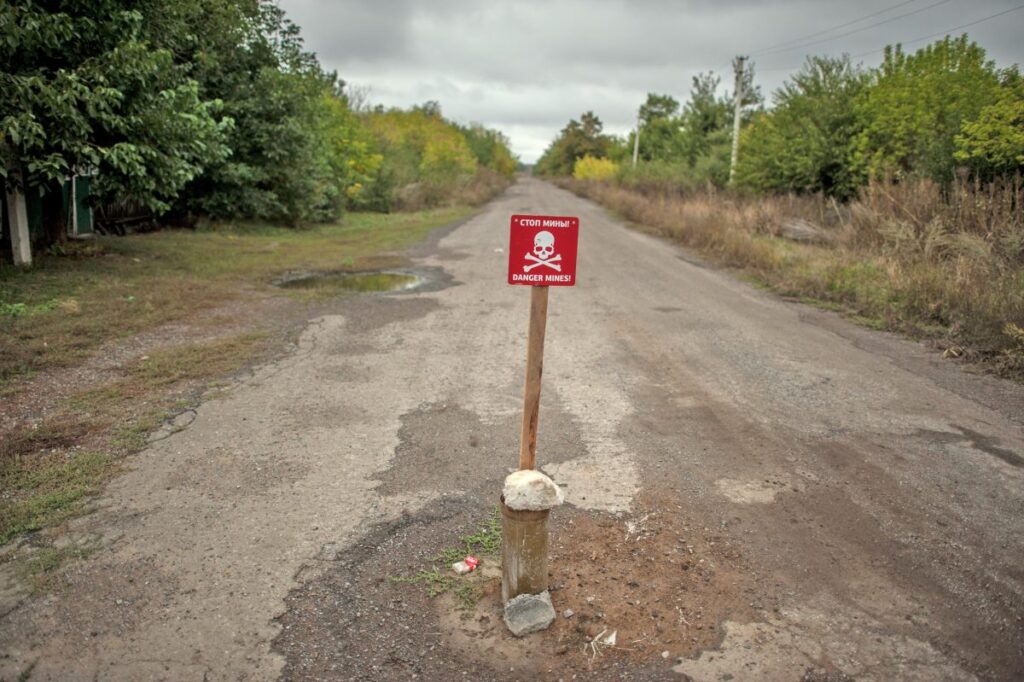
Mercenaries are being deployed by the Russian side in the war against Ukraine, and also in Syria. Many of these originate from the Balkans, where their presence poses a threat to stability. An analysis by Elias Kindl, Vice-President of Paneuropa Youth.
Radomir Počuča was a journalist and TV presenter for the well-known TV channel ‘Pink’ and a spokesperson for the PTJ anti-terror unit in Serbia. His next ‘career move’, however, came as a surprise. In 2014, he went to Donbas as a mercenary. Although he extensively shared these activities on social media, he remained unnoticed by the Serbian public prosecutor’s office. In Donbas, Počuča participated in military actions on the separatists’ side until 2015. It was also recorded that Počuča took part in internal conflicts as a security operative. He himself mysteriously returned to Serbia and surrendered. For this, he received an eighteen-month suspended sentence.
Radomir Počuča was the most prominent Serbian fighter in Donbas, but not the only one. The Ukrainian Ambassador to Serbia, Oleksandr Aleksandrovič, spoke of 300 Serbian mercenaries fighting in Donbas. But who are these mercenaries? Where else might they be fighting? Are mercenaries from the Balkans a problem in the Balkans themselves?
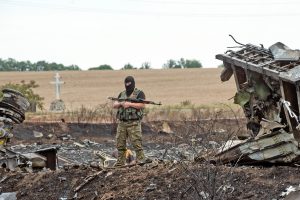
Among the three hundred mercenaries in the Balkans, some individuals have been identified and named by the SBU (Ukrainian secret service). There is Dejan Beric, a sniper. He incurred debts as an entrepreneur and subsequently went to eastern Ukraine. As a former member of the army of the ‘Socialist Federal Republic of Yugoslavia’, Beric had combat experience as a sniper. He deployed these skills in eastern Ukraine.
Not only are individual Serbian mercenaries fighting in eastern Ukraine, but there is also a dedicated ‘Serbian Hussar Regiment’, which consisted of 15 Serbs and 30 Russians. One of these Serbs was Saša Jojić. The 25-year-old Serb fought in Donbas and died in Palmyra. In Donbas, he fought with other Serbs from Novi Sad in the Donetsk area, as part of this ‘Hussar Regiment’.
The ‘Jojić’ case clearly illustrates the structures behind the recruitment of Serbian mercenaries. The organisers are attributed to the ‘Wagner Group’ and pay mercenaries €300 during training and $5,000 per month in Syria after completing their training. If the soldier dies, as in the ‘Jojić’ case, the family receives $50,000. If one fights in Ukraine, the figure is $2,200 per month.
This ‘Wagner Group’ is infamous. It was founded by Dmitry Utkin. As a young man, he worked in special units of Russian military intelligence, then moved to the Moran Security Group. After his resignation, he was first in Syria in 2013 with a unit of over 250 men. He then built up the Wagner unit, which later became active in eastern Ukraine and Syria.
In December 2016, Utkin even attended a reception in the Kremlin. Generals who had earned merits in the Russian military were invited. Utkin, the head of the mercenary unit, was one of the few guests who held no official rank in the Russian army. His invitation was likely due to his soldiers having undertaken tasks for Russia in the Syrian war.
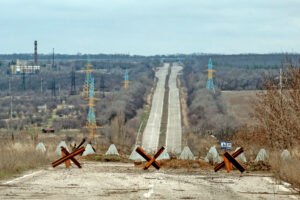
Division line between Ukrainian armed forces and so-called DPR near Avdiivka and Yasinuvata, eastern Ukraine, Thursday, Mar. 17, 2016.
The training, during which one receives €300 monthly, is relatively easy to describe. It begins with the aptitude test, consisting of pull-ups, long-distance running, push-ups, a 100-metre sprint, a Cooper test to assess endurance, and various shooting exercises. Those who pass this aptitude test are permitted to undergo mercenary training, which typically lasts two months. Every man who passes this aptitude test must sign an employment contract for at least six months. These contracts oblige them not to reveal anything about the location of their deployment.
Why are foreign mercenaries needed in Syria and Ukraine? Putin is now struggling to find enough people for his military operations, says Stefan Meister, Russia expert at the German Council on Foreign Relations. Currently, Russia has two conflicts, in Ukraine and Syria, which require many soldiers and much equipment. Even though the Russian military has been modernised since 2008, its capacities are not infinite. Mercenaries are hired by private security firms and receive different employment contracts than soldiers. According to Meister, this makes it easier to prevent information from reaching the public. Particularly in Ukraine, it has been a problem when Russian soldiers were killed fighting against the former ‘brotherly nation’. However, if a mercenary dies in action, the Ministry of Defence can deny any responsibility.
However, it is not only former soldiers or mercenaries fighting on the Russian side in the ‘Donetsk and Luhansk People’s Republics’, but also Serbian neo-Nazis. Two of these were participants in ‘Serbian Action’, which is primarily directed against Roma and Sinti. Both were convicted for distributing inflammatory leaflets. A further five Serbian neo-Nazis fought in Ukraine, according to BLIC magazine. Nothing further is known about their fate.
However, Serbian members of paramilitary groups exist not only in Ukraine but also in the entity of ‘Republika Srpska’. Serbian political leaders are building a paramilitary unit here, similar to a Praetorian Guard. This unit calls itself ‘Serbian Honour’ and is trained in Russian ‘cultural centres’ in Niš. This unit not only has connections to the ‘Night Wolves’, a far-right motorcycle gang. This motorcycle gang has excellent connections to the Russian political elite, including Putin himself. As if these connections were not worrying enough, there are links between this militia unit and former Serbian fighters in Ukraine, South Ossetia, and Abkhazia, who are now fighting in this militia. These troops have been sighted in full uniform in Banja Luka. This unit recruits from the petty criminal Serbian milieu, similar to the Serbian mercenaries in Ukraine. Loyal to Dodik, the purpose of this unit is to control and discipline the opposition should it attempt to rise up. Dodik is thus attempting to secure power.
All of this, of course, has a geopolitical aspect. This is all happening 15 months after paramilitary units stormed the Montenegrin parliament, which is a NATO member. If one includes the entire geopolitical space, the following picture emerges: Romania, Bulgaria, Greece, Albania, Montenegro, Croatia, and Slovenia are all already NATO members. The only Balkan states that have not joined NATO are: Macedonia, Bosnia, Kosovo, and Serbia.
While Serbia has always made it clear that it never had an interest in joining the Western alliance, a different picture emerges in Bosnia. A Bosnian defence official told journalists that Bosnia would activate its ‘Membership Action Plan’. The ‘Membership Action Plan’ is a further formal step towards NATO. This is where the entity ‘Republika Srpska’ and Dodik’s militias come into play again, which could perhaps be used to provoke tensions here.
In the case of Montenegro, too, Serbian nationalists were arrested, including a former police chief, Branislav Dikic. He was accused of planning a coup against the Montenegrin government. This coup was unsuccessful, and Montenegro became a NATO member in 2017, thereby thwarting Russia’s strategic plan to maintain a port on the Adriatic coast.
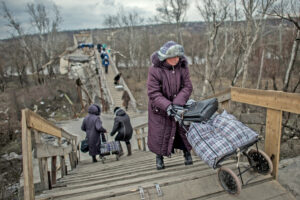
Along the demarcation line in the war in Ukraine, the population is trying to survive.
In Macedonia, too, there were Russian efforts to influence the political situation. There are leaked intelligence papers indicating that Russian spies and diplomats were involved in destabilising the political situation in Macedonia. This occurred over a decade. These spies and diplomats supported pro-Russian nationalists who opposed the possibility of Macedonia joining NATO.
It is clear that mercenaries from and in the Balkans have taken on particular significance in geopolitics. Therefore, they deserve more focus. The problem is that, for example, Serbia acts very laxly in enforcing penalties for Serbian citizens who work as mercenaries for another state in conflicts. After a confession, one usually only receives suspended sentences. This is problematic, especially considering the role these mercenaries play in destabilising Western aspirations of countries in the Balkans. Europe should be particularly alarmed when politicians in the middle of Europe attempt to build a private army. The European community of states cannot and must not accept this, especially if it violates the Dayton Agreement.
Photos: OSCE



