(North) Macedonia – The Humiliated Nation?
Macedonia has been independent for 28 years now – and from the very first day of its regained freedom, it has been pressured and strung along with broken promises. It is a miracle that its people have not yet given up faith in a united Europe. A commentary by Stefan Haböck, International Officer of the Paneuropean Movement Austria.
Macron has decided; his answer is “non”. One of the French President’s favourite words, as he has made it his mission to block every geopolitical position of the EU until all 27 states follow his reform ideas. This time, the “no” was directed at a country with fewer inhabitants than Paris.
Yet the people in that country are accustomed to this, for the existence of the independent Republic of Macedonia has been accompanied by blockades, broken promises, and external pressure.
In 1991, the Socialist Republic of Macedonia declared its independence from the Yugoslav prison of nations. Bulgaria was the first country to recognise the young republic. Greece, not inherently opposed to its independence, protested against the name: Macedonia could, by using the name Republic of Macedonia (епублика Македонија, i.e. Makedonija), lay claim to the Greek region of Macedonia. From that moment on, this absurd accusation formed the foundation of a permanent blockade of the small country by its larger neighbour. Macedonia was forced to suffer the humiliation of being referred to in international usage by the acronym F.Y.R.O.M. – Former Yugoslav Republic of Macedonia. One need only imagine such a practice being imposed by the Allies on Austria in 1955.
Greece, itself a full and well-integrated member with all rights in the European Union and the defence alliance since 1981 and 1952 respectively, and clamouring for European solidarity in times of crisis, blocked every attempt by Macedonia to join the EU and NATO. In 1994/95, an economic embargo followed. The international community did nothing to counter this blackmail by the larger country, beyond the classic admonitions that both sides should find a solution.
Finally, on 12 June 2018, the Greek and Macedonian governments agreed on the Prespa Agreement, which stipulated a change of the country’s name to North Macedonia, alongside the lifting of the blockade by Greece. The agreement is highly controversial in both Macedonia and Greece. Many forces in both countries fuelled rejection, but it passed by a narrow majority. The then Macedonian President refused his consent.
However, this solution gave Macedonia legitimate hopes of finally getting the opening of accession negotiations promised in Thessaloniki since 2003. The commitment from the EU states was in place; European institutions such as the Commission, Parliament, and Council had expressed positive views. But then France intervened and, against the position of the EU Commission, the EU Parliament, and the 27 other states in the Council, cast its veto.
It must be stated clearly again: the start of negotiations does not equate to accession. Over many years (at least 10 years for Macedonia), issues are addressed across typically 30 chapters. Only upon successful completion of all specified chapters and reforms can accession be voted upon. This is the strongest lever for reforms that the EU has with regard to candidates.
As Paneuropa Austria, we viewed the Prespa Agreement positively from a pragmatic perspective. Only this agreement could resolve the blockade. At the same time, we strongly criticised Greece’s pressure and the silence of the other states regarding this blackmail. No country in the EU would ever change or deny its name. Macedonia was forced to do so twice under external pressure – and from a neighbour, no less. First, humiliatingly, to F.Y.R.O.M. in international use, then to North Macedonia. The result: no negotiations.
One wonders which politician would even consider standing up to opposition and doing what they believe is right, when the small word “non” can prevent everything.
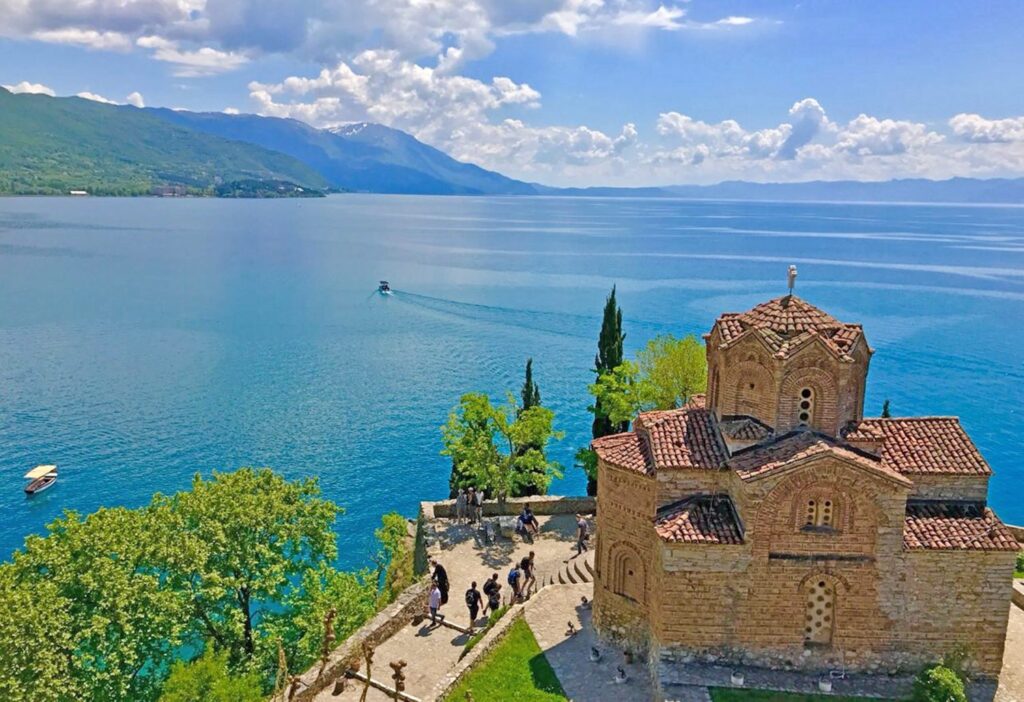
Macedonia is a South-Eastern European region with a turbulent history. An ethnically mixed country with wonderful landscapes, friendly people, and a magnificent culture. Ohrid, one of Europe’s oldest cities, is said to be home to 365 churches and is considered the “Jerusalem of Europe”. Like every transitional country shaking off real socialism, the country experiences crises. Be it corruption scandals by dominant cliques, nationalist rhetoric, the terrorist attack in 2001, or blockades by its neighbour.
Two million Macedonians also know how to make compromises. How, was demonstrated not only by the Prespa Agreement but also by the peace agreement between the Albanian minority and the Macedonians, brokered by President Boris Trajkovski, who, like few others, stood for dialogue, inclusion, and reconciliation. It was politicians like Trajkovski who brought hope to two million people that reforms, dialogue, and reconciliation on the path to Europe were worthwhile. The hope that the country could be part of a united Europe. With the EU’s rule-of-law and market-economy system, which should finally bring Macedonia the definitive leap from a transitional country.
This hope has been stolen from them once again.
The featured image shows a view of Lake Ohrid, Europe’s geologically oldest lake, on the border between Albania and Macedonia.



