Paneuropa and the National Council Election on 15 October
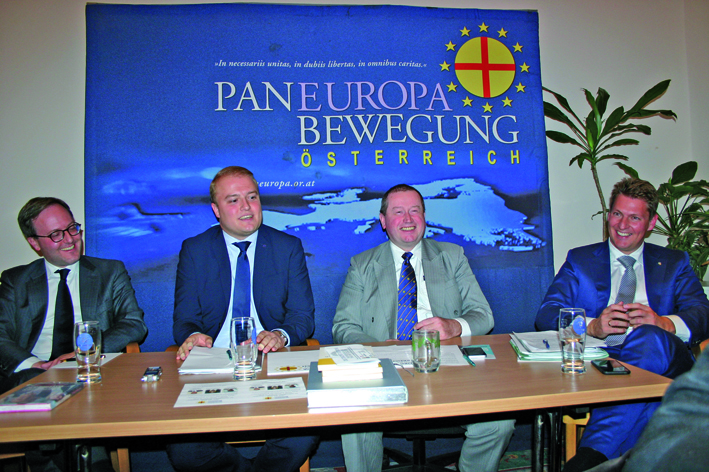
Three candidates for the National Council, who are members of the Paneuropa Movement Austria, discussed the election on 15 October. There was agreement that the need for reform in Austria is great. Arguments were fierce, emotional, but always fair.
The three gentlemen agreed that the election winner on 15 October would be List Kurz, or the ÖVP. They were not entirely in agreement on how large the lead might be. Dominik Oberhofer, speaking from a “Western perspective” (he is from Tyrol), suggested that the People’s Party had the potential for 40 per cent. It was clear to all three panellists that second and third place would be contested between the SPÖ and the FPÖ, but it could be a close call. Only Markus Tschank, the FPÖ candidate, was optimistic that his party would come out on top. The Neos were predicted to re-enter parliament, while there was uncertainty regarding the Greens and List Pilz, whether one or both groups would succeed. All other contesting lists were given little chance; they were not even mentioned in the final question of the discussion regarding an election outcome prognosis.
Four Paneuropeans (members of the Paneuropa Movement Austria) are standing for election to the National Council on three different lists (see also the presentation of the candidates on pages 18 and 19). The Paneuropa Movement had invited them to a discussion at the Paneuropa office in Neulinggasse. The event room was unusually full, and Secretary-General Rainhard Kloucek moderated. Gabriela Stimpfl-Abele, Chairwoman of the Board of Trustees, who is running on the Vienna regional list for List Kurz, had to excuse herself due to a professional commitment in what was then still EU-member Great Britain. This led to a debate between Dominik Oberhofer (who is first on the regional list for Neos-Tyrol and also running on the federal list), Stefan Haböck (the Wels municipal councillor running in the Hausruckviertel constituency for List Kurz), and Markus Tschank (who is running in Vienna for the FPÖ). Tschank only recently joined the Paneuropa Movement, Dominik Oberhofer was Paneuropa regional chairman in Tyrol and also a presidium member, Stefan Haböck is a member of the current presidium and holds the position of international rapporteur.
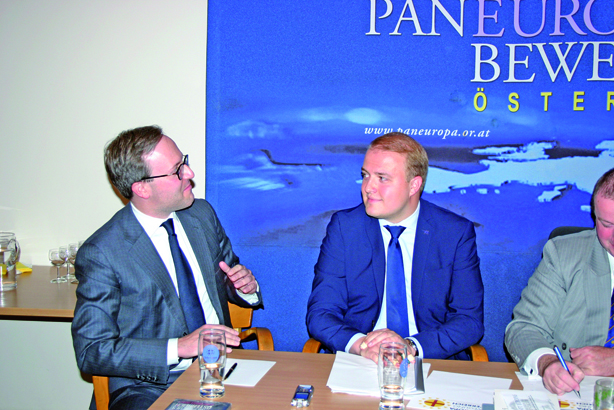
Dominik Oberhofer of the Neos and Stefan Haböck (right) of List Kurz. The two are amenable to a joint government. Both reject another red-black coalition; Haböck also opposes a coalition between the FPÖ and SPÖ. Oberhofer wants to curb the influence of the chambers and advocates for direct election of MPs. Alluding to Sebastian Kurz’s call to Sepp Schellhorn, he says: We have the ministers for the coalition.
When Stefan Haböck stated that a re-run of the coalition between the two previous governing parties must be prevented, not only did his two competitors agree, but the audience also responded with vigorous applause. Furthermore, Haböck hopes for a result that makes a coalition between the SPÖ and FPÖ impossible. When asked about potential coalitions, the Wels municipal councillor said that for ideological reasons he would rule out a coalition with the Reds and Greens, but he could very well imagine a coalition with one or both of the parties represented on the podium. Markus Tschank argued similarly. Dominik Oberhofer, however, said that it could not work with the FPÖ. His reasoning for this was interesting. It was not based on the general accusation of anti-European sentiment or right-wing ideology, but on two demands in the Blues’ current election programme: a minimum wage of 1,750 euros and a minimum pension of 1,200 euros. Both, he argued, were unaffordable; the former for businesses, the latter for the state, as 25 per cent of the budget is already spent on pensions. Reforms are needed here first, especially regarding luxury pensions. Tschank contradicted this, stating that the demand for the minimum wage had already been corrected to 1,500 euros (and this has also been negotiated by the social partners, note).
The Trouble with Cold Progression
However, the day of the discussion showed that cooperation between Neos and FPÖ is indeed possible on some issues. Both parties had submitted a joint motion to the National Council to eliminate cold progression. The MPs of the governing parties, however, rejected the motion, which led to accusations against the ÖVP during the Paneuropa discussion, as the elimination of cold progression was stated in both the government programme and List Kurz’s current election programme. This was the point at which Stefan Haböck had to address the question of how credible the ÖVP’s promises to do everything differently and better truly were. The ÖVP, he argued, had been in government for 72 years, either directly or indirectly through the social partners; nothing in the country’s current state had come about without the ÖVP’s involvement.
Haböck argued with the personality of Sebastian Kurz. He had proven through his leadership style and policies in the Young ÖVP that he stood for a different path. He could not be held responsible for the failures of the old system. Even his closest team was not rooted in this old system.
The need for reform was described as high by all three panellists, and all three also cited it as one of the most important motives for their own engagement. For example, lawyer Markus Tschank said, “more people need to enter the arena.” There are problems on many levels, and the FPÖ is a motor for reform, as the blue-black Schüssel government showed, where the most important reform projects came from the FPÖ. Tschank referred to open problems at the EU level, as well as problems arising from immigration – he made a clear distinction between refugees and immigrants. “The cultural static will change.” Austria is a high-tax country; the burden on businesses and citizens must be reduced. He dismissed claims that the FPÖ wanted to leave the EU as propaganda. However, he made it clear that his party wanted a reform of the EU, with some competences needing to return to the member states, but foreign and security policy clearly belonged at the European level.
Stefan Haböck advocated for a sensible use of taxpayers’ money. He joined the ÖVP under Wolfgang Schüssel because he had a clear vision for Austria. This plan can also be seen in Sebastian Kurz. “I became politically active because people with visions inspired me. I have known Sebastian Kurz for many years, since our time together in the Young ÖVP, and have greatly valued him ever since. That is why we are running together. In Austria and Europe, there is too much regulation; we must strengthen subsidiarity.”
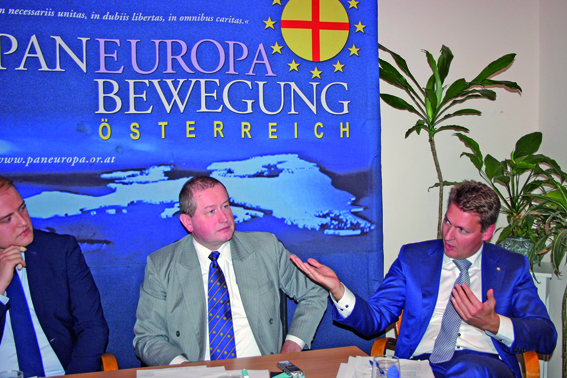
Markus Tschank met with strong opposition when the topic of Russia under Putin was discussed. He sees his party as a motor for reform.
Austria must be a successful part of a strong Europe; this Europe must under no circumstances be centrally organised, nor should Austria be. The Wels municipal councillor emphasised subsidiarity. Foreign and security policy belong at the European level, as does trade policy. It should not be the case that local parliaments torpedo trade agreements for purely partisan and domestic political reasons. Citizens need more freedom again, more opportunities to make their own decisions. And everyone must also be allowed to make mistakes.
Business Inspections: They Want to Dictate Everything
Dominik Oberhofer illustrated his political priorities with several examples from his practical experience as a hotelier. He had barely taken over the hotel from his mother when the first GIS inspection arrived. The result: not 700 euros were to be paid monthly in GIS fees, but over 7,000 euros. The next example was a business inspection – “they want to dictate everything” – and the training to become a fire safety expert, which regulated in detail which of the dozens of different types of fire extinguishers had to be used for which area in the hotel, and cost him several days. He had barely become the Neos regional spokesperson in Tyrol when the financial police appeared at the hotel – with submachine guns. Guests sitting at dinner called the police: the hotel had been raided. When he spoke to the officer in charge about the martial appearance, the officer said: “You are now a public figure, anyone can report you.” That is why he tells this story at all events; so far, he has not been inspected by the financial police again.
But as an entrepreneur and family man, in such situations, one begins to reflect on the system in the country. Citizens and businesses are being drained by this system, and thus the wrong system is being fed. He illustrated the failure using the example of schools, with many dropouts who cannot read with comprehension and thus have no chance of employment. “This is producing the AMS generation.” Oberhofer recalled the 2013 election campaign, when Michael Spindelegger ran for the ÖVP with the slogan “Unleash the Economy.” The result was the introduction of the sparkling wine tax. Originally invented during the monarchy to finance the fleet, it now only causes damage. For tourism, there was an increase in VAT, which in turn increased bureaucracy in this sector.
When asked about his ideas for a common Europe, he named Otto von Habsburg as a political role model. Much of what is in the Neos programme was already demanded by Otto von Habsburg. As an example, he cited the Council of the European Union, which he considered the real problem. Not only heads of government sit there, but also party leaders with their own interests. Therefore, the Council must be made into a second chamber, and the European Parliament upgraded. The Commission should be reduced to 15 members. Foreign and security policy belong at the European level.
Visegrad and Core Europe
Here, there was consensus among the three panellists: foreign and security policy is clearly a European matter. They were not entirely in agreement on other points concerning Europe. Markus Tschank, for instance, argued that the four Visegrad states were being overridden, practically excluded from decisions. Stefan Haböck countered with a quote from Slovak Prime Minister Robert Fico, who sees his country as part of a core Europe. The Czech Republic, he noted, pursues a very sensible economic policy, Hungary agrees in 98 per cent of cases in the Council, and only Poland is currently excluding itself. He emphasised the four fundamental freedoms as the basis for European unification. He also advocated for upgrading the European Parliament as a true citizens’ chamber.
Markus Tschank spoke out clearly against the transfer union at the European level. This, he argued, would upset the balance, which in turn would lead to the EU drifting apart. In doing so, he also criticised Germany’s policy and remarked: “Europe cannot recover through the German character!” The EU should do less, but do it more efficiently. In addition to the already mentioned foreign and security policy, he advocated for the expansion of the internal market.
The Problem with Putin’s Russia
The most intense part of the discussion was then – quite expectedly – when it came to the relationship with Russia. The FPÖ has an agreement with Vladimir Putin’s party and is known for a friendly policy towards his government. Shortly before the discussion, the online version of a “Presse” interview with Hans Peter Haselsteiner had appeared, in which he stated that the EU should have forgotten about Eastern enlargement and integrated Russia instead. Haselsteiner is known as a major donor to the Neos.
Markus Tschank argued with Michael Gorbachev, who had written that, in the course of the fall of the Iron Curtain and German reunification, the Russians had been promised that NATO would not expand eastward. He criticised that international politics is made by the USA, that the interference of Western intelligence services in Ukraine, which led to the end of the Yanukovych government, is a fact, and that Crimea is simply Russian. He advocated for free trade with Russia.
The contradiction was fierce. Dominik Oberhofer made it clear in one sentence that Haselsteiner’s economic interests are not the Neos’ line. There is fundamentally nothing wrong with a free trade agreement with Russia, but not with the regime that rules Russia today. And because Innsbruck’s Olympic bid was currently being discussed in Tyrol, he recalled the games in Sochi, Russia. In the shadow of the games, Putin began the long-planned attack on Ukraine.
Regarding the accusation that NATO had expanded eastward contrary to promises made to Russia, Stefan Haböck emphasised that NATO had not expanded, but rather the peoples of Central Europe had “fled a socialist-fascist dictatorship.” Moscow’s aggression, he asserted, is clearly responsible for the 11,000 deaths in Ukraine. He himself wished to stand neither with the USA nor with Russia, but advocated for a strong Europe.
In addition to other topics, such as the position on sole proprietorships, which are placed under suspicion of bogus self-employment by legislators, or compulsory membership in the chambers – on both issues, the three panellists expressed dissatisfaction with the current situation, albeit with varying degrees of criticism – the striking choice of words by ÖVP leader Sebastian Kurz, who referred to citizens of neighbouring countries as EU foreigners, was brought up in the Europe question – raised by a guest – as was the significance of the free mandate.
The Significance of the Free Mandate
The occasion for this was a report by the moderator about a conversation with an MP who is no longer running for election, who said: he had expected that opposition MPs could achieve little in parliament, but that being practically just a ‘hand-raising machine’ in a governing party had disappointed him. Markus Tschank argued primarily from a legal perspective. The free mandate is regulated in Article 56 of the Federal Constitutional Law and is not in contradiction with party discipline. The regulation merely ensures that an MP cannot lose their mandate due to exercising a free mandate. Stefan Haböck said that he is known in the party for not holding back his opinion, but that in many cases one must rely on the expertise of others.
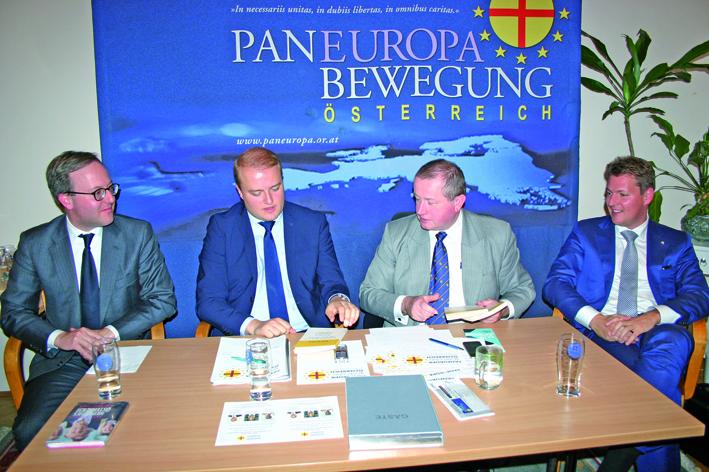
No political bribery. To conclude the discussion, the three candidates received “Crisis and Future of Democracy” by Felix Somary. His 20 Social Laws of Inverse Proportions serve as a warning against political errors.
The clearest criticism of current practice came from Dominik Oberhofer. “In reality, the social partners, the chambers, govern.” To strengthen the free mandate, electoral districts must be better organised, among other things. Based on cooperation with the FDP in Germany, it is clear how the position of MPs is strengthened by direct election of mandates. Therefore, he also advocated for a change in electoral law towards direct election of MPs.



