Paneuropa: Vital Tasks for the New Federal Government
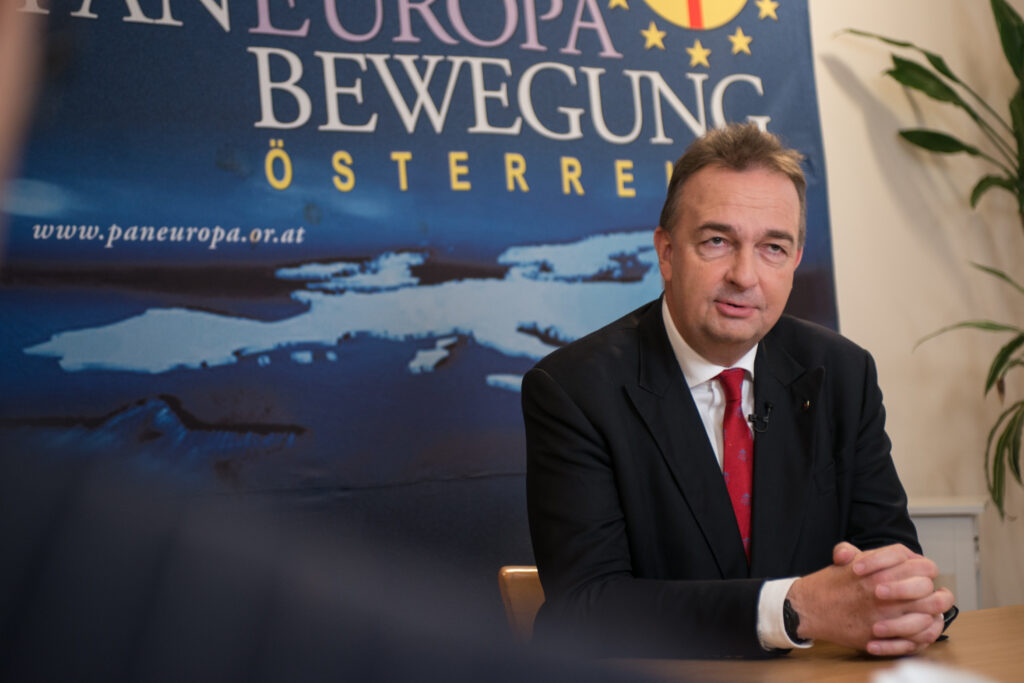
Paneuropa President Karl von Habsburg on the central questions of our time: subsidiarity, security, foreign policy, and media policy as key factors.
(Vienna, 18/12/2017) In light of the swearing-in of the new Austrian Federal Government, the President of the Paneuropa Movement Austria, Karl von Habsburg, expressed his satisfaction with the fundamental commitment of all presumptive government partners to European integration: “Europe is too important to fall victim to party-political skirmishing,” Habsburg stated literally.
The Paneuropa President calls on the new government to continue to adopt a constructive, pro-European stance. Habsburg also described it as gratifying that the concept of subsidiarity has received stronger emphasis. However, Habsburg warns that subsidiarity is not exhausted by merely defining the relationship between the national and European levels.
Subsidiarity: A Key Concept
“Subsidiarity is a social principle based on the premise of locating competences where they can best be fulfilled. The question of whether something should be solved nationally or Europeanly therefore falls short. Some things could be solved much better by states, districts, or municipalities than at the federal level or above,” Habsburg reminds us. “Europe must be given competence where this competence – such as in foreign and security policy – can unfold sovereignty. At the same time, however, the sovereignty of citizens to once again unfold their freedom and responsibility must be strengthened. The goal is not the expanded paternalistic welfare state, which regulates and redistributes as many areas of life as possible at the state level, but personal freedom and responsibility, family autonomy, freedom of religion, private property, a free economy, etc. Subsidiarity does not demand a primacy of politics, but a primacy of law and freedom,” as the Paneuropa Movement Austria formulated in a position paper on the occasion of its recently held General Assembly.
One issue that can undoubtedly only be solved meaningfully at a European level is security. Paneuropa therefore welcomes the agreement on PESCO and the fact that Austria will also participate in it.
Habsburg gives the new Federal Government three important points to take with them, which will be decisive for the future of our country and our continent.
- Enlargement/foreign policy fields of action
Austria enjoys a very good reputation in the countries of South-Eastern Europe – both due to historical connections and a forward-looking policy under Foreign Ministers such as Dr Alois Mock, but also the Paneuropa Union under the leadership of Otto von Habsburg. “Without peace in the Balkans, there is no peace in Europe,” Karl von Habsburg warns urgently.
“Austria must recognise and exercise its position as a strong ally of the South-Eastern European states as a responsibility. This also means providing stronger support to the six Western Balkan states – Albania, Bosnia and Herzegovina, Kosovo, Macedonia, Montenegro, and Serbia – on their path towards membership.”
Particular attention should also be paid to Ukraine. “Ukraine needs a clear European perspective,” Habsburg demands.
2. Information policy
All too often in recent years, the national level has tended to seek the blame for things that do not work well in Brussels. In this way, a negative campaign against Europe takes place. Equally, an anti-European campaign by various foreign agents has been observed for some time, disguised as news magazines and using half-truths and misinformation to deliberately stir up sentiment in Europe. “We must not let the reins out of our hands when it comes to public opinion,” emphasises Karl von Habsburg, who calls for a European awakening regarding external propaganda. In this context, he invites reflection on whether programmes such as 3Sat or arte could also broadcast in foreign languages – mentioning Ukrainian, Serbian, or Russian as examples. “We must not let Europe be talked down – and we should also correct some prejudices in non-EU states about this Europe,” says Habsburg.
3. Central Europe
“Austria’s historical and cultural connection with its Central European neighbouring countries, the Central European cultural community, should be the basis for a new cooperation that not only serves to represent common interests at the EU level but also makes a significant contribution to overcoming the re-emerging divide between Eastern and Western Europe,” says Karl von Habsburg.
Featured image: c Katharina Schiffl



