Paneuropa Welcomes Western Balkans Chapter in German Coalition Agreement
Paneuropa Welcomes Western Balkans Chapter in German Coalition Agreement
A clear stance on accession negotiations and visa liberalisation with Kosovo offers a glimmer of hope. But: words must be followed by action.
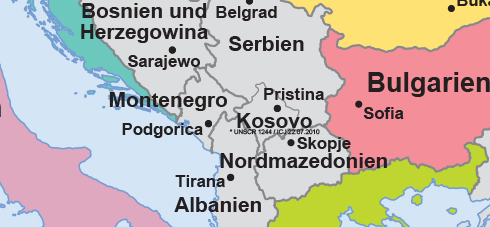
The new German federal government, comprising the SPD, Greens, and FDP, has dedicated a chapter to the Western Balkans in its coalition agreement. It reaffirms the commencement of negotiations with North Macedonia and Albania, the implementation of visa liberalisation for Kosovo, and the continuation of ongoing negotiation rounds with Serbia and Montenegro. Paneuropa Austria welcomes these written statements on Southeast Europe, but will hold the German federal government accountable for its actions, because: too many promises to the citizens of Southeast Europe have already been broken.
Secretary-General Rainhard Kloucek sees visa liberalisation for the citizens of Kosovo as a crucial milestone for trust or distrust in EU institutions. Should some states continue to resist the promised visa liberalisation, positively disposed states could, for their part, lift visa requirements, he suggests.
For Philipp Jauernik, Paneuropa Youth Chairman, the visa step is a very small one. “Given the sluggish development of the past 25 years, such a trivial step as visa liberalisation already appears to be a success. In reality, however, the massive radicalisation, particularly in Bosnia and Herzegovina, shows how little progress has been made in the region. This is primarily due to the fact that EU states still accept the USA and Russia, and increasingly China, as leading powers in the Balkans. Europe must finally learn to speak with one voice and not permit foreign interference on its own continent.” Otherwise, one should not be surprised that Serbia, for example, continues to orient itself towards Moscow and Kosovo towards Washington, rather than towards Brussels, Berlin, or Vienna.
Stefan Haböck, International Officer of Paneuropa Austria, emphasises that the entire foreign and geopolitical fate of the European Union is tied to Southeast Europe. If the Union fails to integrate a comparatively small but enormously important region, thereby alienating pro-Europeans, non-European geopolitical players will exert their power right in the heart of Europe.



