Parliaments in Shackles
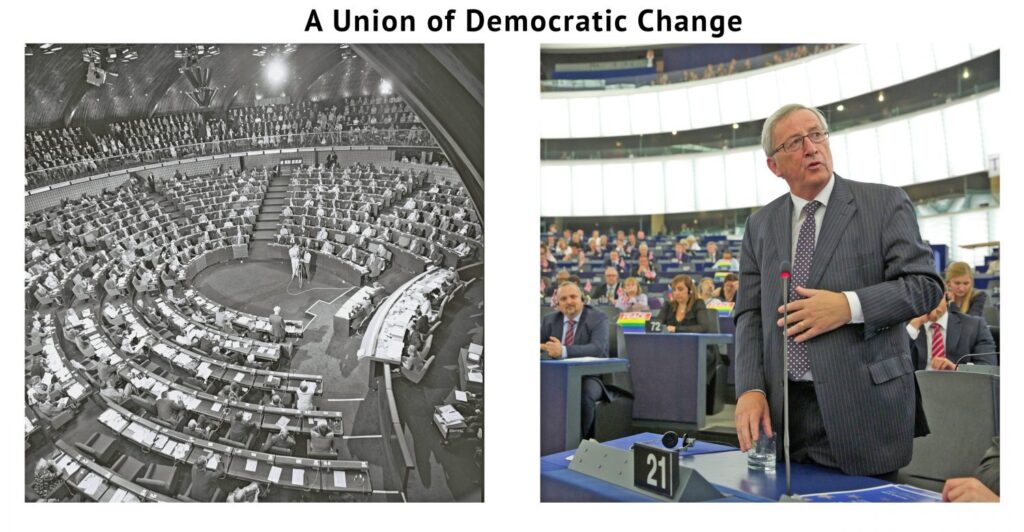
Parliamentarianism appears to be in retreat across Europe. The culprits behind this development are usually the parliamentarians themselves. The idea of a ‘Spitzenkandidat’ (lead candidate) in the European elections, who is then intended to become President of the Commission, is just one of several examples of parties shackling themselves. By Rainhard Kloucek, Secretary General of the Paneuropa Movement Austria.
No Taxation without Representation. This was one of the battle cries in the early days of the parliamentary representation of citizens. The power of rulers was to be limited by parliaments. The tendency of governments to extort more and higher taxes from citizens was to be checked by the power of the people’s representatives. Bear in mind, this was at a time when the tithe was still seen as brutal exploitation, and the tax rate was somewhere well below ten per cent. Today, in European countries – with exceptions like Switzerland or Liechtenstein – this benchmark is well over 40 per cent, often over 50 per cent, and for that part of the population that actually still pays net into the system, it is already around 80 per cent or even higher.
Parliaments were once supervisory bodies
Parliaments emerged as supervisory bodies. They were meant to control the government. Facing the parliaments was the ruler, usually a king, who appointed his government. Factions formed within the parliaments, but the king and his government were not bound by these factions. In the British Parliament, the mother of European parliaments, it was not parties that were elected, but candidates in their constituencies (who could, of course, belong to parties or factions). Furthermore, the British Parliament has a House of Lords, which operates independently of daily politics and thus serves as a shield against ad hoc legislation.
Who appoints the government?
The USA, which consciously broke away from the monarchical tradition, created the position of President instead of a monarch. However, the President is elected directly by the people, independently of parliamentary elections. The theoretical supervisory function of the Senate and the House of Representatives as representatives of the citizens and the states is thus established. The power of parties is also lower in the USA than in Europe.
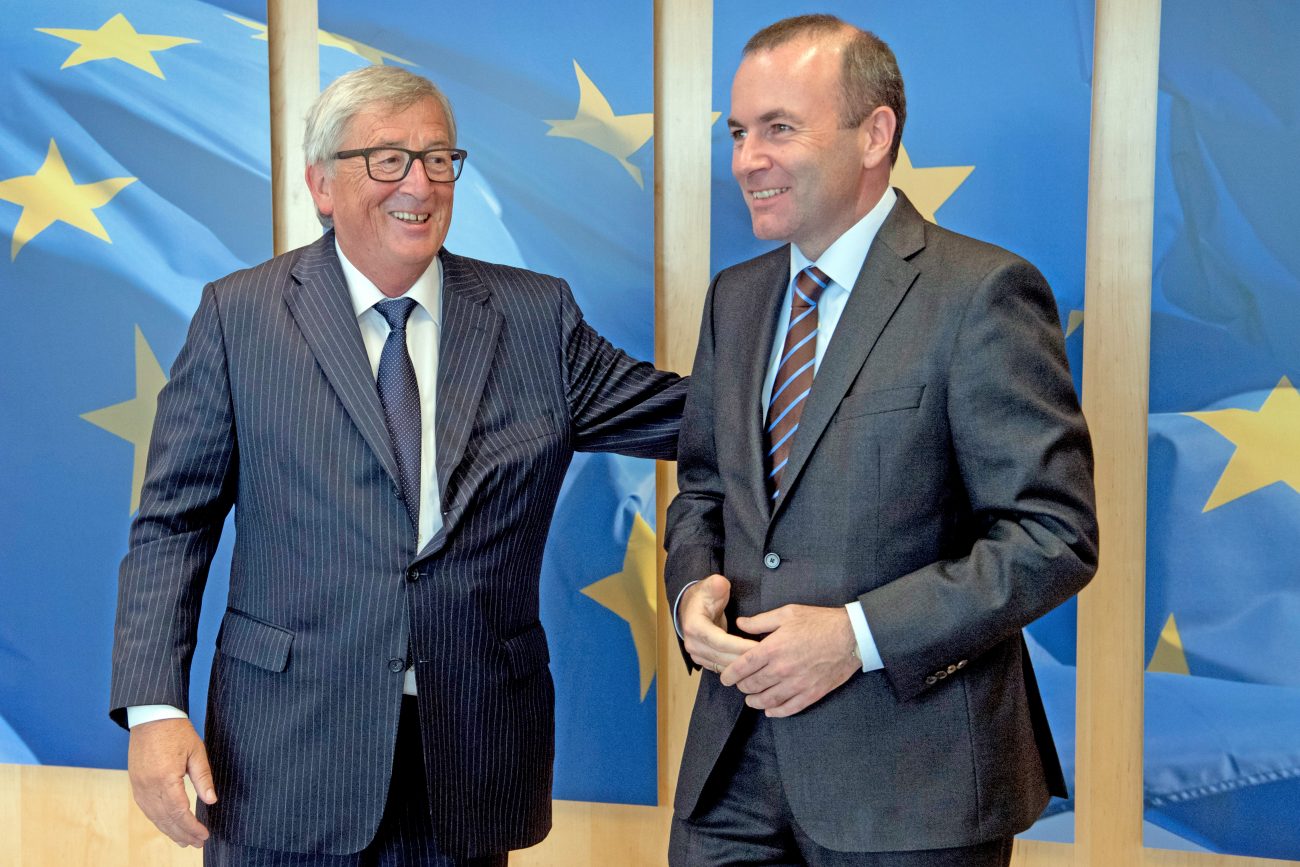
Manfred Weber, pictured on the right, is the leader of the EPP group in the EP and one of the strongest advocates of the lead candidate idea. Some observers suspect that he is seeking this position for his own group in order to become President of the Commission.
The triumph of the party-state
In Europe, the end of the First World War brought a great upheaval with the collapse of empires and the emergence of so-called nation-states. It was the beginning of the rule of parties. They became the new masters in parliaments and governments. Citizens no longer sent supervisors of the government to parliament, but parties, which then formed the government depending on the election outcome, equipped with a parliamentary majority of the same party or the same party coalition. Even if the term ‘Gleichschaltung’ (enforced conformity) of parliamentary majority and government seems harsh to many, it reflects the reality of everyday political life in most European countries. Even in France, where the President is directly elected and assembles his government, this harmony between the President (as a party candidate) and the parliamentary majority is the rule, even if there have been situations where the President’s party had no majority in parliament. It remains to be seen what impact the current situation in France will have, where the current President created a new movement that brought him to the Elysée Palace and his new movement to parliament with a majority.
Parliamentarianism has been forgotten
For most people, this ‘real constitution’ has caused the original idea of parliamentarianism to fall into complete oblivion. They no longer realise that in an Austrian National Council election, for example, they are strictly speaking electing their representation in parliament; instead, they believe they are electing the government or even the Chancellor. Even the instrument of preferential votes has not corrected this awareness, but has instead strengthened the belief in a direct election of the government. This is undeniably in the interest of party strategists, even if victorious parties now call themselves ‘movements’.
Lead candidate does not accept the election
The lead candidate claims the position of Chancellor. He runs at the top of the list and organises a preferential vote campaign with his party or movement, which usually results in the lead candidate receiving the most preferential votes in his party. Formally, therefore, the voters bestow great trust in a candidate to represent them in parliament (as only the composition of parliament is elected in a National Council election), but de facto, the lead candidate of the winning party does not accept the election at all, but moves to the head of the government.
Governor is not directly elected
This practice produces the most curious results, which are no longer even noticed by most citizens. For instance, during the state elections in Lower Austria, one party actually claimed that the ‘Landeshauptfrau’ (Governor) could be elected directly. Linguistically, this was a brilliant move, as one could not contradict the literal meaning. However, the political illusion of a direct election of the Governor created by this was a deception of the voters. The truth was that the incumbent Governor ran as her party’s lead candidate on the state list. This meant she could be elected directly with a preferential vote, but for the state parliament, not for the function of Governor.
What has been established practice in national elections for decades was practised for the first time at the European level in 2014: a lead candidate in the European elections. This practice is to be repeated in the 2019 European elections. The lead candidate of the winning party is intended to become President of the EU Commission. The incumbent Commission President Jean-Claude Juncker obtained this position because his group, the European People’s Party (EPP), received the most votes in the 2014 election.
A lead candidate who does not even run
This practice is far more dangerous at the EU level than at the level of nation-states. This is because there is no Europe-wide list. The composition of the European Parliament is determined by elections held in the constituencies of the member states. A lead candidate can therefore only be elected in one country. In 2014, the lead candidate of the Socialists, Martin Schulz, ran in Germany, as he is German. The Luxembourger Jean-Claude Juncker of the EPP was not on the list at all, not even in his home country. In reality – although he was the lead candidate – he did not run at all. This clearly shows that in this specific case, it was only about parties filling positions, not about achieving the broadest possible public approval.
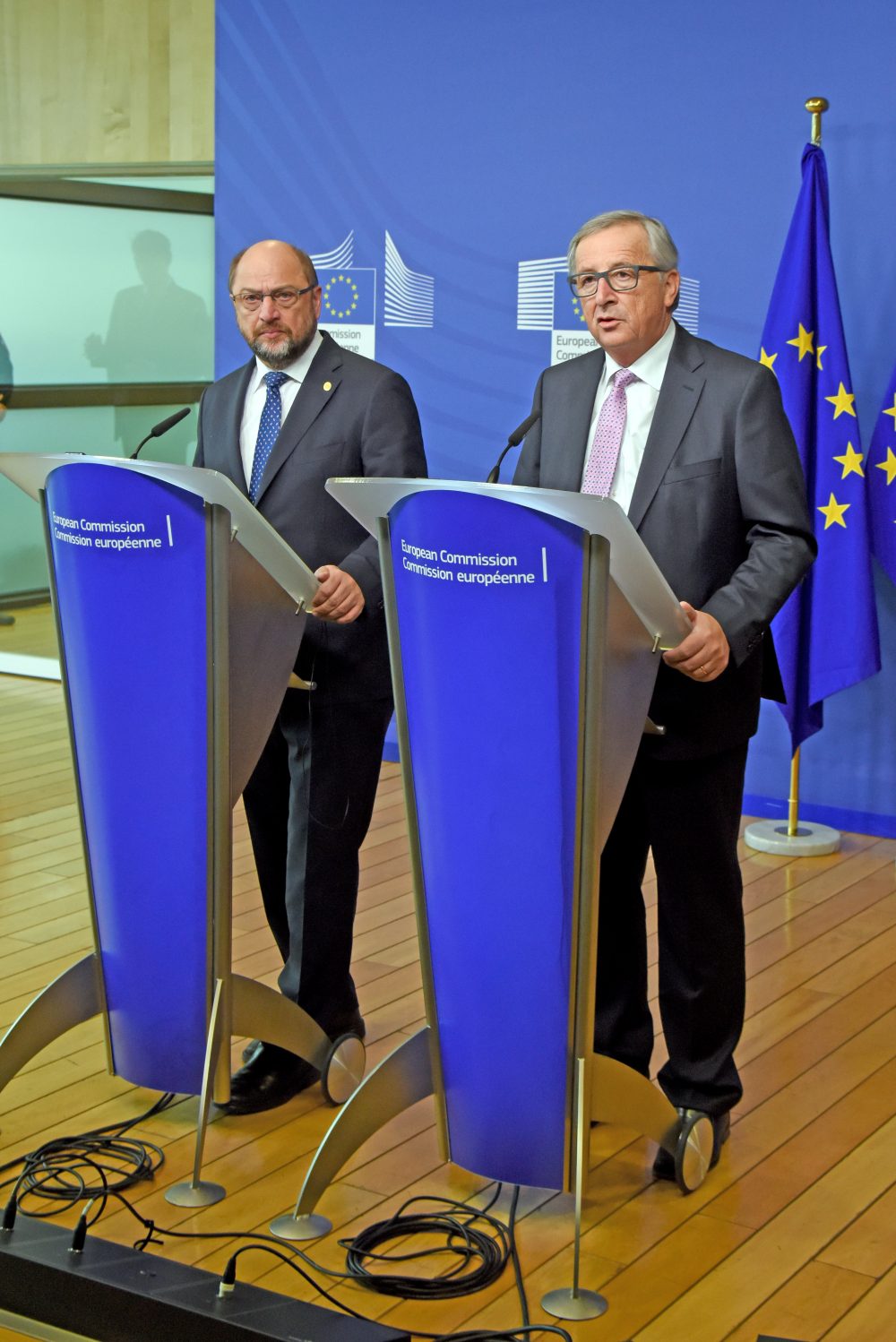
Martin Schulz for the Socialists and Jean-Claude Juncker for the European People’s Party were the lead candidates of their parties in 2014. Schulz naturally only ran in Germany; Juncker’s name was not to be found on any list of candidates.
There is also another weighty argument, namely the institutional structure within the EU institutions and the cooperation between these institutions. According to the current treaties, i.e. according to current law, the Commission President is proposed by the governments. The European Parliament then approves (or not). The parties or groups have therefore reached an agreement by which they push aside current law – the rule of law being one of the principles and values of the EU. Party power replaces the rule of law.
In the European Parliament, there has been no whip system until now. However, with the lead candidate, who does not even intend to run for parliament himself, such a whip becomes mandatory in the election of the Commission, as otherwise the whole idea of the lead candidate would not work. What is propagated by advocates of this practice as a strengthening of the European Parliament and its parliamentarians is in reality a massive weakening of parliamentarians as representatives of the people. The only thing strengthened is the power of the group leaders.
Lux-Leaks and the failure of Parliament
The effects of this policy could be observed shortly after the 2014 European elections and the appointment of the new Commission. No sooner was the Juncker Commission in office than Lux-Leaks became known. In his capacity as a government representative in Luxembourg, Jean-Claude Juncker negotiated special agreements with large companies that guaranteed these firms better tax treatment than was provided for by law. Now Juncker was President of the very Commission that is considered the guardian of the treaties. His political conduct was incompatible with the office entrusted to him. Strictly speaking, if the European Parliament took its role seriously, it should have introduced a motion of no confidence. But that was not possible for the large groups, as they had already agreed in advance on who should become President of the Commission. Had the EPP agreed to the removal of its own lead candidate as Commission President, it would not have been able to present any other candidate as the strongest group, since that person was not the lead candidate. The European Parliament thus failed as a supervisory body; the promised strengthening of Parliament turned into its weakening.
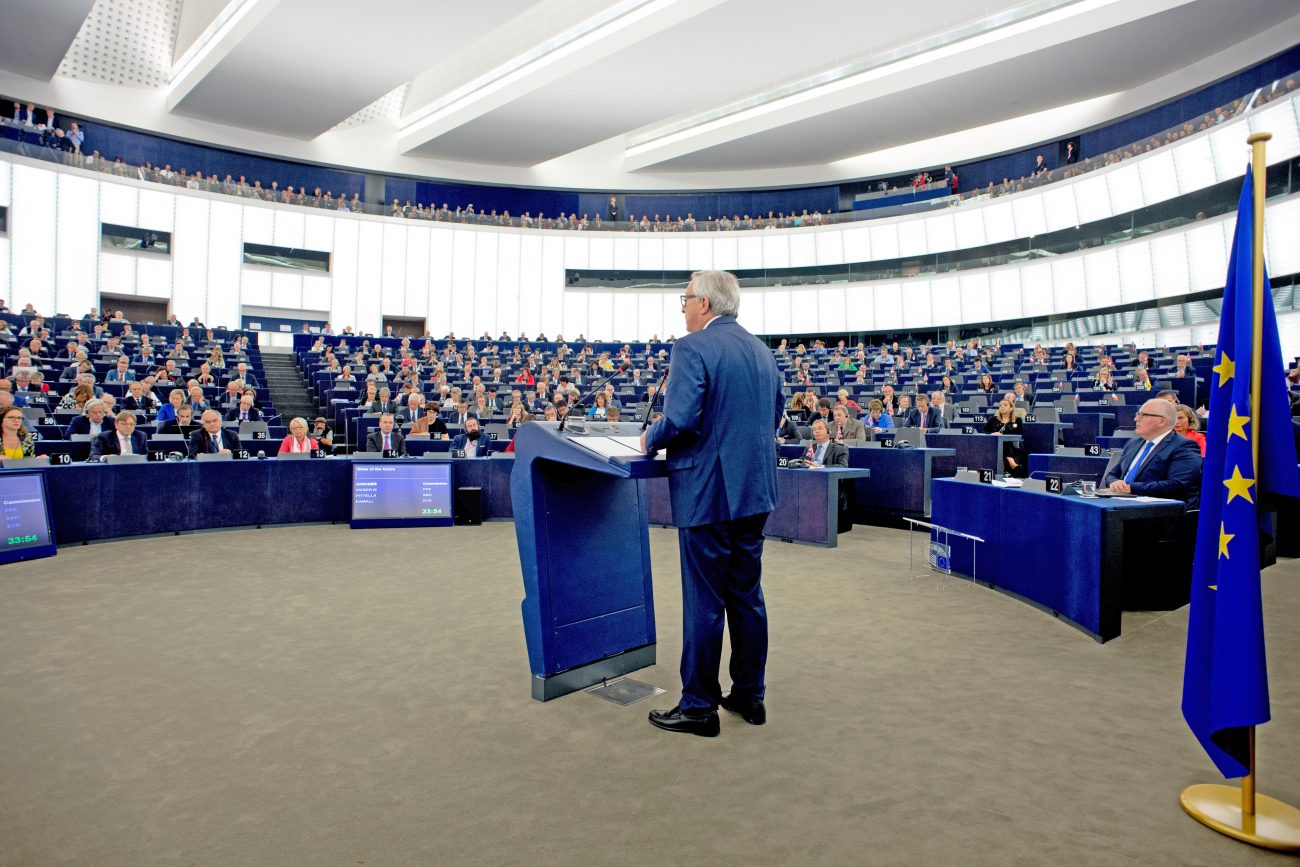
Under the slogan of democratising the European elections, the large groups pushed through the selection of a lead candidate in 2014. The lead candidate of the strongest group was to become President of the Commission. This procedure ignores the existing treaties. It does not strengthen the European Parliament either, but only the party leaders. The European Parliament should be the supervisory body of the Commission. The lead candidate concept weakens the supervisory function because the majority group is beholden to the Commission President.
This weakening becomes particularly striking when one draws a comparison to the events of the late 1990s. In the Santer Commission of that time, there was the French Commissioner Edith Cresson, who stood out for a particularly idiosyncratic interpretation of her conduct in office.
Although the European Parliament had significantly fewer powers back then, and a vote of no confidence could only have been passed against the Commission as a whole, the motion of no confidence was introduced in Parliament. It ultimately failed due to pressure from the governments of the member states. Now, Parliament has shackled itself.
Images: European Union 2014 / 2015 / 2017



