Propaganda Against Europe
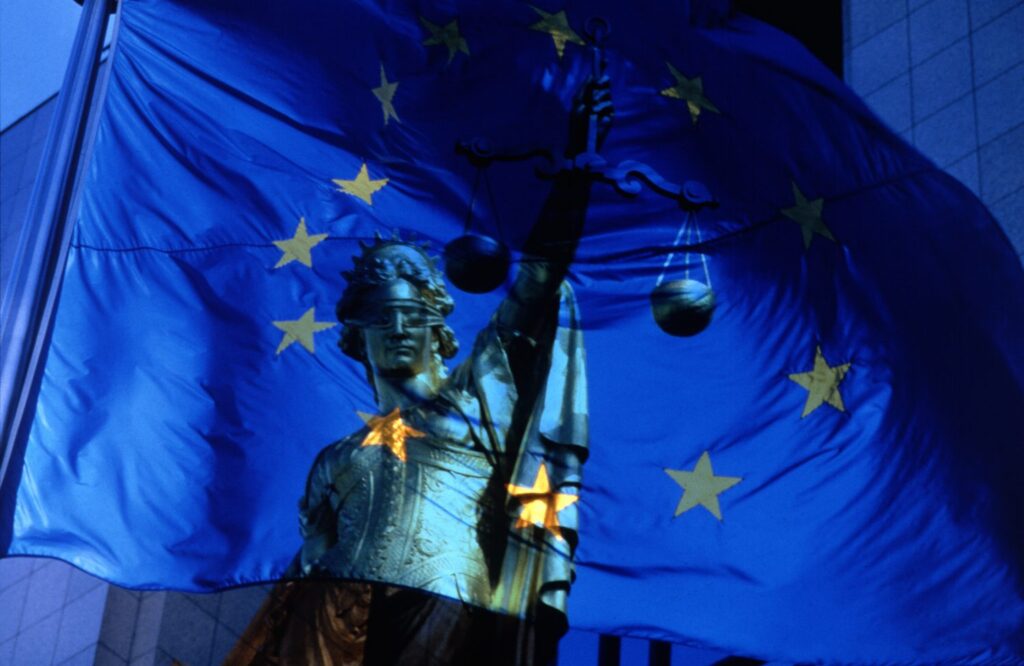
The rule of law and a free market economy are the guarantors of Europe’s success. Yet, they are severely threatened by propaganda, writes Stefan Haböck, International Officer of the Paneuropa Movement Austria.
Democracy, in conjunction with the liberal rule of law and the market economy, is a model of success. Never in history have people been wealthier or freer. We owe this, among other things, to innovation, free enterprise, and access to education. The most successful – that is, the freest and most developed – countries in this regard almost all share a foundation upon which their success rests: rule-of-law, market-oriented democracies with extensive civil and fundamental rights and the condemnation of corruption.
Those who have the rule of law behind them invest. Those who can think freely research. Those who are allowed to make individual decisions take responsibility. All of this was only possible because the oppressive yoke of the collectivist and criminal systems of the 20th century could be overcome in 1945 and 1991. After the brutal regimes of annihilation, Europe has found a way of living together that is based on the rule of law, democracy, protection of fundamental rights, independent judiciary, anti-corruption, market economy, solidarity among individuals, subsidiarity, and cooperation.
The European Model is in Danger
A strong EU is anathema to many powers. The attacks against the European model only confirm its success. Nothing less than European democracy is at stake. The hybrid warfare waged by those powers that fear freedom, democracy, and the rule of law threatens our coexistence – and finds supporters within Europe. The battle raging here is more than a usual conflict between states. It claims human lives, as Ukrainian orphans have felt for five years. It threatens the aforementioned foundation upon which Europe’s success rests. For this foundation draws its strength primarily from the trust that citizens place in it.
This is where hybrid warfare begins. While the Cold War was about two competing ideologies, this new type of warfare no longer aims for the other side to be believed. “The crucial thing is rather that nothing is believed anymore. ‘In an ever-changing, incomprehensible world the masses had reached the point where they would, at the same time, believe everything and nothing think that everything was possible and nothing was true’,” wrote the great thinker Hannah Arendt in 1951. So, believing everything and nothing – the undermining of trust in the rule of law, in freedom, market economy, and individualism.
Today, only a small group of confused radicals can still be lured by communism or National Socialism. And, of course, most people are aware that Canada and Spain, in sum, offer more freedom, participation, and security than, for example, fundamentalist autocracies. The goal of propaganda is to deliberately sow doubt in the “system”. The boundaries between a – fallible, often arduous, imperfect, but overall free – system and the – arbitrary – system of autocracies are to be blurred. There are two reasons for this: On the one hand, a divided Europe represents significantly less global competition for other major powers. This can be seen in the agreement with Iran, the customs dispute with the USA, or China’s strategic infrastructure investments.
On the other hand, many regimes are now facing growing popular discontent. Globalisation has de facto abolished isolation. Young people, especially, see what is possible elsewhere; that other political systems offer significantly more prospects; that it can work without corruption; that one no longer has to fear ending up in a labour camp for an opinion. Where tanks were once sent, propaganda is now deployed, its most important component being the destabilisation of the opponent. Many former Eastern Bloc states, such as the Baltics, have developed a strong stance against these types of attacks based on their experience. The rest of Europe slept for too long.
Ukraine as a Testing Ground
The example of Ukraine is a good one. After the collapse of the Soviet Union, a large part of the once-oppressed peoples managed to escape to freedom. Influence over the Baltics or Southeast European states was lost – at the latest with those states’ accession to the EU and NATO. When millions of Ukrainians set out to oust one of the most corrupt cliques ever to rule in Europe, alarm bells rang both inside and outside Ukraine: this country must never succeed, with market economic structures and a genuine rule of law.
Even at the beginning of negotiations for the Association Agreement, which was intended to bring the country more economic stability, a propaganda wave of enormous proportions began. One of the most frequently spread lies about Ukraine is that the country is governed by “far-right fascists”. That this is claimed by far-right extremists might still pass as bitter irony. In fact, the claim was a strategically placed lie surrounding the 2014 presidential election campaign. A TV channel reported on the “electoral victory of a far-right politician” who, in truth, achieved 0.7 per cent. But the seed was sown. To this day, the claim persists. A Jewish president and a Jewish prime minister change nothing about this.
Stoking Enmity, Mobilising Compatriots
State or state-supported propaganda from outside against European states is not only intended to unsettle the population but also to influence their own people. Well-known here is the debate about the influence of Islamist associations on Muslims in Europe, specifically from Turkey, on people living here. Because this influence does not happen in secret and some heads of state openly boast about it, this debate is lively and also fuels politicians who show less apprehension towards other systems.
The German case of “Lisa” is also interesting. On social media, reports about the girl who claimed “Southerners” had abducted her went viral. Non-European media spread this story. Suddenly, demonstrations occurred simultaneously in several German cities. Far-right groups exploited the issue. Ultimately, it was a foreign minister personally who openly accused the German authorities of covering up a crime. This targeted statement was, of course, intended to incite the population in Germany. The goal was clear: the German state was to be discredited. Germany, at that time still the politically most powerful and today still the economically most potent country in the EU, was to be destabilised.
Sowing Distrust Against “the Elites” as a Success Factor
Of course, deliberate false claims have been a tool in political struggle for millennia and are not exclusive to any country. However, far more subtle and therefore more promising is widespread disinformation against “those at the top”: The day after the downing of flight MH17 over eastern Ukraine with more than 300 dead in 2014, 57,000 tweets were sent accusing the Ukrainian government.
Around the Brexit referendum in 2016, tens of thousands of fake accounts (including Iranian ones) sent about ten million tweets. Around the mass protests in Catalonia in 2017, bots flooded Twitter, sharing Julian Assange’s tweets tens of thousands of times, all against the Spanish government and the EU. In September 2017 alone, Assange was mentioned 940,000 times via hashtag – mainly in connection with Catalonia. As a Spain expert, he had been unknown until then.
In the run-up to the Italian elections in 2017, migration dominated the agenda. “El País” analysed that from February to July, 98,000 users on Twitter sent more than a million tweets on the subject. The two most influential foreign media were the non-European platforms “Huffington Post Italia” and “Sputnik Italia”.
On 17 January 2018, Facebook blocked around 300 accounts in and from countries of the former Soviet Union that had spread fake news. It turned out that the Latvian platforms were operated by a non-European platform.
During the “Yellow Vest” protests in France in 2018/2019, security personnel appeared who had fought as mercenaries in Donbas. More than 600 fake accounts tweeted several thousand times a day about the protests. The content mainly came from two non-European media outlets.
The Rule of Law Faces a Problem
Anyone can post anything online – and within a few hours or even minutes, it spreads. Circulating a clarification of the same magnitude is almost impossible. The sheer volume of posts on networks also presents a problem for the rule of law. How can freedom of speech (and thus the freedom to spread nonsense) be distinguished from attacks by non-European powers?
In 2017, the EU foreign ministers jointly declared their intention to take stronger action against non-European propaganda. EU institutions are responding with education, scientific analyses of fake news and propaganda, and appeals. In 2015 – three years before the EU Commission – the European Parliament established a task force specifically to uncover fake news and present facts. With a budget of 1.3 million euros and 17 employees, efforts are now being made to expose false reports.
However, there is also a desire to resort to tougher measures and compel online platforms to block propaganda accounts. The fine line between censorship and necessary action is known to the actors involved. Should the state intervene here? What is merely “clickbait”, and what is a brazen lie? Here, it must be clearly stated: the debate about what the state is allowed to do is enormously important. It is also being conducted in Europe, not in the states from which many propaganda waves originate. This January, the Foreign Affairs Committee adopted a resolution specifically targeting threats from third-state propaganda. Uncovered propaganda is to be published alongside the truthful facts.
However, all state measures are useless if the actual target of propaganda, the citizen, does not himself develop a sense of what is reputable and what is not. That we can all live in freedom is not a given. Freedom is precious and fragile. Social media can – and this is also the responsibility of each individual user – as a place of free speech, enrich discourse and provide space for reputable arguments. Or it can go down in history as the biggest rubbish dump of lies, disinformation, and hate.
Text published in Couleur-Magazin of the MKV and the Wiener Zeitung.
c Feature image: European Community 1996



