Rule of Law Amidst Chaos: Kosovo Votes Again
Political tension remains high in Pristina: After some chaos last year, the country goes to the polls on Sunday. Ironically, however, the favourite is not permitted to take up a mandate. By Philipp Jauernik.
So, the time has come again: Less than eighteen months after the ballot in October 2019, the citizens of Europe’s often-called youngest state, the Republic of Kosovo, are once again called to vote. The reason for this appears technocratic at first glance: In December 2020, the Constitutional Court declared the election of the government in June of that year unconstitutional.
Looking back: The 2019 election did not bring a landslide in terms of vote shares, but the mood clearly indicated a shift in power. For the first time, the PDK, which emerged from the UCK guerrilla army, was originally social democratic and is now centre-right, was no longer part of the government – unlike the left-wing nationalist Vetëvendosje (VV, Albanian for “Self-Determination”) of the quite popular former student politician and ex-political prisoner Albin Kurti, which entered a national coalition for the first time and also provided the Prime Minister with Kurti. It had formed a coalition with the liberal-conservative LDK and a Serbian list.
The alliance did not last long: Less than two months after the swearing-in, 82 of the 120 parliamentarians approved a motion of no confidence. The trigger was the dismissal of Interior Minister Agim Veliu (LDK) by Prime Minister Kurti without consulting his party, after Veliu had, in turn, publicly declared a state of emergency due to the Covid-19 pandemic. The LDK described this as a breach of the coalition agreement.
However, the mood had been very unstable even before that. Constant friction between Kurti and President Hashim Thaci over who should exercise a negotiating mandate at an international level, as well as with the US Special Envoy, Richard Grenell, who, on behalf of US President Trump, was supposed to achieve a deal between Kosovo and Serbia with considerable pressure. Kurti stood in the way, as he – in the opinion of numerous observers, not entirely without justification – criticised the lack of transparency in the process. The fact that Kurti’s VV occasionally flirted with the highly politically sensitive topic of a unification of Kosovo with Albania certainly added fuel to the debate.
On 3rd June, Parliament finally elected the economist Avdulla Hoti (LDK) as the new Prime Minister – by a narrow margin of 61 votes. This is where the problem lies, as one of the approving MPs was not actually eligible to vote due to a criminal conviction. Consequently, the Constitutional Court declared Hoti’s election invalid and ordered new parliamentary elections.
These will now take place on 14th February. Another victory for Vetëvendosje is expected, with all forecasts predicting massive gains. What this means for the future of the country is unclear. Kurti himself, according to the Supreme Court on 29th January, is not allowed to run due to a final conviction in autumn 2018. However, his party is likely to be in a position to form a government. How much the often impetuous group will pursue the path of diplomacy remains to be seen, as does the role of Kurti himself, whose influence within his party remains unbroken. From an observer’s perspective, the strong role of the courts, whose rulings are also implemented, is certainly striking. One thing is clear: the young state, despite all political turbulence, uncompromisingly pursues the path of the rule of law.
Philipp Jauernik studied history and worked, among other things, as a consultant for relations with Southeast Europe in the European Parliament. He is the federal chairman of the Paneuropa Youth Austria (founded 1922) and a member of the board of the Austrian-Kosovar Society. He also serves as editor-in-chief of “Couleur” magazine.
This text originally appeared in the “Wiener Zeitung”.
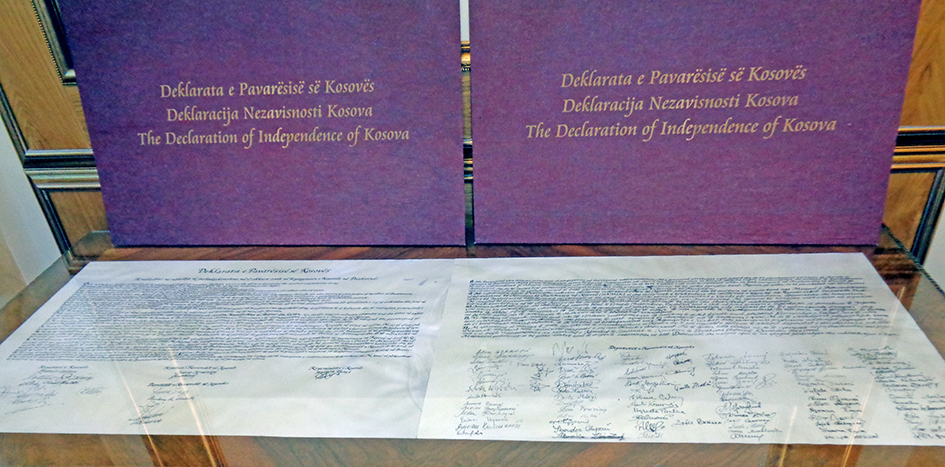
The featured image shows Kosovo’s Declaration of Independence. c Paneuropa



