Sanctions and Illusions
The sanctions against Russia are repeatedly criticised. They would harm Europe more than Russia. A claim which, though false, is vehemently asserted by certain circles. It is undisputed that Europe has woefully neglected its security policy for decades. However, a robust security policy is necessary to prevent despots from being motivated to wage further wars of annihilation. An assessment by Rainhard Kloucek.
Sanctions are a shot in one’s own foot, or as the pro-Putin Hungarian Prime Minister Viktor Orbán put it, a shot in one’s own lung; they would only harm Europe and not affect Russia at all; the majority of the people would be against economic sanctions against Russia; they would not end the war either; and anyway, nobody wants to freeze for Ukraine. These are the messages that come daily from politically relevant circles, from the FPÖ to the AfD in Germany, from social democrats and old communists, from vaccine opponents who see a US-orchestrated conspiracy behind every event, from Austrians who believe that neutrality has protected us from all harm, but also from representatives of business organisations – Harald Mahrer, head of the Chamber of Commerce, should be recalled here.
The arguments for rejecting sanctions usually include the increased value of the rouble, price inflation, rising energy costs, the incompetent EU, incompetent politicians in general, and the claim that the USA is the sole beneficiary of Russia’s war against Ukraine.
Personnel Problem in Politics
Indeed, one could agree with some of the arguments put forward. The rouble’s value has risen, the euro’s value has fallen, energy costs are increasing, and price inflation is reaching heights not seen in 40 years. Added to this is a policy that made us dependent on Russian gas supplies, usually with the argument that Russia supplied cheap gas and had always been a reliable partner, even during Soviet times. This dependence was further exacerbated after Putin had already used the gas weapon several times, directly against Ukraine and indirectly against European Union countries. Warnings were ignored. Similarly, in European security policy, a course was pursued that massively reduced all military capabilities for defence. On the one hand, to cash in on the peace dividend and funnel money into welfare-state redistribution programmes (voter bribery?), and on the other hand, because it was believed that there would be a warning period of approximately ten years for wars. Yet, even with the annexation of Crimea, experts and politicians were surprised. However, there was still no reaction to the Russian threat. Life was simply too comfortable. And even if one does not want to join the pub-talk sentiment of “all politicians are incompetent”, one must admit that we have a personnel problem in leadership positions across many political levels in Europe.
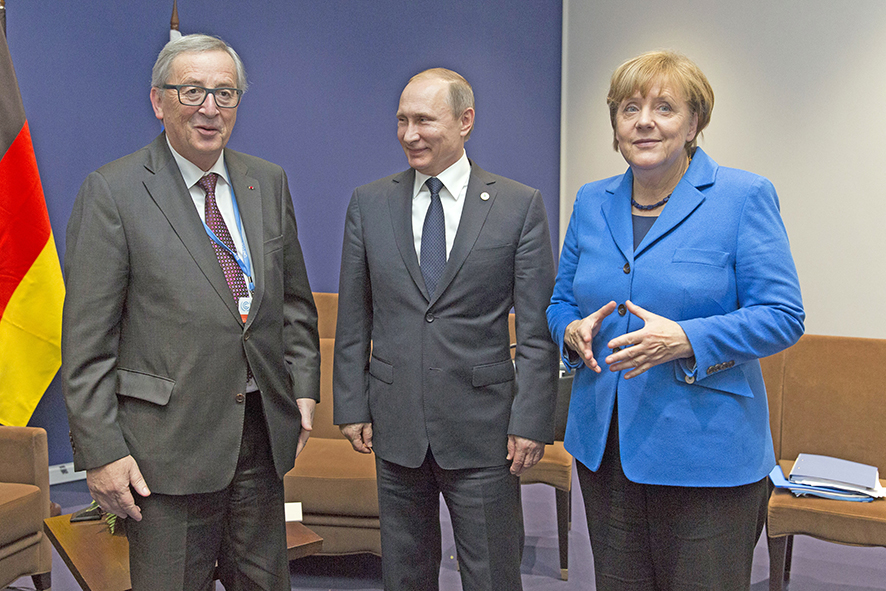
Jean-Claude Juncker, Vladimir Putin, President of Russia, and Angela Merkel, German Federal Chancellor (from left to right). European policy underestimated Vladimir Putin’s imperialist ambitions for too long.
The COVID-19 policy certainly also played a role in the aversion to ruling politicians. Some mistakes were probably made here, partly because there was no experience at the beginning of the pandemic, leading to drastic measures that have now almost all been reversed. Communication on this was clearly in need of improvement. Clever demagogues and populists naturally tried to capitalise on this mood. A recent study published in Profil showed the parallel between vaccine opponents and those who downplay Russia’s war of annihilation against Ukraine. According to the study, a majority of unvaccinated people blame the USA, NATO, and Europe for this war, not the aggressor Russia.
But are the sanctions really a shot in our own foot? Can they end the war or help to end it? To answer this, one must carefully distinguish several things and clearly define what was intended to be achieved with which measures.
Can Economic Sanctions End the War?
It is clear that economic sanctions will not end a war. It is equally clear that economic sanctions have negative effects on both sides. This is also logical. If one does business, it is because one benefits from it. This applies to both sides. Without a benefit, one would not do the business. If this business ceases, both sides lose something.
This principle also underpins the policy of change through trade. Through steadily increasing trade, trust was supposed to grow between the then-existing Soviet Union and the West. This policy was advocated by social democrats, who also had strong factions within their own ranks that saw (and still see) the goal of their policy in actually existing socialism, and was viewed sceptically and even initially opposed by bourgeois parties. This policy prevailed. In retrospect, this policy also had its successes. The Soviet Union proved to be a reliable supplier of raw materials, even though it remained a totalitarian state until its end.
In 1975, the USSR signed the Helsinki Final Act within the framework of the Conference on Security and Co-operation in Europe (CSCE, now OSCE), which stated: “They (the signatory states, editor’s note) will also respect the right of each other participating State freely to choose and develop its political, social, economic and cultural system as well as its right to determine its laws and regulations. Within the framework of international law, all participating States have equal rights and duties. They will respect the right of each other participating State to determine and develop its relations with other States in accordance with international law and in the spirit of the present Declaration as it wishes. They consider that their frontiers, in accordance with international law, can be changed by peaceful means and by agreement. They also have the right to belong or not to belong to international organisations, to be or not to be a party to bilateral or multilateral treaties, including the right to be or not to be a party to alliances; likewise, they have the right to neutrality.”
The non-alignment already agreed upon was then reaffirmed in November 1990 in the “Charter of Paris for a New Europe”. Russia, as the successor state to the USSR, later confirmed these agreements.
Change Through Trade and the Interdependence Theory
The policy of change through trade is also based on the so-called interdependence theory. This approach assumes that states become so intertwined in a web of treaties through mutual dependencies (interdependencies) that, firstly, all sides benefit, and secondly, a war between these states would no longer be possible. One of the foundations of this interdependence theory, however, is rational behaviour by political actors. War is expensive and destroys prosperity-enhancing trade relations. Therefore, anyone who acts rationally (sensibly) prefers to trade with their neighbour rather than smash their head in. Because you can no longer trade with a dead neighbour.
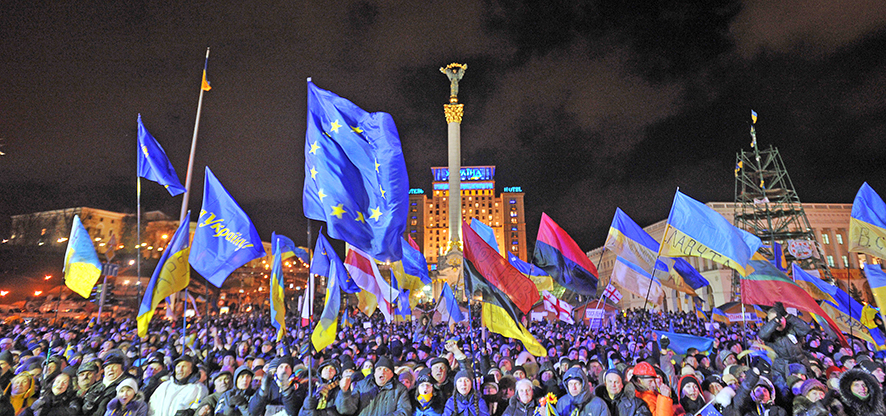
The Ukrainians have clearly chosen the European path. They want to finally shake off Moscow’s oppression.
This rational behaviour could evidently be assumed for the totalitarian USSR, but it no longer applies to Vladimir Putin’s rule. Power in the USSR rested on three pillars: the Party, the KGB, and the Red Army. It was a balance of power in which the failure of one rationally acting pillar was supposed to be absorbed by the others. Putin’s Russia, however, is based on a fusion of the KGB, renamed FSB, with organised crime. Russia today is a mafia state where the old KGB officer and later FSB chief Vladimir Putin is simultaneously the boss of all oligarchs who must pay him tribute. The behaviour of this system follows the logic and rationality of criminal organisations: violence to expand one’s own power. In Lenin’s sense, for Putin, gas is the rope with which he will hang the capitalists who previously sold him the rope. Once European states are dependent on Russian gas, and welfare-state-spoiled citizens are accustomed to cheap raw materials, they will torpedo domestic raw material extraction. Indeed, in countries like Germany and Austria, domestic gas production was abandoned with flimsy arguments and special economic interests. There are indications that these groups were supported by Russia. With the gas tap, Putin holds an extremely efficient weapon to spread fear and terror across Europe about a cold winter with every turn of this valve. The term ‘gas war’ has taken on an entirely new meaning.
The question of how economic sanctions work was already addressed by the Paneuropa Movement Austria in April 2015 – the year before, the EU had already decided on some sanctions against Russia in response to the annexation of Crimea – in the “IV. Otto von Habsburg Symposium”. Norbert F. Tofall from the Flossbach von Storch Research Institute then presented studies that clearly show that economic sanctions are not suitable for achieving political goals. This does not mean that sanctions only harm one’s own side. They do indeed have an effect on the sanctioned state. However, political goals must be pursued with political means, and security policy goals with security policy means. (See also the two articles by Norbert F. Tofall in “Paneuropa” 03/2015.)
Boycott of Raw Material Supplies
Opponents of sanctions against Russia usually argue that these sanctions only affect Europe. This is clearly false. Linked to this is the assumption that Putin’s game with the gas tap is a direct consequence of the sanctions against his regime. Politically far-sighted analysts, such as the President of the Paneuropa Movement Austria, Karl von Habsburg, had already demanded in the initial discussions on the Russian invasion of Ukraine that the EU must now respond with a boycott of Russian raw material supplies. The export of raw materials is the main source of income for Russia and thus also the main source of funding for the war.
This demand was based on the assumption that Putin would use the gas weapon anyway. Europe had to pre-empt him by acting quickly, especially given that Putin would turn off the gas tap himself – albeit not entirely. So, whoever acts quickly and decouples quickly will also get out of the dilemma faster. However, even with the much simpler boycott of Russian oil supplies, it became clear that individual states like Hungary or Greece were blocking it and securing circumvention options. While other former Eastern Bloc countries had long taken measures to become independent of Russian supplies, the Orbán government had progressively increased its dependence.
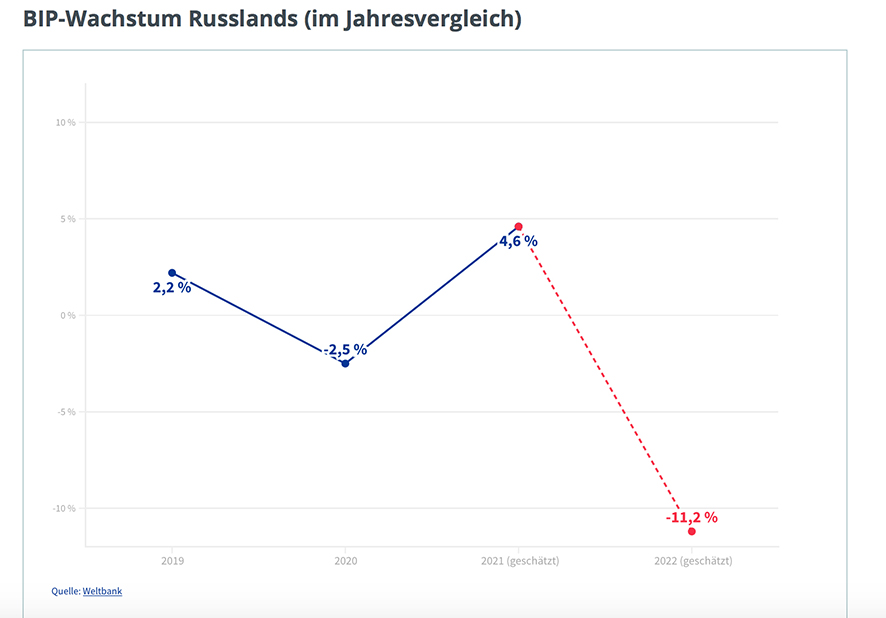
The anticipated decline of the Russian economy is massive.
Putin thus holds the gas weapon in his hand. Every reduction in supply causes the price to rise. Russia can therefore achieve the same, if not higher, revenues from sales to Europe with less supply. Energy experts assume that Russia will not completely stop gas supplies to Europe, at least not in the short term. This is partly because the gas fields from which raw materials for Europe are extracted are not connected to the pipeline network that supplies, for example, China. The infrastructure for this must first be built, which takes time and money. A second reason is technical. Once closed boreholes can only be reopened with great effort, which would be a shot in Russia’s own foot.
Russia’s Dependence
Jeffrey Sonnenfeld and Steven Tian illustrate Russia’s high dependence on the European gas export market in an article for “Foreign Policy” on 22 July.
For example, pipelines to Asia have only ten percent of the capacity of pipelines to Europe. 83 percent of Russia’s gas exports go to Europe, which accounts for 46 percent of the supply in Europe. According to Gazprom data, gas production in Russia has already been reduced by 35 percent. This is just one example of the negative effects of the war on the Russian economy. Regarding gas dependence, it must also be added that the high dependence, which exists in Hungary, Germany, and Austria, for instance, does not affect all countries.
A problem that Sonnenfeld and Tian point out in their article (which in turn is based on the work of numerous other experts and their data analyses) is the availability and credibility of data from Russia. The data supplied by Russia is a “cherry-picking” exercise; the data is incomplete, selective, omits unpleasant facts, or is no longer published at all.
For example, the import of goods plays an important role for the Russian economy, accounting for about 20 percent of GDP. However, this import has collapsed by more than 50 percent in recent months. And it has not been entirely replaced by imports from China and other countries, as some suspect. In addition, there is inflation of between 40 and 60 percent. The sale of Western cars has plummeted by 95 percent. The two authors refer to the looming unemployment due to the withdrawal of Western companies and report an exodus of half a million people, most of whom come from the ranks of highly qualified workers. The authors refute the story of a high budget surplus due to increased energy prices; regarding currency reserves, they point out that Western countries have now frozen approximately 300 billion dollars, which are later to be invested in the reconstruction of Ukraine. According to their analysis, the Russian economy is imploding.
The former Deputy Energy Minister of Russia, economist, opposition politician, advisor to Alexei Navalny, who now works for the Martens Centre for European Studies in Brussels, writes that the concealment of data is indirect evidence of the strong negative effects of sanctions on Russia.
Inflation in Russia
He illustrates how data from Russia is manipulated using inflation. Officially, it was said to be 17 percent in May. However, many reports indicate a significantly higher rate of price increase. And the Russian Central Bank reports an observed inflation of over 25 percent. The observed inflation, in turn, results from opinion polls. According to Milov, the Central Bank has also carried out massive interventions, on a scale not seen since the early 1990s. This means that a true value of the rouble can no longer be determined.
Apart from the short-term effects of sanctions that are already discernible, the medium- and long-term effects are what matter to the economist. Milov writes of the greatest deglobalisation of a major economy in history. Russia will be cut off from international markets, from the financial and service sectors, from technology and logistics. And even the official figures from Rosstat show production declines in various industries of 50 to over 90 percent. For example, minus 60 percent for refrigerators and freezers.
Even the government anticipates a 50 percent decline in imports (in April), while other studies estimate this decline at 70 to 80 percent. In the first quarter of the year, real incomes fell by 1.2 percent year-on-year. These income declines are reportedly increasing, as is unemployment. The nominal strengthening of the rouble, however, has no positive effects on the economy.
The Long-Term Consequences of Sanctions
Vladimir Milov assumes that the truly negative effects on the Russian economy are yet to come. Cut off from the Western world, he believes, no successful economy can be built.
Oleg Vyugin, formerly Deputy Head of the Central Bank and the Ministry of Finance in Moscow, now active in other areas of the Russian economy, also refers to the long-term effects of the sanctions. In an interview with “Die Presse” (28 July 2022), he states that in the short term, Europe might suffer more. “But in the medium term, looking at 2023 and 2024, Russia will naturally suffer more.” And he also refers to the danger of using the gas weapon. Because by throttling agreed deliveries, other buyers would turn away due to a lack of reliability. “And that is a loss for the Russian economy.”
Only for Inferior Goods
40 percent of the Russian budget depends on revenues from oil and gas exports. These revenues will become even more important in the future because other tax revenues are falling due to the economic decline. Russia can replace some of its trade with the West through trade with China, India, Iran, or possibly Turkey, but not everything, and above all, as Vyugin emphasises, only “for inferior goods”. Oleg Vyugin does not believe that sanctions will be able to end the war.
A forecast on the further economic development in Russia can be read on the European Council’s website, which in turn is based on World Bank studies. According to this, imports will fall by 35 percent, and exports by over 30 percent. For this year, a GDP decline of eleven percent is expected, and an inflation rate of approximately 22 percent.
The aim of EU sanctions is not to directly affect Russian society, which is why, for example, food or health products are exempt. Essentially, the sanctions are designed to directly target Vladimir Putin’s power system. Therefore, the sanctions are directed against areas that are intended to impact the war economy, such as embargoes on high-tech products. And there is a list of individuals from Putin’s power apparatus who are directly affected by the sanctions. This ranges from entry bans into the EU to the freezing of assets in the EU. The European Commission has compiled information material on this on its website.
A problematic aspect of the sanctions is their porousness in some areas. For example, the oil embargo was riddled with many exceptions, from Hungary to Greek tankers. Gas imports are not banned by the EU; here, Putin plays on the fears of many Europeans of a cold winter.
Price Inflation in the EU
The existing price inflation must be separated from the sanctions. Even if the war and the gas game have an impact on price developments in some areas, many other factors are also to blame for the high price inflation. Supply chain problems must be mentioned, as well as, for example, the policy of the European Central Bank, which has long abandoned its legally enshrined mandate of creating monetary stability (inflation target of approximately two percent) in favour of financing the deficits of states. However, the debt levels of individual EU states are not caused by “the EU”, but by these national states, which have long since ceased to adhere to the stability criteria established when the euro was introduced.
So, are the sanctions actually a shot in our own foot or in our own lung, harming only European countries and not Russia? Undeniably, the sanctions also harm the European economy. A review of which sanctions work and which do not, where loopholes exist, and how they can be closed, is also sensible. Even if the data situation is often inadequate, massive negative effects on Russia are evident, which will increase with the duration of the sanctions. Can the war be ended with economic sanctions? The answer to this question must clearly be no.
Should we therefore lift the existing sanctions and simply wait to see how Russia’s war of annihilation against Ukraine ends? This question can only be answered if the objective is defined. If one wants to expose Ukraine to Russian subjugation, if one wants to simply accept that a despot ignores all rules of international politics, all international obligations entered into by his country, then one can plead for an end to sanctions and indulge in the illusion that one will remain warm. However, the probability that Putin, after a swift conquest of Ukraine (because it is no longer supported and Putin’s imperialism is not reacted to), will contentedly retreat to the Kremlin is significantly lower than the probability that he will then develop an appetite for more, i.e., push the war further west. No reaction to Putin’s crimes would also encourage every despot in the rest of the world to follow suit. It would be an invitation for China to start a war against Taiwan.
You Cannot Do Business with a War Criminal
But if sanctions cannot end the war, and the West supposedly wants peace, why are sanctions necessary? Because you do not do business with a war criminal like Putin and you do not continue to fill his war chest through business. A policy of business as usual would be an invitation to Putin and all other despots to unleash their imperialist fantasies. This would be the end of the free world as we know it, an end to civilised relations between states, an end to international treaties, and the enforcement of the law of the strongest. With all the painful consequences that history shows us.
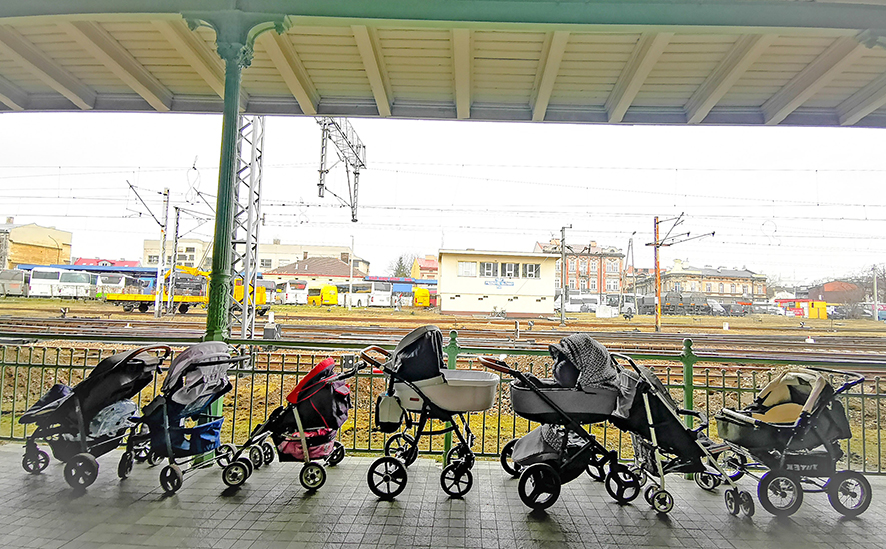
An action with empty prams was intended to highlight that Russia’s war of annihilation against Ukraine has so far murdered hundreds of children.
That Putin started the war is probably also a consequence of the West’s weak reactions after his war against Georgia in 2008, the annexation of Crimea, and the beginning of the war in Donbas in 2014. Europe could then, as now, only react with sanctions (which were far too weak at the time), because Europe had dangerously neglected its security policy in the past decades since the end of the Iron Curtain. If military support for Ukraine from most EU countries is hesitant, this is not only a consequence of the political weakness of the leadership personnel but also proof of the inability to defend oneself in the event of an attack.
Austria is probably a negative extreme example here. And even if there were many announcements after 24 February that the armed forces would now be equipped with new gear, that the defence budget would be increased, no measures have yet followed these announcements. There has been no decision to increase the defence budget so far. The only motion adopted in a corresponding session of the National Council was a declaration that barracks should be equipped with solar panels.
From the given facts, one must therefore conclude that while sanctions do not end the war, they are a necessary reaction to the crimes of the Putin regime. Only a strong Ukraine, which thwarts Putin’s conquest plans, will end the war. To this end, the West must continue and intensify its support for Ukraine with military equipment. Europe, in particular, must invest in its own security and security policy.
c Contributory images: European Union 2022 Peter Kohalmi, European Union 2014 Genya Savilov, European Union 2015 Johanna Leguerre, European Union 2022 Francesco Malavolta.



