The election is over – what now?
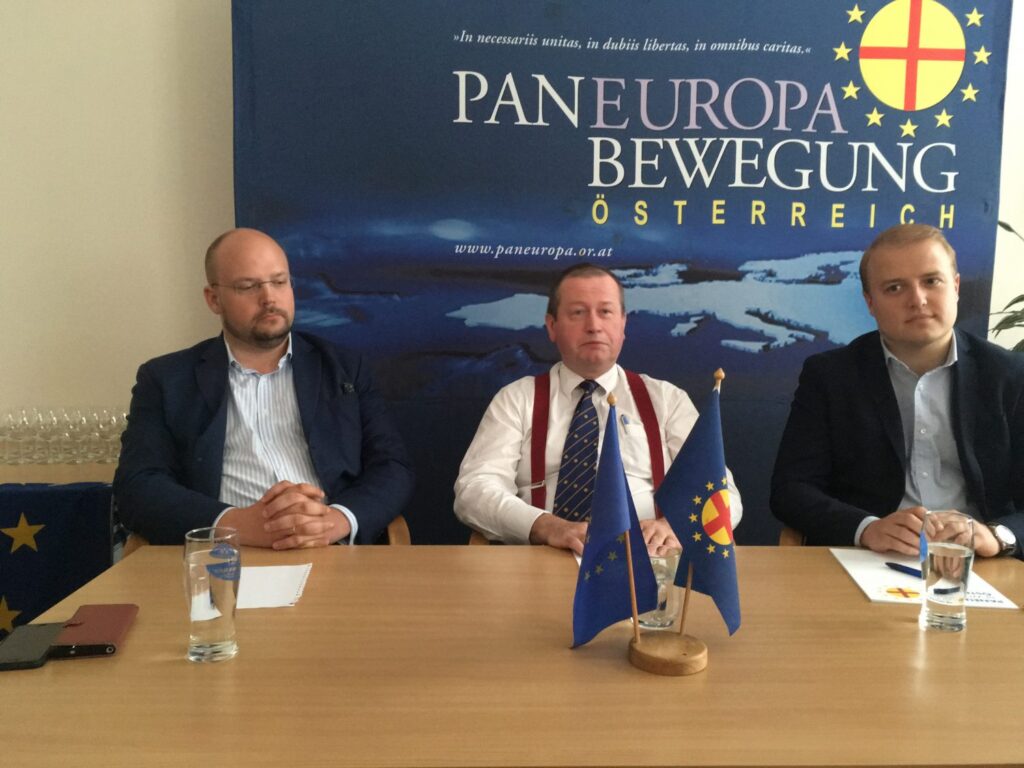
Philipp Jauernik, Federal Chairman of Paneuropa Youth, and Stefan Haböck, International Officer on the Presidium of the Paneuropa Movement Austria, discussed the European election and provided interesting insights. By Charles Steiner.
The European election has concluded – and the results are certainly worth considering: voter turnout significantly increased to over 60 per cent; while the two major factions lost overall, the Liberals gained, as did parties from the extreme spectrum – but not to the extent many feared and they had hoped. And the lead candidate model has failed. These are the central conclusions that can already be drawn about the ballot, explains Stefan Haböck, International Officer on the Presidium of the Paneuropa Movement, during the last Jour Fixe with Philipp Jauernik, President of Paneuropean Youth Austria, moderated by Secretary-General Rainhard Kloucek. However, the result as such is not unproblematic. Although the national factions – nomen est omen – are unable to cooperate and thus form alliances, the political landscape has shifted somewhat. In the allocation of top jobs, for instance, a dominance of Western European states over Central and South-Eastern European countries has emerged, with the latter playing hardly any role. Macron and Orbán swept away the lead candidate model with their blocking stance.
Jauernik explains that while the figures could certainly suggest an erosion in Europe’s party structure, he qualifies this. The result, he argues, reflects more a desire for renewal and reliability. He bases this on the results of the ÖVP candidates: Angelika Winzig scored well with a strong preferential vote result, and Othmar Karas even expanded his result. And, that domestic politics plays a strong role in voting behaviour in European politics, at least subconsciously. Nevertheless, the regional connection stands out, as could be inferred from Winzig’s result. Regarding the lead candidate model, Haböck added that it failed because party-political interests in some countries – France and Hungary – prevailed.
But has this strengthened the role of nation-states? Jauernik says no, not generally. In some countries, such as Austria, there was interference in the election campaign, with former Chancellor (still Chancellor at the time of the European election) Sebastian Kurz pre-empting several European policy issues; however, this was not the case in Germany, where Angela Merkel did not interfere at all. His conclusion: it is not the nation-states that have become stronger as a result, but the parties.
What does this mean? That remains to be seen. At the very least, the enlargement process is likely to continue to stall; further accession talks in the foreseeable future are rather unlikely for the South-Eastern European countries of North Macedonia and Albania, and even less so for Ukraine. However, this could quickly backfire, as these countries are slowly losing patience with numerous promises lacking concrete steps. Nevertheless, both discussants remain cautious – they say statements can only be made once the newly elected institutions have begun their work. In any case, it will remain exciting, both are sure.



