The future of South-East Europe as a moral yardstick for the EU
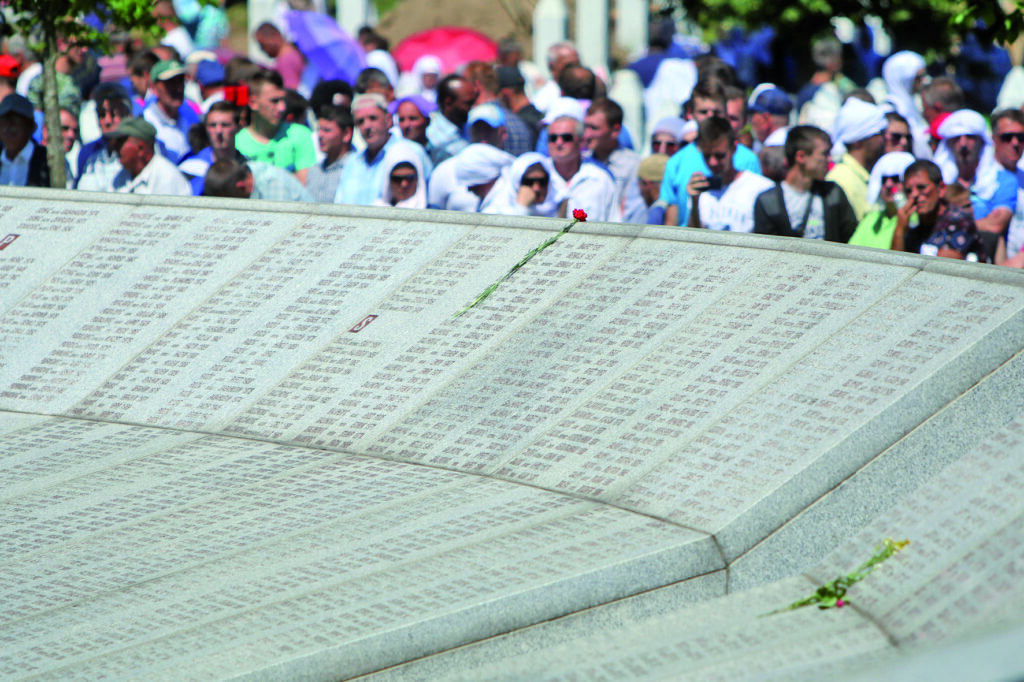
Twenty-four years ago, Srebrenica saw the worst war crime in Europe since the Second World War. The rest of Europe stood by and watched. Has the international community learned its lesson? By Philipp Jauernik, Chairman of the Paneuropa Youth Austria.
8.000. This is the figure commonly cited when Srebrenica is discussed. Srebrenica is a town in Bosnia and Herzegovina, near the border with Serbia. Due to the massacre that took place here 24 years ago, Srebrenica often stands as a proxy for all the atrocities that occurred in South-East Europe during the 1990s, during the wars that accompanied the final collapse of socialist Yugoslavia.
8.000. This is the approximate number of dead to be mourned in Srebrenica. They were almost exclusively men and boys, from the young to the old. All were members of the Bosniak ethnic group. They were executed within a few days. The United Nations has classified the actions of Ratko Mladić’s units as genocide.
Srebrenica was not the first massacre during the horrific European bloodshed of the 1990s. One by one, the constituent republics of Yugoslavia declared their independence and gradually reformed towards democracy. Resistance from Belgrade was at times extremely violent – and conditions, especially in Bosnia and Herzegovina and Kosovo, were often akin to civil war. The front lines ran not only between regular armies but also along irregular formations. Above all, however, they ran between neighbours and, in some cases, straight through families.
This is vividly illustrated in cities such as Sarajevo and Mostar, which were and remain multi-ethnic. Despite all efforts for peace and reconciliation, then and since, many wounds heal only slowly. Some never heal. Fathers, mothers, siblings, relatives, and acquaintances – there is likely no one in the entire region who does not have at least one death to mourn in their immediate circle.

The South-East European region, where six countries do not belong to the EU, is of strategic importance for Austria and Europe.
With the Kosovo War in 1999, the phase of major conflict was over for the time being, albeit with some aftershocks. Naturally, much has happened since then. The EU accessions of Slovenia and Croatia are particularly positive highlights. In these two countries, the transition succeeded. The citizens of Bosnia and Herzegovina, Kosovo, North Macedonia, Montenegro, and Serbia have been less fortunate. They are all in a waiting position regarding the future. They all orient themselves – some more strongly, some less so – towards the European Union. Where else? some might ask rhetorically. But this question falls short, very short. Even if they seem unlikely at first glance: alternatives do exist. And they should not please us.
What happens in South-East Europe also affects us in Austria
Ultimately, one thing is clear: South-East Europe is not far away. It is on our doorstep. Sarajevo is just over 600 kilometres from Vienna, no further away than Stuttgart and only slightly further than Bregenz or Berlin, but 400 kilometres closer than Brussels. Even the seemingly distant Kosovar capital, Pristina, is closer to the Austrian capital than the Belgian one.
What happens in South-East Europe affects us in Austria; it affects us in the whole of Europe. Others know this too. While in the past it was primarily Russia and Turkey that sought to be strong players in the region, in the recent past it has increasingly been China. And the US presence remains strong, often stronger than that of the rest of Europe. And here lies the rub. Can it really be in the strategic interest of the EU and its member states to leave this nearby region to the influence of other global powers? Would it not be far wiser to be the most important partner for European states ourselves?
Austria’s foreign policy has traditionally taken a very far-sighted position here, positioning itself as a helper and supporter of South-East Europeans. Names like Alois Mock, Wolfgang Petritsch, and Erhard Busek carry a very good reputation in Croatia, Bosnia and Herzegovina, and Kosovo for good reason. At the recent Europaforum Wachau, North Macedonia’s Prime Minister Zoran Zaev mentioned another Austrian, Johannes Hahn, who as EU Commissioner has rendered invaluable service to the region – not least with his masterful mediation in settling the decades-old naming dispute between the former Yugoslav republic and EU member Greece.
Unfortunately, other EU states are not yet there. While the European Parliament has for years repeatedly called for the abolition of visas for citizens of Kosovo, a few states are still blocking the solution at the Council level. Kosovars are thus the only people on the entire continent who still cannot travel freely. The EU presented Kosovo with an extensive catalogue of criteria to achieve visa liberalisation. The country has met all criteria, the EU Commission has confirmed their fulfilment, and the security situation has been verified. The promise was made: if Kosovo meets the criteria, visa-free travel will follow. That promise was not kept. This is detrimental to the credibility of EU states. Nor should the geostrategic aspect be forgotten: it would be downright negligent to leave a vacuum for other international actors to exploit whose values do not align with our own.
Real EU offer to South-East European states needed
One of the current problems is that French President Emmanuel Macron’s plans, for instance for a separate Eurozone budget, were rejected by a majority of EU states. However, he has made his consent to EU enlargement directly contingent upon their implementation. Whether such an important geopolitical decision should be allowed to fail due to what are ultimately domestic political desires is something everyone must judge for themselves.
Reconciliation is necessary and is a command not just of the hour, but of our time. It is urgently necessary for EU states to jointly make a genuine offer to the six states of South-East Europe and to support them much more actively than before in reaching out to one another. Europe cannot afford to further frustrate the reform-oriented, pro-European population in the Balkans through blockades. As Commissioner Hahn rightly put it at the Europaforum Wachau: “The EU must export stability instead of importing instability.” In this respect, the EU integration of the Western Balkans is an investment in our own security and stability. Europe watched the bloodshed of the 1990s far too passively. It is a historical obligation to be more active today.
This article originally appeared as a guest commentary in the Wiener Zeitung.



