The Kuril Islands: A Blackmail Ploy?
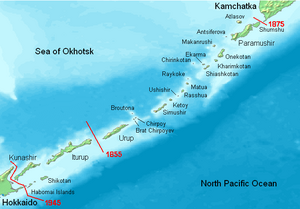
For some time now, the debate surrounding the status of the Kuril Islands has been a recurring theme in the media, particularly concerning talks between Russia and Japan. These are a group of islands north of the Japanese island of Hokkaido, which were occupied by the Soviet Union at the end of the Second World War and never returned to Japan. The Soviet, and later Russian, side consistently stressed that they would be returned following an official peace treaty, yet this peace treaty has still not materialised. A commentary by Karl von Habsburg.
The Japanese side has repeatedly asserted its claim to the foreign-occupied islands of the Habomai Archipelago, Shikotan, Etorofu, and Kunashiri. The inhabitants of these islands belong to the Ainu group, most of whom live in Japan on Hokkaido. The nearest Russian-occupied islands are very close to the Japanese mainland, less than 10 kilometres away. During the Cold War, this led to both the islands and the northern coast of Hokkaido becoming one of the most heavily militarised zones in the world.
Today, Russia is striking a more conciliatory tone, speaking of a possible return of the islands to Japanese control, should a peace treaty be concluded. However, observers familiar with the matter assume that the peace treaty is not the real object of negotiations, as it would merely reaffirm the status quo in relations between Russia and Japan. Instead, there are persistent rumours that Russia has made an ‘immoral offer’ to Japan: the islands would be returned if Japan recognised Russia’s annexation of Crimea. These rumours are further fuelled by Russia’s repeated insistence that any return could only occur after a referendum by the inhabitants of the Kuril Islands. From our experience in Crimea, we know how Russia exploits rather flimsy votes to consolidate its political position. The principle seems to be: if the inhabitants of the Kurils vote in a referendum to return to Japan (which they undoubtedly will – just imagine the offer: either live in First World Japan or remain the last island of Russia’s Sakhalin Oblast), then Russia’s claim to Crimea must also be supported. Of course, this is yet another instance of comparing apples and oranges. Japan’s claim to the Southern Kurils was not even disputed by Moscow, whereas the annexation of Crimea involved the military alteration (by ‘little green men’) of a sovereign border of a neighbouring country, a border that Russia itself had guaranteed.
We can only hope that Japan resists this offer and adheres to international norms and agreements, however tempting the Russian proposal may be. Shinzo Abe is undoubtedly in an uncomfortable predicament.
This article originally appeared on Karl von Habsburg‘s website.
Feature image c Wikipedia



