The Lure of Power
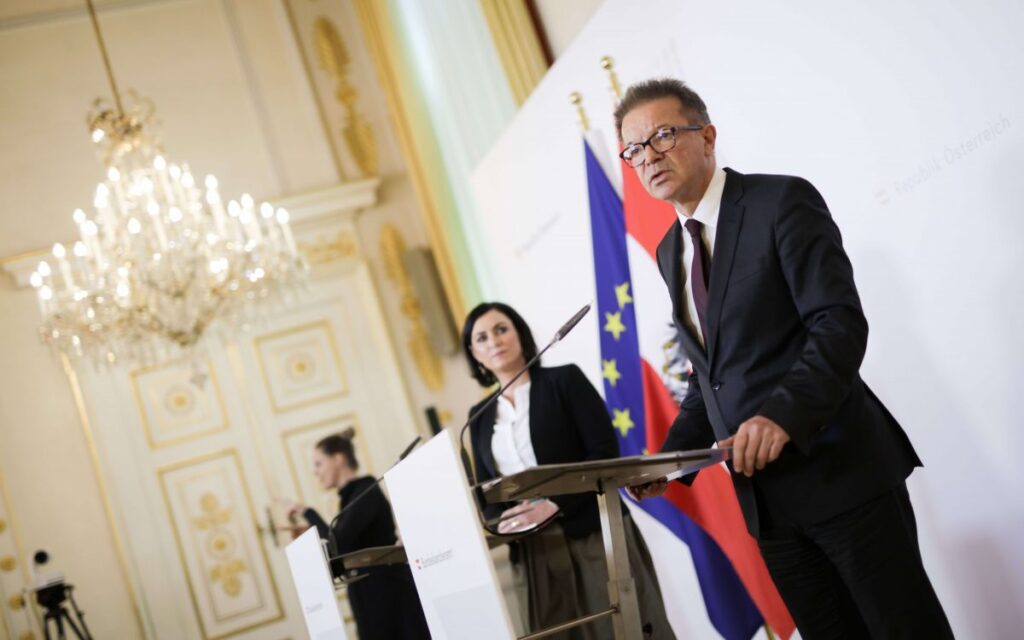
Almost unnoticed by the public, Health Minister Anschober hinted in an interview that, after the coronavirus crisis, he intends to shape climate policy with similarly harsh and restrictive measures. A dangerous proposition, states Rainhard Kloucek, Secretary-General of the Paneuropean Movement Austria.
Exceptional times demand exceptional measures. A pandemic, such as that caused by the coronavirus, is one such exceptional time. People know this. Therefore, they acknowledge the restrictive measures taken by the governments (and parliaments) of states, and usually adhere to them. Indeed, they even accept that opposition parties allow a united front with ruling parties to contain the pandemic with these restrictions and ultimately – so the hope goes – to defeat it.
The responsible citizen is always aware that the restrictions imposed are, in themselves, a sign of a restrictive regime (the term dictatorship is deliberately not yet used here). Curfews, movement profiles via mobile phone data, the closure of shops and restaurants, and thus the highly probable ruin of many businesses, increased unemployment, and a massively rising national debt which subsequently leads to higher tax burdens and further restrictions on freedom, are accepted because health and survival hold a higher value for people. It is similar to security. If the lions escape from the circus, one will gladly forgo a walk, because a hungry lion poses a greater threat than the restriction of freedom.
However, anyone who fundamentally surrenders freedom for the sake of security will ultimately have neither. A crucial aspect for the acceptance of these restrictions is therefore their temporary nature. They have a foreseeable end. Of course, there are also people who fundamentally dream of a dictatorship. But we assume that this is a small minority.
Restrictions Must Be Temporary
And because restrictions have (or must have) an expiry date, they are not applicable to other problem solutions. Or are they? At least Health Minister Rudolf Anschober, who appears quite friendly at his press conferences, seems to have further plans here. In the Ö1 Mittagsjournal on 14th March 2020, he said (when asked why climate protection does not involve such drastic measures as in combating the virus): “It is truly remarkable that a community has been created and exists in the shortest possible time, which is now working together on implementation. And that we have initiated things which probably everyone a week ago would have said were impossible in Austria. We will need this mindset for climate protection, for the biggest global crisis we face. I consider this a learning process, and I look forward to tackling the climate crisis with similar political resolve once we have successfully overcome the coronavirus crisis.” (Quoted in Addendum.)
The Green Minister openly expresses a desire for a restrictive regime to achieve political goals. It is astonishing that the Health Minister’s announcement has provoked hardly any reaction. Imagine if Herbert Kickl of the FPÖ had said that, or even Hungarian Prime Minister Viktor Orbán. A storm of indignation over such dictatorial intentions would have swept across Europe. With a Green politician, it is merely noted. One could cynically remark: what else should we expect from this party, it is known for not caring about the personal freedom of citizens. At least Andreas Unterberger has made Anschober’s dangerous threat the subject of his commentaries.
Now, it is undoubtedly true that the given restrictions lead to a reduction in CO2 emissions, making it easier for governments to achieve their so-called climate targets. However, Anschober’s statement completely ignores one point, which is already becoming noticeable in the coronavirus crisis: the economic downturn. Some dreamers naturally believe that we simply need to become more modest. But this is not about becoming more modest; it is about a relapse into massive poverty. Just three weeks of coronavirus measures have led to the shutdown of entire economic sectors. For a foreseeable period, support measures can help, even if the decline in economic output is already worrying.
However, if such drastic measures were to continue (as Anschober apparently envisages), a gigantic wave of insolvencies and mass unemployment would be the consequence. But the unemployed no longer pay taxes, nor do bankrupt businesses. A lack of tax revenue makes it impossible for the state to maintain the standard of living through redistribution. National debt is already a massive problem, which would then be even worse. And the ECB cannot endlessly print money to maintain such an illusion of prosperity (without CO2 emissions).
We are not even talking about the effects in other countries yet. Just consider the current oil price, which has fallen to a level that is a loss-making business for most oil producers. What happens to and within economies that are essentially dependent on oil revenues, such as Russia or Saudi Arabia? Stability in these countries will not improve as a result.
Prosperity Ensures a High-Level Healthcare System
A flourishing, division-of-labour economy is the foundation of our prosperity. This prosperity, in turn, is the foundation for a high-level healthcare system. Without this prosperity, we could not afford it. A high-level healthcare system is a prerequisite for us to be able to manage a pandemic like the current one. Without this prosperity, people would die even with restrictive measures, because the healthcare system would be unable to treat them.
Now, a Green politician might, out of ideological blindness, advocate for the destruction of prosperity. However, a Health Minister should be aware of the connection between prosperity and a high-level healthcare system.
Featured image: Health Minister Anschober with Minister Elisabeth Köstinger at a press conference. Copyright: BKA / Andy Wenzel



