The Message of the Pan-European Picnic
While the message of the Pan-European Picnic in 1989 was clearly the overcoming of the Iron Curtain, today it is: Freedom for Ukraine!
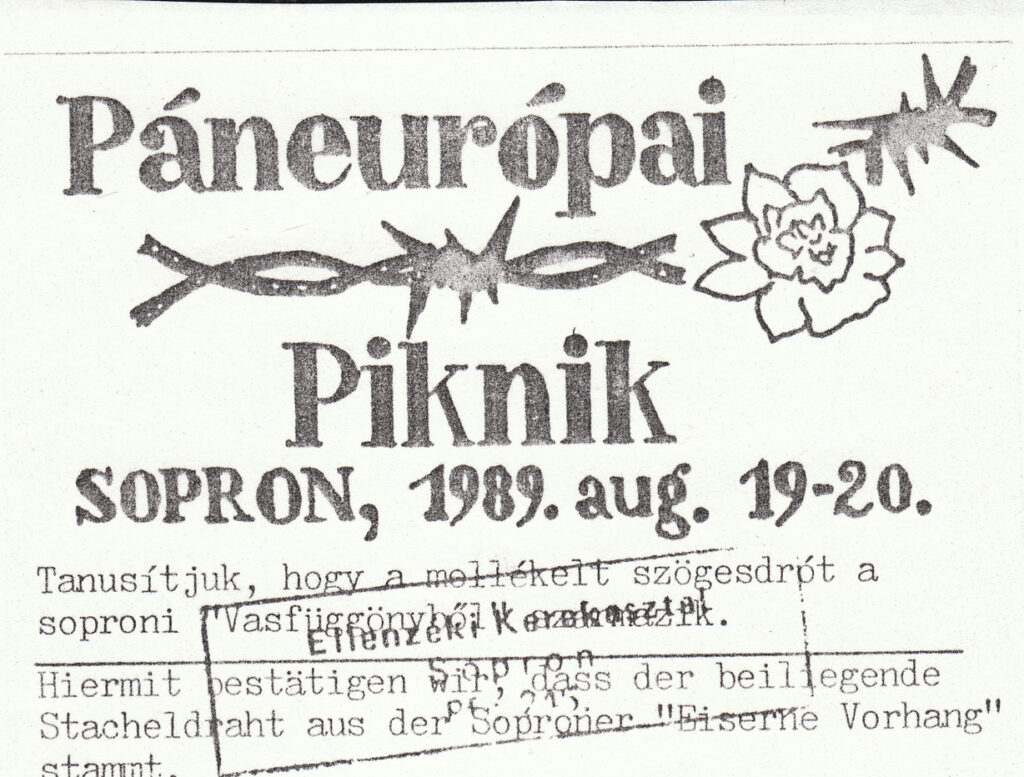
On 19 August 1989, the ‘Pan-European Picnic’ took place on the Austro-Hungarian border. The Iron Curtain had already begun to show gaps because Hungary had started dismantling the broken border security installations. Alois Mock and Gyula Horn had already jointly cut through a section of the Iron Curtain on 27 June 1989.
The idea behind the ‘Pan-European Picnic’ was to open the border for a short time so that Austrian guests could easily attend the picnic on the Hungarian side. A picnic, quite simply. Yet the picnic turned into a historic event. For weeks, citizens of the so-called GDR had been waiting in refugee camps in Hungary for a chance to reach the West. The ‘Pan-European Picnic’ provided that opportunity. 661 Germans were able to flee to freedom. And even though the border was closed once more, the hole in the Iron Curtain was too large to be sealed again. This was followed in September by Hungary opening its borders, in November by the fall of the Berlin Wall, and ultimately by the end of the division of Europe. The path to genuine European unification was also clear for the peoples of Central and Eastern Europe.
What had begun peacefully, however, led to the bloody wars of conquest by Slobodan Milošević in Yugoslavia. The Soviet Union was dissolved, but almost two decades later, the Russian despot Vladimir Putin began to implement his dream of restoring the Soviet Union with wars against Georgia (2008) and Ukraine (2014). Europe’s reaction was weaker than in 1989, which encouraged Putin to expand the war against Ukraine into a war of annihilation in 2022.
If the message of the Pan-European Picnic in 1989 was ‘dismantle it and take it with you’—a clear call to tear down the Iron Curtain—then 33 years later, this message must clearly mean: full support for Ukraine to push back the Russian invasion. Slava Ukraini.



