The Perception of War
More than one thousand days ago (this article was originally written for the print edition of the magazine Paneuropa in December 2024), Russia began its invasion of annihilation against Ukraine. The war had already begun in 2014 with the invasion of Crimea and eastern Ukraine. Distorted narratives still shape public discourse about this war of aggression. It is time to question the convenient myths. By Anna Pattermann
19 November marked 1,000 days since the start of the full-scale Russian invasion of Ukraine. The 1,000th day is a symbolic date – an opportunity for reflection. But the question arises: is this reflection actually taking place? The answer often remains unaddressed.
19 November is a day of reflection, but also a day of contradictions. The official Instagram page of the Austrian Federal President Alexander Van der Bellen stated: “1,000 days since Russia’s invasion of Ukraine. […] Putin knows no mercy.” For us Ukrainians, however, the war did not begin in February 2022, but with the Russian annexation of Crimea on 20 February 2014 – a response to the democratic, pro-Western Maidan movement and the Revolution of Dignity. On this symbolic day, there have therefore been 3,924 days of Russian aggression.
This discrepancy in perception shows a fundamental difference between Ukrainian and Western societies. Where does this difference come from? Two thoughts come to mind: on the one hand, we seem trapped in a fog of partial truths that makes it difficult for us to see the full reality. On the other hand, it demonstrates the disturbing efficiency of Russian propaganda, which skilfully manipulates narratives and directs public focus.
Questioning convenient myths
The 1,000th day is an opportunity to critically question the “convenient myths” that we maintain in Austria and the West. A particularly widespread myth is the idea that all of this is “only Putin’s fault”.
The illusion of Putin’s guilt
This narrative reduces the complexity of the Russian state apparatus to a single person and ignores the systemic dimension of Russian aggression. Many people seem to hope that the war will end as soon as Putin is no longer in power. But that is a dangerous misconception.
As the Austrian expert on disinformation Dietmar Pichler emphasises, Russian propaganda would not be so effective without the support of the broad Russian population. Focusing on Putin alone ignores the accomplices within the Russian elites and the active role of Russian society.
An authoritarian system like Russia’s is a complex structure, comparable to a Lego set: every part – whether it be the Ministry of Defence, Foreign Affairs, or Education – has a specific function, but all work together towards a primary goal: oppression, destruction, and the weakening of democratic values.
The danger of a distorted narrative
The idea that everything depends on Putin leads not only to a trivialisation of the systemic nature of the Russian state apparatus, but also to an ignorance of the long-term consequences. As long as the power structures and the authoritarian system of Russia remain untouched, the threat to democratic states will persist.
Democracy: Our Security
I understand that many people in Austria and elsewhere are simply looking for peace and quiet. But from my experience, I know: democracy is our security.
When I recently visited the liberated areas of Kherson, I spoke with many brave people. When asked what the Russian occupation meant to them, I often received the same answer: fear. Fear of arbitrariness, repression, and violence.
In democracies, our security is based on our values: the rule of law, human dignity, and freedom. These values are anchored in our laws and protect us.
In authoritarian systems like Russia, however, such values are irrelevant. There, all institutions – from schools and media to kindergartens – work towards creating a parallel reality in which war is presented as justified and oppression becomes the norm.
Ideological wars and values
We are not only in a military conflict but also in an ideological war. The cooperation between authoritarian regimes such as Russia, North Korea, and Iran, and the apparent support from China, shows how dangerous this ideological struggle is. In these systems, the population is conditioned to despise Western values such as human dignity or freedom and instead accept a system of control and oppression.
Rediscovering our values
This leads to a central question: do we in Western democracies have a sufficient awareness of our own values? In an ideological war, it is crucial to understand what we are fighting for. Without this awareness, we risk losing our strength and unity.
I feel that we are often so caught up in our daily lives that we hardly find time to pause and reflect: who are we? What are our values? Democracy often seems self-evident to us, as something that will always be there. But this self-evidence carries risks. It tempts us to look for simple solutions in difficult times without grasping the complexity of the situation. In doing so, we forget that simple solutions can often have a high price.
This is my greatest concern: that we only regret once we have lost something. But it does not have to come to that. I hope that everyone who reads this article starts to think and addresses these topics in their own circles. Only through dialogue and awareness can we put the importance of our values back at the centre and protect our democracies.
The 1,000th day of the full-scale Russian invasion is more than just a symbolic date – it is a touchstone for Ukraine, for Europe, and for the entire free world. It calls on us to pause and ask ourselves the decisive questions: what does democracy mean to us? Which values are worth defending? And how can we, each and every one of us, actively contribute to this protection?
War of narratives, ideologies, and identities
This war is not just a conflict of weapons, but also a war of narratives, ideologies, and identities. In authoritarian systems like Russia, the population is raised to despise freedom and human dignity. Propaganda replaces facts, and reality is twisted to secure power and control. But what happens here in the West? Have we perhaps become too accustomed to taking democracy for granted?
The truth is uncomfortable: democracy is not a given. It is an achievement that must be defended and filled with life anew every day. Like a delicate plant, it needs care, mindfulness, and the commitment of all who benefit from its strength.
It is said that those who sleep in a democracy wake up in a dictatorship. It is up to us to break through this complacency, to question myths, and to take responsibility – as individuals and as a community. We must not wait for others to act or hope that things will resolve themselves. Because they do not. Reflection on our values, the willingness to face challenges, and the courage to stand up for freedom and dignity are the strongest tools we have.
Ukraine is not only fighting for its survival, but also for ideals that connect us all. The 1,000th day reminds us that our freedom, our security, and our democracy are inseparably linked. The strength of a free world lies in its unity, its awareness, and its determination to stand up for what is right.
Responsibility and clear positions
This day must not only be a moment of remembrance. It should inspire us to take responsibility in our daily lives: through conversations, through actions, through a clear position. Democracy begins with each of us. May these 1,000 days be a wake-up call to defend not only Ukraine but also the values that sustain us all.
Together we can create a future in which freedom, justice, and human dignity are not the exception, but the rule.
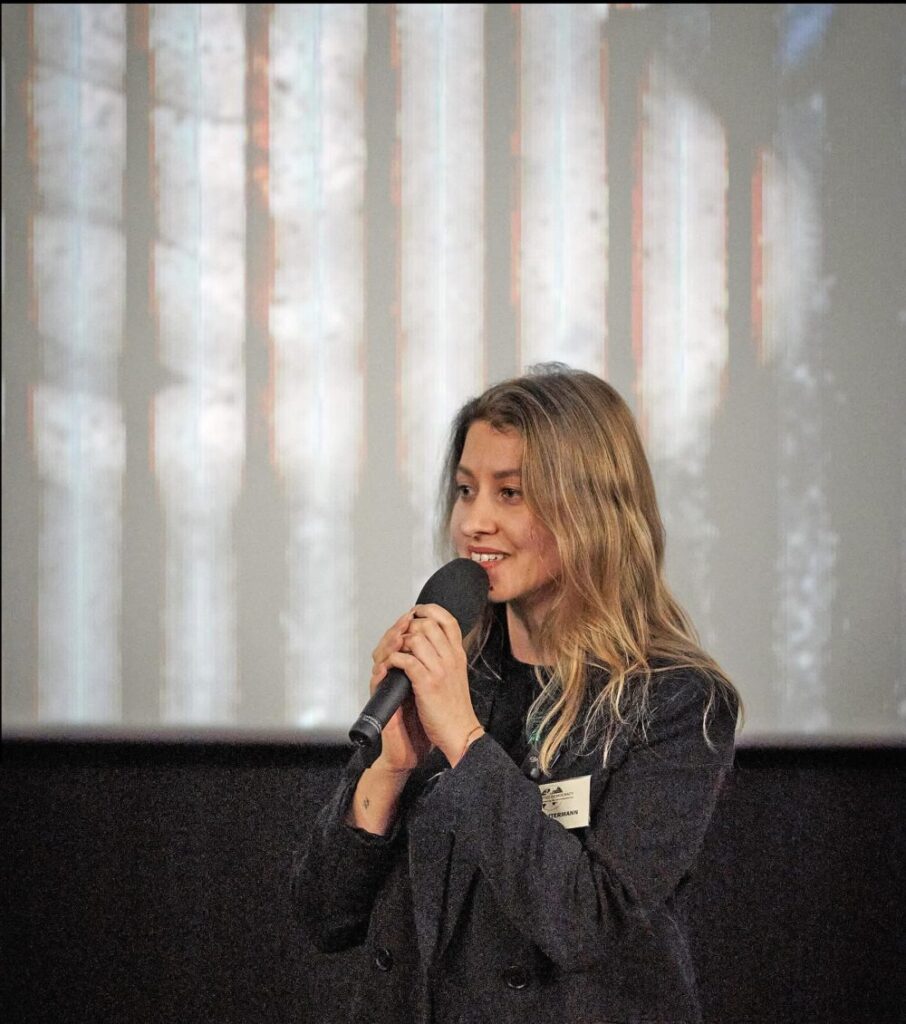
Anna Pattermann is the chairwoman of Unlimited Democracy. The featured image shows her at the presentation of the film “Bucha”. The film tells the story of the occupation of Bucha, a suburb of Kyiv, through the eyes of a volunteer in Ukraine. Photo copyright: Valeria Maltseva.



