This is not a peace plan
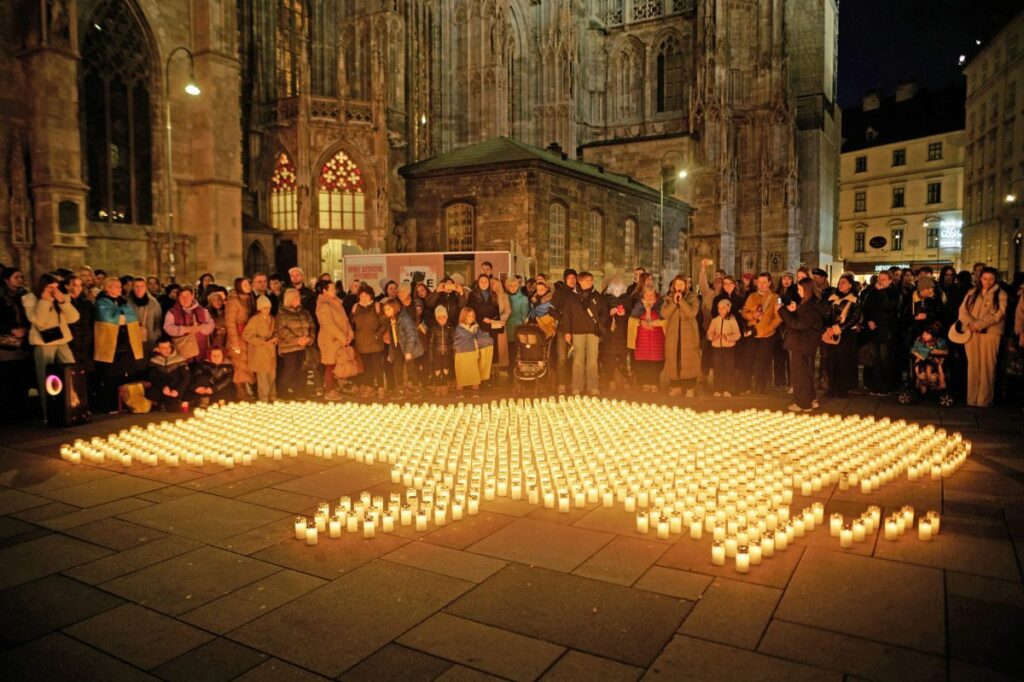
The peace plan for Ukraine that isn’t one. Some comments on the 28 points of the alleged US peace plan for Ukraine. Commented on by Rainhard Kloucek
- Ukraine’s sovereignty is confirmed.
Ukraine’s sovereignty was already confirmed by the dissolution of the USSR at the end of 1991 and by various other treaties such as the Budapest Memorandum, which was also signed by Moscow. However, Moscow has not adhered to any of these treaties.
- A comprehensive non-aggression agreement is concluded between Russia, Ukraine, and Europe. All ambiguities of the past 30 years are considered settled.
The prohibition of wars of aggression is already anchored in the UN Charter. Are there international treaties that stand above the UN Charter? What is the point of an agreement that merely repeats what is already international law?
- It is expected that Russia will not attack neighbouring countries and that NATO will not expand further.
By signing the UN Charter, Moscow has already confirmed that it will not wage wars of aggression. Moscow has not adhered to any such treaty.
- A dialogue between Russia and NATO is conducted under US mediation to resolve all security issues and create conditions for de-escalation, to ensure global security, and to improve opportunities for cooperation and future economic development.
A Russia-NATO dialogue already existed. Specifically, before Moscow’s military aggression against its neighbouring countries. It no longer has any meaning because Moscow’s imperialism has destroyed it. Based on what facts should a new dialogue now bring more success?
- Ukraine receives reliable security guarantees.
Exciting. But which ones?
- The size of the Ukrainian armed forces is limited to 600,000 soldiers.
So the victim of the war is supposed to give up its ability to defend itself?
- Ukraine agrees to enshrine in its constitution that it will not join NATO, and NATO agrees to state in its statutes that Ukraine will not be admitted in the future.
It is NATO’s right to refuse a country’s accession. However, dictating to a country that its freedom to choose alliances is to be restricted, and that this must be enshrined in its constitution, contradicts all existing international treaties that guarantee the freedom of a sovereign state to choose its alliances. This point is a clear contradiction of Point 1.
- NATO commits to not stationing troops in Ukraine.
That is NATO’s right. However, why NATO should accept this point is unclear.
- European fighter jets will be stationed in Poland.
Agreed.
- 10. US Guarantee
– The USA receives compensation for its guarantee.
– If Ukraine attacks Russia, it loses the guarantee.
– If Russia attacks Ukraine, in addition to a decisive, coordinated military response, all global sanctions will be fully reintroduced; the recognition of the new territory and all other benefits of this agreement will be revoked.
– If Ukraine launches a missile attack on Moscow or St Petersburg without provocation, the security guarantee becomes invalid.
Does the USA see itself as the sole guarantor power? What is the decisive military response? Everything in this point is very vague.
- 11. Ukraine is eligible for EU membership and receives short-term preferential access to the European market while this issue is being reviewed.
Ukraine has candidate status, which makes it clear that it has the right to EU accession. The point regarding preferential access to the European market is interesting because the USA’s best allies in Europe, namely Hungary and Poland, are vehemently opposed to opening the agricultural market. So, what is the purpose of this point from the US perspective?
- 12. A comprehensive global package of measures for the reconstruction of Ukraine, including but not limited to:
a. Creation of a Ukraine Development Fund to invest in fast-growing industries such as technology, data centres, and artificial intelligence.
b. The USA works with Ukraine to jointly rebuild, develop, modernise, and operate the Ukrainian gas infrastructure — including pipelines and storage.
c. Joint efforts to restore war-affected areas for the renovation, reconstruction, and modernisation of cities and residential areas.
d. Infrastructure development.
e. Mining of minerals and natural resources.
f. The World Bank develops a special financing package to accelerate these measures.
No problem.
- 13. Russia is reintegrated into the global economy:
a. The lifting of sanctions will be discussed and agreed upon gradually and on a case-by-case basis.
b. The USA enters into a long-term economic cooperation agreement covering joint development in energy, natural resources, infrastructure, artificial intelligence, data centres, rare earth mining projects in the Arctic, and other mutually beneficial business opportunities.
c. Russia is invited to rejoin the G8.
Wonderful. Moscow is rewarded for its war of annihilation, and the UN Charter is declared meaningless by all forces supporting this point.
- 14. The frozen funds will be used as follows: USD 100 billion of frozen Russian assets will be invested in US-led reconstruction and investment measures in Ukraine. The USA receives 50% of the profits from this project. Europe adds another USD 100 billion to increase the available investment volume for Ukraine. The remainder of the frozen Russian funds will be placed in a separate US-Russian investment vehicle that implements joint projects in specific areas. The fund is intended to strengthen relations and increase common interests to create a strong incentive against a resurgence of the conflict.
This is about the business interests of some US companies. It has nothing to do with the Western community of values. Europe cannot put up with this.
- 15. A joint American-Russian working group on security issues will be established to promote and monitor compliance with all provisions of this agreement.
Do Washington and Moscow really think they can divide the world between them in terms of security policy? This is too reminiscent of the great power politics of bygone times.
- 16. Russia will enshrine its non-aggression policy towards Europe and Ukraine in law.
Russia has already enshrined so much in law. Anyone who seriously studies Moscow’s politics knows that Moscow does not feel bound by treaties. History shows this.
- 17. The USA and Russia agree to an extension of the treaties on the non-proliferation and control of nuclear weapons, including the START I agreement.
Okay.
- 18. Ukraine agrees to be a non-nuclear state in accordance with the Treaty on the Non-Proliferation of Nuclear Weapons.
This was already agreed upon by the Budapest Memorandum, which was broken by Moscow.
- 19. The Zaporizhzhia nuclear power plant will be put into operation under the supervision of the IAEA, and the electricity generated will be split equally between Russia and Ukraine — 50:50.
Resuming the operation of the nuclear power plant under IAEA supervision makes sense. But why should Russia get half of the electricity produced?
- 20. Both countries commit to implementing educational programmes in schools and society to promote understanding and tolerance of different cultures and to eliminate racism and prejudice:
a. Ukraine adopts EU rules on religious tolerance and the protection of linguistic minorities.
b. Both countries agree to abolish all discriminatory measures and guarantee the rights of Ukrainian and Russian media and education.
c. Any form of National Socialist ideology and activities must be rejected and prohibited.
Ukraine is already obliged by the EU accession talks to comply with all EU standards, and thus international agreements. This includes the provisions on National Socialist re-engagement. Moscow has considerably more room for improvement here. Russia should also be obliged to accept European standards for the protection of ethnic groups and minorities (even if there is no reason to assume that such an obligation would have any relevance for Moscow).
- 21. Territories:
a. Crimea, Luhansk, and Donetsk are recognised de facto as Russian, including by the USA.
b. The line of contact at Kherson and Zaporizhzhia is frozen, which de facto means recognition along this line.
c. Russia gives up further agreed territories outside the five regions it currently controls.
d. Ukrainian armed forces withdraw from the part of the Donetsk Oblast they currently control. This withdrawal zone is considered a neutralised, demilitarised buffer zone and is internationally recognised as territory belonging to the Russian Federation. Russian forces will not enter this zone.
This contradicts paragraph 1.
- 22. Following agreement on future territorial arrangements, both the Russian Federation and Ukraine commit not to change them by force. Security guarantees do not apply in the event of a breach of this commitment.
Sounds like a capitulation by the USA and the international community, who are thereby accepting that wars of aggression pay off. In Beijing, they are probably already rejoicing in view of the intention to conquer Taiwan.
- 23. Russia will not prevent Ukraine from using the Dnipro for commercial activities, and agreements will be made for the free transport of grain across the Black Sea.
- 24.
Sounds nice, but how is it supposed to work? Blowing up the dam was already prohibited, but that did not stop Moscow from doing it. How is such an agreement on the use of the Dnipro to be secured? As far as the Black Sea is concerned: Odesa already has the right of access to international waters in compliance with all international treaties. If Russia has not adhered to existing law so far, why should it do so now? The question also arises as to where the other Black Sea coastal states stand on this point.
- 25. A humanitarian committee will be established to clarify outstanding issues:
a. All remaining prisoners and bodies will be exchanged on an ‘all for all’ basis.
b. All civilian prisoners and hostages, including children, will be repatriated.
c. A family reunification programme will be implemented.
d. Measures will be taken to alleviate the suffering of the victims of the conflict.
Sounds plausible.
- 26. Ukraine will hold elections within 100 days.
The deadline is short. From when should it apply? Who guarantees that Moscow will not interfere?
- 27. All parties involved in this conflict receive full amnesty for their actions during the war and commit to making no future claims or filing complaints.
This point contradicts all international agreements against war crimes. Moscow’s gang of murderers is thus granted immunity. This puts the self-image of the free West to rest. Crime pays (again).
- 28. This agreement is legally binding. Its implementation will be monitored and guaranteed by the Peace Council chaired by President Donald J. Trump. Sanctions will be imposed in the event of violations.
An agreement is only meaningful if it is legally binding. What is a Peace Council chaired by President Trump supposed to be? That sounds like vanity.
- 29. As soon as all parties agree to this memorandum, the ceasefire takes effect immediately after both sides have withdrawn to the agreed positions to begin implementation of the agreement.
Which is unlikely to happen.
This peace plan has nothing to do with peace. Moscow is rewarded for its attack, the USA wants to extract financial sweeteners, and Europe, including Ukraine, is expected to pay. Even if there are improvements (which are already being discussed), this is not a reasonable basis for negotiations. Europe must finally grow up. An independent Ukraine is in Europe’s interest. Europe’s foreign and security policy dimension must be strengthened; the transatlantic partnership can only function on an equal footing.
Source for the ‘peace plan’: https://www.diepresse.com/20328280/trumps-28-punkte-plan-fuer-die-ukraine-im-wortlaut?brid=VBiR3JXKdaFp-LuF7ybXCQ



