Unholy Alliance
Protectionists of all stripes, from Greens to nationalists, from communists to Catholics, are forming an unholy alliance against a trade agreement with the Mercosur countries. Their claims are populist. By Rainhard Kloucek
Austria exports goods worth just over one billion euros a year to the Mercosur states and imports goods worth less than half a billion euros from these countries. A good deal, which can now be further improved for both sides through a trade agreement between the European Union and the Mercosur countries (Argentina, Brazil, Paraguay, Uruguay, and Venezuela; Venezuela’s membership is suspended). Currently, a series of relatively high import duties (protective tariffs) still hinder the free exchange of goods. Protective tariffs always obstruct trade because they make products artificially more expensive. Free trade always brings gains in prosperity because it increases the number of traded products and lowers prices. Ultimately, 100 per cent of the population benefits because 100 per cent of the population are consumers.
But in Brazil and other Latin American countries, the rainforest is burning. Slash-and-burn is an ancient method of land acquisition for agriculture in the region, but it is also a method of agriculture itself. Just as in Africa, where even larger forest areas than in South America are on fire, though this is currently hardly mentioned. In Brazil in particular, the combination of fires in the rainforest and President Bolsonaro—who is regarded as right-wing and therefore represents a bogeyman for many—is a welcome opportunity to establish a direct link between these two events and the trade agreement: the rainforest is burning, Bolsonaro is to blame, and the trade agreement is therefore bad and also responsible for the fires. Such is the simple conclusion, which cannot actually be explained factually but resonates populistically and helps in soliciting donations.
The fact that slash-and-burn has existed before, even without a Mercosur agreement, is ignored. Also ignored is the fact that the agreement includes provisions for rainforest protection, climate protection, and quality assurance for agricultural products. Without this agreement, these obligations for the Mercosur countries would not exist.
Agriculture is the second populist pretext against the agreement. Here, the interests of various left-wing parties and pseudo-moral corporations (such as Greenpeace and WWF) merge with protectionist approaches from all shades of the agricultural lobby (among the Blues and Blacks) and Catholic organisations. One Farmers’ Federation MEP spoke of ‘junk meat’ with which we would then be flooded. The population must be protected from the import of poor quality and the farmers must be saved. Arguments to substantiate these claims are not provided.
The fact that there are no arguments does not stop the populists from beating the drum with these slogans. After all, it is an election campaign, and such simple formulations can be used to whip up sentiment for one’s own cause. The fact that this implies Austrian farmers produce such poor quality that they must fear allegedly poor (or perhaps good?) quality from South America is suppressed, as is the insinuation that voting citizens are not mature enough to make their own consumption decisions.
By the way: Austria’s farmers also export goods worth more than eleven billion euros per year. Protective tariffs harm them just as much as they harm industry.
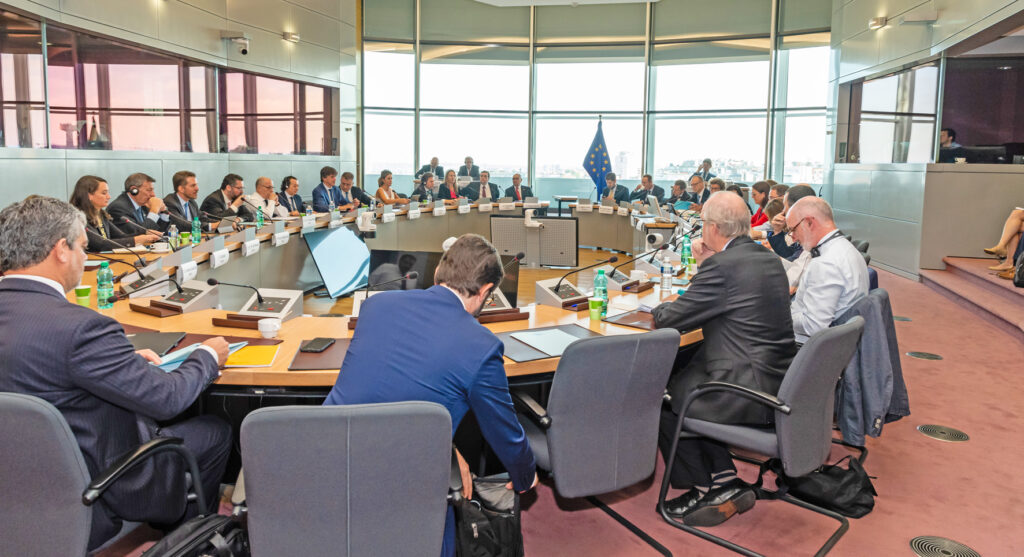
Featured image: © European Union 2019; The European Commission negotiated the agreement with the Mercosur countries on behalf of the EU states.



