Where is China Growing?
I do not usually believe in megatrends, as their long-term nature means they are usually overtaken by reality. In the case of China, however, I am making an exception, as development over recent years has been quite stable and the political rulers have ensured that their economic planning is not influenced by “disruptive factors”, such as democratic elections. Thus, the de facto ruler Xi Jinping has obtained permission from the not exactly overly democratic People’s Congress to continue governing practically without restriction, no longer hindered by a reduction in the number of re-elections. We can therefore expect that Xi, who is currently 65 years old, will still be exercising his function in 2035 – in the prime of his life by Chinese standards. A commentary by Karl von Habsburg.
But what does the megatrend say? In China, economic growth will continue until around 2050; only then will it reach its peak. By then, however, the entire economy will have doubled compared to today. China is already the world’s largest production site and has been the largest consumer since 2018. It is also already a leader in the field of mobile payments. By 2039, China aims to be the most technologically advanced country and have roughly double the economic power of the United States. China ensures more than 50% of world production for 125 of the world’s most widely used products.
Based on these megatrends, however, the Chinese leadership is making some bolder statements: for economic reasons, they expect reunification with Taiwan by 2025, and a return of the 82-year-old Dalai Lama to Lhasa within the next five years.
It is also interesting to note what is missing from the megatrend: for example, an outlook on how the conflict in the South China Sea around the Spratly and Paracel Islands will continue. Here, the Chinese position is unyielding when questioned. These islands were internationally granted to them after the Second World War, once the Japanese occupation was over. Yet it is precisely here that a point of conflict could arise, upending the finest planning for the coming decades. Most coastal states of the South China Sea, such as the Philippines and Vietnam, but also the United States, maintain that the islands in question are not islands at all, as they are mostly underwater. They argue it is merely a Chinese claim to expanded territorial waters, and thus a massive expansion of their 200-mile exclusive economic zone. Furthermore, it would bring some of the most important shipping trade routes under its control.
However, when it comes to restricting trade routes, the fun stops for the Americans. The USA is dependent on trade via maritime traffic, as its main markets are located across an ocean. For China, this is only partially true, as it is currently putting great effort into a modern rail link with Europe, which could naturally also serve large parts of Central Asia and Russia. And here lies a huge potential for conflict. History has shown us time and again that when there is a dominant power and it is suddenly challenged by a rising new power, this leads in most cases to a military confrontation. It is no different in politics than in business or on the playground.
What China does differently from the other great powers, the USA and Russia, despite all its expansionist policies, is that it does not export “values”. The West exports democracy as an all-saving grace, if necessary with fire and sword, and Russia exports a clearly totalitarian worldview. China wants to be economically dominant, but does not immediately act to transform society in third countries.
China also has a special relationship with democracy and human rights. If you talk to a Chinese politician about this topic, you get an interesting answer. Reference is always made to the interplay between efficiency and democracy. If democracy makes things inefficient, then it must give way to efficiency; otherwise, it is acceptable. One receives the same answer when asking about human rights.
In the conflict between China and the United States, one is repeatedly reminded of the dispute between figure skaters Tonya Harding and Nancy Kerrigan. It is not yet clear which of the two countries is taking on the role of Harding or Kerrigan. Ultimately, both lost.
The coming years will show whether China continues its current rapid development or whether some unforeseen conflicts derail the megatrend.
The article originally appeared on the site of Karl von Habsburg.
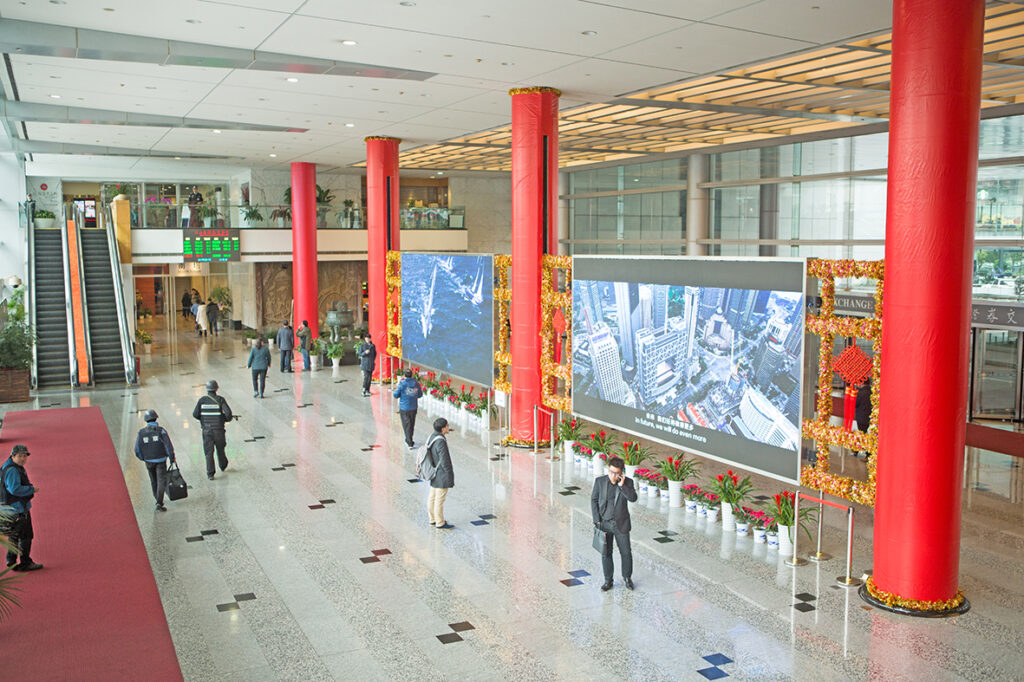
The image shows the Shanghai Stock Exchange, © European Union 2017.



