Why do we not understand Eastern Europe?
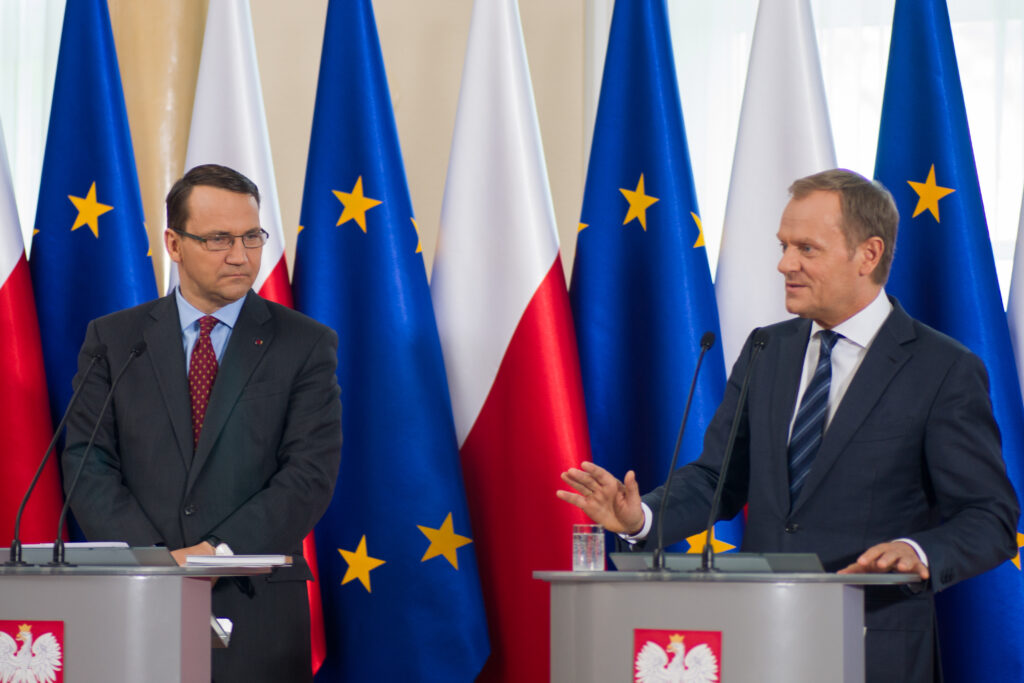
How historical amnesia clouds our view of the real needs of our Eastern European neighbours – and why our priorities are misplaced. A commentary by Stefan Haböck, International Secretary of the Paneuropa Movement Austria.
Every day, one can read plenty about the embarrassments of the US President. Some of it is politics, some just gossip. So far, so familiar. We have already grown accustomed to Trump being the biggest media star at the moment. And he is not the only one.
Plenty of Washington, hardly any Moscow, nothing from Sofia
Every day, one hears more “news” about him, his family, his advisors, or some local politicians in Illinois speaking out against Trump, than all serious EU reporting combined. Recently, the orf.at homepage featured seven reports under “International” – five of which were about the USA and Trump.
Paneuropa has criticised on previous occasions that Eastern and South-Eastern Europe are virtually non-existent in domestic reporting. If elections take place (for example in the EU member state Bulgaria), they are dismissed with a brief news snippet. Background information, analysis, or anything similar – nowhere to be found. Of course, the USA has a global political significance that can be topped by hardly any other state. Whether that justifies constant reporting on purely internal American affairs is another matter.
It cannot be down to the size and importance of the country alone. For Russia, too – a nuclear power with around 170 million inhabitants and an exclave in Europe – is de facto non-existent in daily reporting.
Domestic news from the largest country on earth? Nowhere to be found. Who is President Putin’s spokesperson? Nobody knows him. The funnier presidential spokesperson was, after all, the one in Washington. How is the Russian Federation actually structured? 20% of the population is Muslim – in the country that is often seen as the salvation of the Christian West? What influence does a Kadyrov have? Who knows. What we do know is what Hollywood actors think about the US President. Relevance for Europe? How on earth are we supposed to understand countries about which we learn absolutely nothing.
Do we understand the East at all?
“Russia-understander” – a word mostly used for domestic propagandists of the government there. This completely subverts the meaning behind “understanding Russia”. Because, of course, in order to see and analyse current political situations and future developments, one must understand the respective country, its people, traditions, and concerns, whether one shares them or not. This is called geostrategy. Analysing the situation and deriving strategies from it. Something Europe has forgotten – but which the world’s great powers implement and enforce ruthlessly day after day.
Much of the lack of understanding and missing reporting certainly stems from an actual failure to understand – namely, ignorance of the language, the script, and everyday culture. Sure, with primary school English, one can certainly follow President Trump. Anyone who grew up with The Simpsons knows the satire of the political system inside out. US health insurance? Europe can weigh in on that.
But the issue goes deeper. It is a fundamental failure to understand Eastern Europe. The concerns, hopes, and history of the peoples there.
The unholy pact – a recurring trauma
24 August marked the 78th anniversary of an event that was partly responsible for the brutal conflagration known as the Second World War. And it remains deeply embedded in the DNA of our neighbours in Eastern Europe to this day.
On 24 August 1939, the German Foreign Minister von Ribbentrop and the Soviet People’s Commissar Molotov (in the presence of the tyrant Stalin) signed the “German-Soviet Non-Aggression Pact” – known as the Molotov-Ribbentrop Pact or simply the Hitler-Stalin Pact. On 1 September, the Wehrmacht invaded Poland. A short time later, the Red Army arrived.
The repeated occupation of Poland by the great powers surrounding it. We should understand why Poles and Balts flinch when various politicians speak once again of Germany and Russia being “natural neighbours”.
Nobody would dream of suggesting that countries of the former Danube Monarchy should have to ask Vienna for permission for anything. Yet for the former countries of the Soviet Union, this is taken for granted. Why? Nationalists and many socialists, and unfortunately even some conservatives and liberals, deny Eastern European peoples their freedom and self-determination. Moscow must be consulted. A country in Eastern Europe cannot be independent for long enough for “us” to finally grant it full sovereignty.
A conflict in Europe is brewing
The European Union is seething. After the “North-South conflict” over financial aid for Greece moved somewhat out of focus and was replaced by the refugee debate, a West-East conflict is currently underway that should not be underestimated.
Eastern Europe is a term often used for the countries that were located east of the Iron Curtain. This term, which for me carries no negative connotation, shall be used here as well, even though Prague is not actually east of Vienna.
One does not even need to descend into daily politics and the outbursts of individual semi-authoritarian national politicians who have chosen Brussels as their target. This target is gladly used by almost all national politicians, whether from the East or the West.
In “East” and “West”, the lack of understanding for one another is growing
While Western European states complain about a lack of solidarity from Eastern European EU partners, especially regarding the distribution of refugees, mistrust towards Western EU members is rising in Eastern Europe. The conflict manifests itself in the dissenting votes and the planned lawsuit by four member states regarding refugee distribution quotas and the issue of “inferior food quality for Eastern countries”.
For many, the Eastern European peoples are still considered backward, not “ready for Western
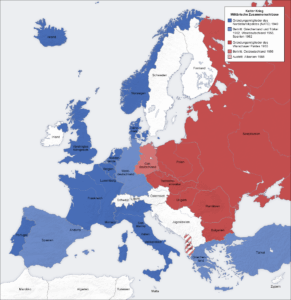
The Iron Curtain divided Europe for decades. To this day, it continues to exert an unconscious influence in many minds.
Source: own map, based on Generic Mapping Tools and ETOPO2,
Author: San Jose, 7 October 2006
democracy”. This thesis is supposedly proven by pointing to dubious, nationalist governments. The “East-bashing” following the Bundestag elections speaks for itself. And it ignores the fact that in wealthy, Bavarian Ingolstadt (unemployment 2.3%), the AfD achieved between 13% (first votes) and 15% (second votes).
And yes, in Romania, a clique around the socialist leader Dragnea pulls the strings, and in Poland, a nationalist government is pursuing Poland’s exit from the Western rule of law.
What does this prove? Nothing. In Greece, a communist-nationalist government is in power; in Germany, successors of the SED regime head federal states. Marine Le Pen did not become President, but around 41% voted in the first round for the far-right Front National or the far-left candidate Mélenchon.
In Great Britain, UKIP flickered about, and a democratically legitimised parliamentary majority led the country into Brexit chaos. No one would suggest that the French, British, or Germans were unready for democracy.
Transition countries need support, not censure
Yes, some countries in Eastern Europe have problems. And? They are transition countries. Some more so, some less. While the Czech Republic shows economic growth, low unemployment figures, and a budget surplus, a government in Romania is attempting to relax anti-corruption laws – to protect their party cronies. It is inherent to transition countries that challenges exist, especially in the areas of the rule of law and corruption. Here, neither wagging fingers nor threats help – only clear support for all those fighting against corruption and the decay of the rule of law.
Every year, Romanians take to the streets. Most recently against the socialists Ponta and Grindeanu (this should be mentioned, as Eastern Europe is usually only associated with right-wing nationalist governments here).
The desire for freedom, dignity, and independence
It is around 26 years since these countries cast off the burden of real socialism. Every one of these countries was ruined after decades of socialism. The economy lay in tatters. Corruption characterised public institutions. Who could be trusted after decades of informant networks and government thugs like the Securitate and others?
And yet, the people behind the Iron Curtain fought – for freedom. The irrepressible desire to no longer be vassals or subjects of autocrats.
And every time the desire for freedom grew stronger, the rulers sent in tanks. Vilnius Bloody Sunday. Prague Spring. To name just two examples.
Thousands of people died for freedom. And ultimately, they triumphed. The fall of the Berlin Wall, the cutting of the fence to Hungary, the overthrow of the Ceaușescus.
The freedom these peoples achieved around 1990 is not always fully granted to them. The right of peoples to self-determination? It only applies until these peoples want to join NATO voluntarily. Naturally, Austria is allowed to rail against a food regulation it helped pass – but for an Eastern European government, which imposes extremely tough reform requirements on its citizens, to hold a different opinion on refugee distribution, that is deemed unsolidary.
Security – a fundamental need strongly present in politics
Perhaps we in the “West” are not sufficiently aware that many – one should never generalise – people in Eastern Europe have different acute needs than in the rest of Europe. Anti-corruption is a daily topic, especially in Romania, which the population courageously confronts.
Building a capable (welfare) state is also an issue in countries where the average pension is €90,
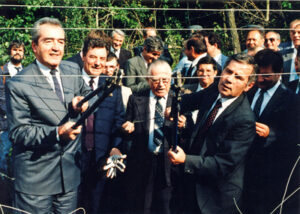
Alois Mock: One of the last top politicians west of the Iron Curtain who was (rightly) credited with a deeper understanding of Eastern Europe.
Source: http://www.alois-mock-europastiftung.at/
likewise a topic. Enforcing the rule of law in countries where judges from the communist era are still active. And not to forget: the social system. It is clear that governments of states where the average salary is around €200–€300 say they cannot overburden their own social system.
And then there is the issue of security – the need that, due to many experiences, ranks highest in Eastern Europe. And this is far too little respected in Austria, the country that has shirked every security policy positioning by hiding behind neutrality and being surrounded by NATO states.
The constant talk of “legitimate spheres of interest” – all this sets off alarm bells in the Baltics and Eastern Europe. And while the whole world looks at Trump’s escapades (distractions?), Eastern Europeans feel threatened in their freedom and independence once again.
Foreign rule. Partition. Pawn of the great powers – fear is fed by history
On 24 August 1939, Hitler’s fascist National Socialist regime and Stalin’s communist regime signed the “German-Soviet Non-Aggression Pact”. This pact regulated everything that today reminds the countries of Eastern Europe of their darkest times. Described as “neutrality” and the “recovery of lost territories”, the two most brutal systems of rule Europe has ever experienced divided up land and people. Poland, the Baltics, Ukraine, Belarus – pawns of the great powers.
Incidentally: “neutrality” and “recovery” – both words are often heard today in connection with the annexation of Crimea. Why the history of Crimea is started precisely with the rule of the Tsarist Empire and not with Ottoman rule will probably remain an eternal mystery. The fact that the expulsion and murder of the Crimean Tatars hardly finds its way into political speeches is negligent.
Hundreds of millions of deaths later, the brave people in the divided, occupied, annexed, and plundered countries fought for their freedom – and their dignity. And they fought their way to Europe. Eastern Europe belongs to Europe, just like the West, North, and South.
If fundamental historical events such as the Molotov-Ribbentrop Pact receive no media attention today, the understanding of what the people in the East had to endure for decades may also be extinguished. When the economic miracle began in Germany, the tanks were rolling in the East.
Are our priorities in the political and media debate correctly ordered?
Perhaps we should all analyse our priorities again. 4,400 news reports on the “Molotov Ribbentrop Pact” on google.at (several of them from the Kremlin-funded station Sputnik) stand against nearly 7 million hits for “Scaramucci”. A man who held a position in a US government agency for exactly ten days.
No state within the EU has the right to wag a moral finger at others. And we certainly should not do so with countries that have risen from the ruins of socialism. Political differences of opinion will always exist – and yes, I too am massively concerned about the rule of law in some Eastern European countries.
Europe is the key to equal European countries
But: What Europe has managed to do is find a common framework in which to operate. Together, conditions are set in Brussels; together, there is a commitment to fundamental freedoms. In Brussels, de jure, Poland counts for as much as France, Hungary as much as Spain. Only when national arrogance comes into play does this balance falter.
That the European Convention on Human Rights, which guarantees dignity and rights to all, stands above all this is something we should consider with gratitude every single day.
Austria had the grace to be free after 1955. To have democratically and freely elected governments. Freedom of expression. The rule of law. Let us not point fingers at our friends who have only been allowed to enjoy these freedoms for a shorter time. Let us not wag our fingers. Instead, we should learn their history, which is always a shared history with us. Understand it. Get to know their needs. Go on holiday there. Sightseeing in Eastern European countries. Rediscover common roots. Learn the local languages. International understanding in practice.
Stefan Haböck is International Secretary of the Paneuropa Movement Austria.



