Macedonia has voted – the EU must now deliver on its promise
North Macedonia is clearly positioned as pro-European. The states of the European Union must finally keep their word to avoid further fuelling frustration in South-Eastern Europe. A commentary by Stefan Haböck, International Officer of the Paneuropa Movement Austria.
Stevo Pendarovski is the new President of the Republic of North Macedonia. In the second round, the candidate of the governing Social Democrats prevailed against the candidate of the opposition conservative VMRO, Gordana Siljanovska-Davkova, with around 52 per cent. Voter turnout was around 45% – and thus just above the 40% threshold for the validity of the ballot.
FYROM becomes North Macedonia
Pendarovski’s victory is not only a victory for the government of Prime Minister Zoran Zaev, but will now also seal the renaming of the state. The incumbent President Gjorge Ivanov, who is not allowed to run again after two terms, has so far refused to sign the law on renaming passed by parliament. He completely rejects the Prespa Agreement, which was negotiated between the Greek and Macedonian governments.
The new president will likely sign the law, and thus the “Former Yugoslav Republic of Macedonia” – the Paneuropa Movement has never used this name, consistently speaking of Macedonia instead – will become the “Republic of North Macedonia”.
The longing for identity cannot simply be brushed aside
As Paneuropa Austria, we have strongly criticised the decades of blackmail of this small country in South-Eastern Europe by its larger neighbour, Greece. An EU and NATO country that constantly places hurdles in its neighbour’s path can, at best, only be described as lacking in solidarity.
The Prespa Agreement, which was intended to settle the name dispute, was therefore a major step, and respect must be paid above all to Alexis Tsipras, who linked his political fate in Greece to the agreement. Negotiation is always better than confrontation.
However, one must understand the resentment of the Macedonian population. Identities are an essential part of a people’s history, and it must not be forgotten that both the former Soviet republics and the countries of the former Yugoslavia are still in a stage of transformation and self-discovery. This is a process that Western European states underwent in freedom after the Second World War.
The country needs tough reforms for the benefit of the population
For pragmatic reasons, however, blocking the agreement is not constructive. Macedonia’s population wants to join the EU and NATO. The agreement with Greece was therefore an absolute must for this path.
We emphasised this, among other places, here https://pan.thatscommunication.de/ein-kompromiss-macht-den-weg-frei-in-die-eu-alles-gut-oder/.
The country is still dominated by the massive rivalry between the governing Social Democrats and the conservative VMRO. It is a matter of allegations of corruption, threats, legal proceedings against politicians of the opposing party and, of course, the identity of the country, of which the name is a reflection.
Such processes are not unusual in countries in transition. The system of “real socialism” never allowed the structures of modern states to emerge. Distrust in state institutions, corruption, a partisan judiciary – all this must first be laboriously dismantled. Both parties are therefore called upon to massively intensify their efforts in these areas.
Above all, Prime Minister Zaev must deliver if he wants to lead his country towards the EU. The reservations in many states towards South-Eastern European countries are too great for their governments to afford to delay reforms for personal gain.
Unemployment is high, and trust in the rule of law is weakened. Young people are leaving the country.
But the EU states must also deliver
The stalling tactics of the international community towards the Balkan states must end. The fact that an EU state shields a convicted former politician from Macedonian justice (thereby signalling that party friendships count for more than the rule of law) was just another slap in the face for reform-oriented Macedonians.
Macedonia was granted accession status in 2005; in 2018, France and the Netherlands again blocked the start of negotiations. The “yellow vest” movement shows that these domestically motivated tactical games do not pay off. It exists in France despite the blockade of the Balkans.
The EU must now – 14 years after the promise – react and start the accession negotiations (promised for many years) with the country. If the EU states want to be credible in their South-Eastern Europe policy (“Western Balkans policy”), then the peaceful solution and Macedonia’s goodwill must also be honoured. What Europe cannot afford is a reform-oriented but frustrated pro-European population in the Balkans.
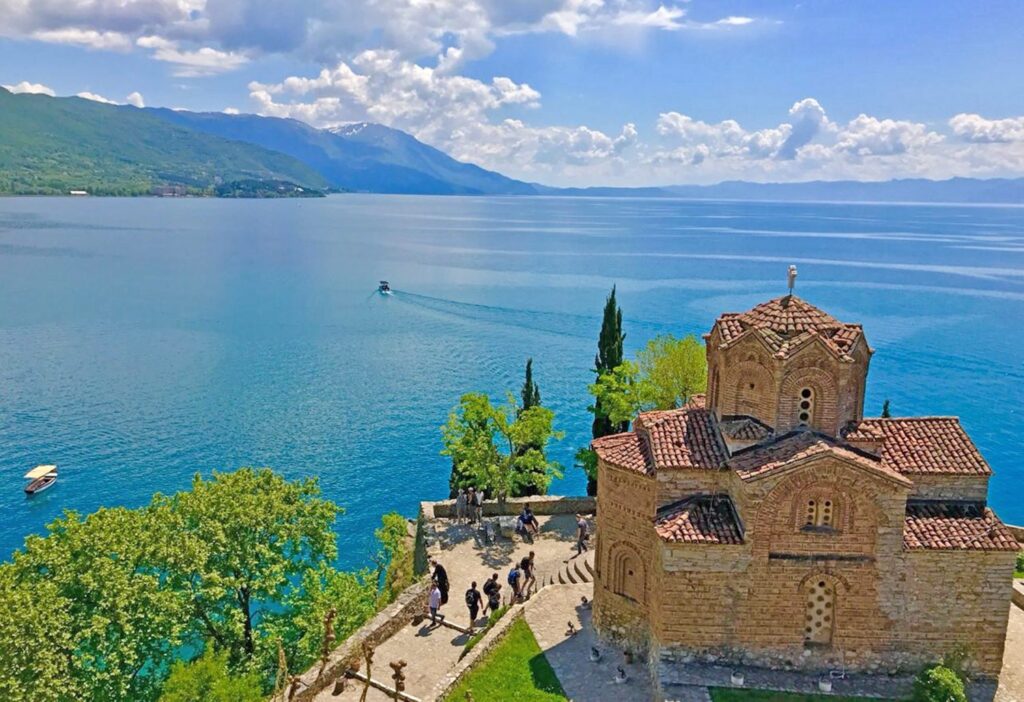
The featured image shows a view of Lake Ohrid on the border between Macedonia and Albania.



