A compromise paves the way to the EU. All good, then?
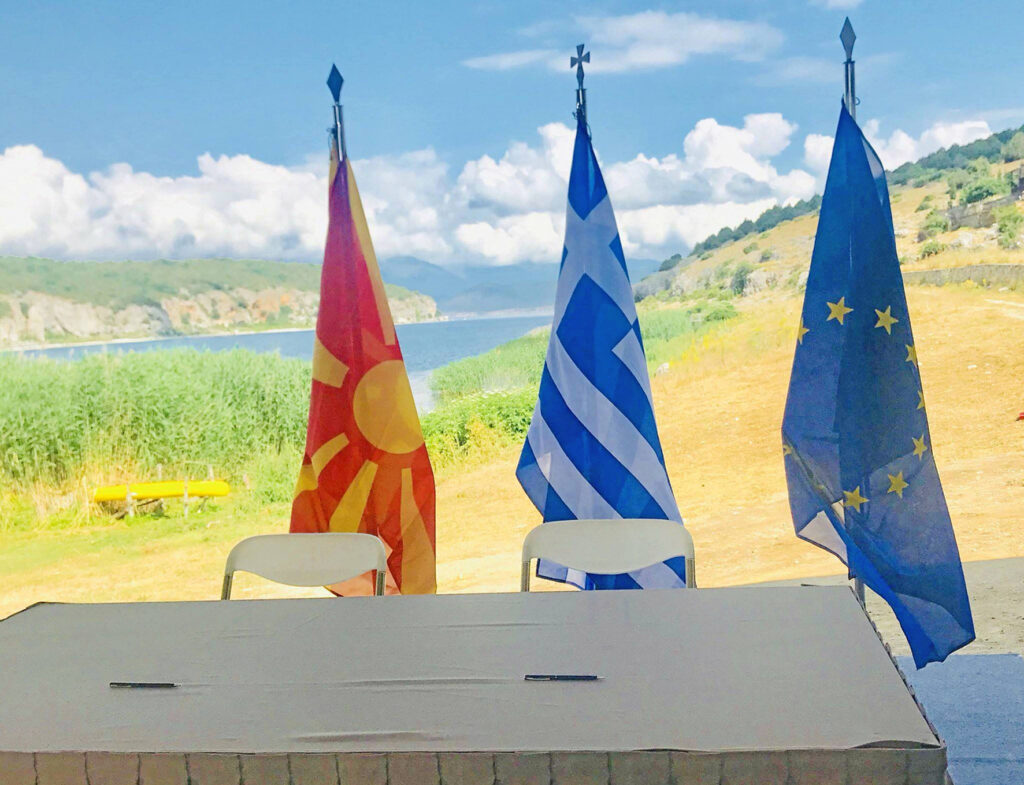
It is done – after almost a quarter-century of dispute over its name, Greece and Macedonia have reached an agreement. Macedonia, hitherto humiliatingly referred to as ‘FYROM’ in international jargon, is soon to be named ‘Republic of North Macedonia’. In return, Greece is clearing the way for the South-Eastern European country’s accession to NATO and the EU. It still seems we have not fully grasped what a historic step was taken at Lake Prespa. A happy ending, then? However, it is worth taking a look at the Macedonian side too. There, the constitution must be amended, and the people still need to be consulted. The agreement has been signed, but not yet implemented.
A commentary by Stefan Haböck, International Officer of the Paneuropa Movement Austria.
I have had the pleasure of visiting Macedonia twice this year. This South-Eastern European country, which was part of Yugoslavia and declared its independence in 1991, remains largely unknown to many in Austria. People are aware of the name dispute, but otherwise, little is known, unless one delves back to Alexander the Great.
Macedonia wants to join NATO and the EU – this common goal unites its politics
Macedonia, an EU candidate country since 2005, is a wonderfully scenic nation. As is the entire Balkans, for that matter. Politically and economically, it is a classic transition country. Like all regions of the world ruined by socialism, much had to be rebuilt in Macedonia. This takes time and requires calm, a cool head, and support. Political factions are divided by years of struggle. Yet, all are united in the conviction that the country’s positive development can only occur as a member of the European Union.
The Greek blockade also paralysed the country
It is clear that many reforms still need to be implemented here. Politicians must act. For 13 years now, citizens have been waiting for European states to support their country. But one must also be strict with Macedonian politicians: the implementation of reforms in the areas of the rule of law, the economy, or media freedom rests solely with them. The conflict with its neighbour overshadowed a sustainable reform agenda.
But: even if all criteria had been met, Macedonia could not have been admitted to the EU until today. Why? One EU state has been blocking it in the relevant committees from the very beginning. Greece. The reason seems trivial to us – yet it delves deep into the history of the Balkans and speaks of national pride, grievances, and at times, pure nationalism.
A name as a bone of contention – to whom does the historical region belong?
Macedonia refers to itself as the ‘Republic of Macedonia’. No problem, were it not for the region of Macedonia in Greece. And the historical ‘Macedonia’ of Alexander the Great. Recognition of the name ‘Republic of Macedonia’ would lead to territorial claims in Greece, so Greece asserted. Macedonia countered: the history of the country and the region dates back to Alexander the Great – today’s Macedonia is clearly the successor to the historical one. These statements were underpinned by the construction of colossal statues in Skopje. Alexander the Great, Philip II – some 26 metres high. One provocation from political leaders on both sides followed another.
Macedonia has experienced a chequered history – occupation by the Ottoman Empire, division between Serbia, Greece, and Albania, part of Yugoslavia. Such regions are always characterised by a search for identity and historical roots. The issue was further complicated by internal ethnic conflicts between Macedonians and ethnic Albanians, who make up over 25% of the population. Ethnic conflicts are always problematic; in the Balkans, they led to the most brutal wars of modern times.
When one is not allowed to call oneself ‘Macedonian’…
I understand the scepticism in Macedonia regarding the newly concluded agreement. One must remember what it does to a people whose independent country is blocked by its neighbour for around 25 years. A people not allowed to freely choose its name. And one that was on the verge of not being allowed to call its own language ‘Macedonian’ because the larger neighbour forbade it.
As Paneuropa, we sharply criticised Greece’s blockade.
The right to self-determination of peoples is an important principle that must also apply to Macedonia. We take the view that states in Europe should support each other in positive development, not block it. Nationalism is the greatest poison in Europe, as demonstrated by both World Wars and the campaigns of annihilation in the Balkans.
Europe means reconciliation. The Balkans offer an opportunity for this.
What we learned after the World Wars was reconciliation. Europe means reconciliation. I wrote this about Serbia and Kosovo back in 2017, paraphrasing the image of Helmut Kohl and François Mitterrand in Verdun. The conflict between Macedonia and Greece is also, in the long run, about reconciliation. Admittedly, both sides made mistakes. Injustice occurred.
A clear signal!
And here we come to the historic event that took place in mid-June at the aforementioned Lake Prespa. In the presence of EU Enlargement Commissioner Johannes Hahn and EU High Representative Federica Mogherini, Foreign Ministers Dimitrov and Kotzias signed the agreement negotiated by Prime Ministers Alexis Tsipras and Zoran Zaev. And this happened right in the Greek-Macedonian-Albanian border region. One can only imagine what Matthew Nimetz must have felt. The man who, for 24 years, negotiated as UN Special Envoy between the two countries to reach a solution in the name dispute.
Courage instead of nationalism, compromise instead of conflict
Personally, I have the utmost respect for both Prime Ministers for this agreement. Both have tied their political fate to it. The Greek Prime Minister narrowly survived a vote of no confidence in parliament only the day before the signing. A politician from the far-right ‘Golden Dawn’ called for the military to arrest the government. One must imagine the pressure at play here.
However, the decisive step for the agreement’s implementation is yet to come: in Macedonia, the constitution must be amended. A referendum is to be held in the autumn for this purpose. For weeks, parts of the opposition have been demonstrating against the outcome, as have some in Greece. This is a legitimate right in democracies and does not require further evaluation. An internal debate about the agreement must take place. The pros and cons must be named and weighed. This must be granted to a transition country; a democracy must develop and can never be imposed.
However, the riots by nationalists, some holding Russian flags, who are radically demonstrating against the agreement, must be clearly rejected.
As understandable as the uneasy feeling of many Macedonians may be – that they might only be seen as ‘second-class Macedonians’ by Greece and the European Union – one must clearly distance oneself from vulgar nationalism.
Essentially, the outcome can be viewed pragmatically. Greece, unfortunately, as a member of the EU and NATO, holds the stronger hand and could therefore block Macedonia for another 25 years. Which is why the agreement on ‘Republic of North Macedonia’ is a viable path, as long as people are allowed to call themselves ‘Macedonians’.
When travelling in the Balkans, one repeatedly experiences how absurd nationalism is. While politicians argue over which country has a longer history with a particular general, in the evenings, people naturally listen to Serbian music while eating Bulgarian salad, Turkish baklava, and Bosnian ćevapčići. Rakija is available in every country. And everyone between Zagreb and Istanbul truly loves ajvar.
What belongs together comes together: a peacefully united Europe, where regions trade with each other, artificially created borders are dismantled, and minorities in neighbouring countries are protected. Macedonia is a profoundly European country and should therefore become a member of the European Union as quickly as possible. Side by side with its Greek and Albanian neighbours.
If the signed agreement from Lake Prespa makes this possible, then it has our full approval.
Featured image: Michael Karnitschnig | Hahn’s Office



