Europe’s Youngest State
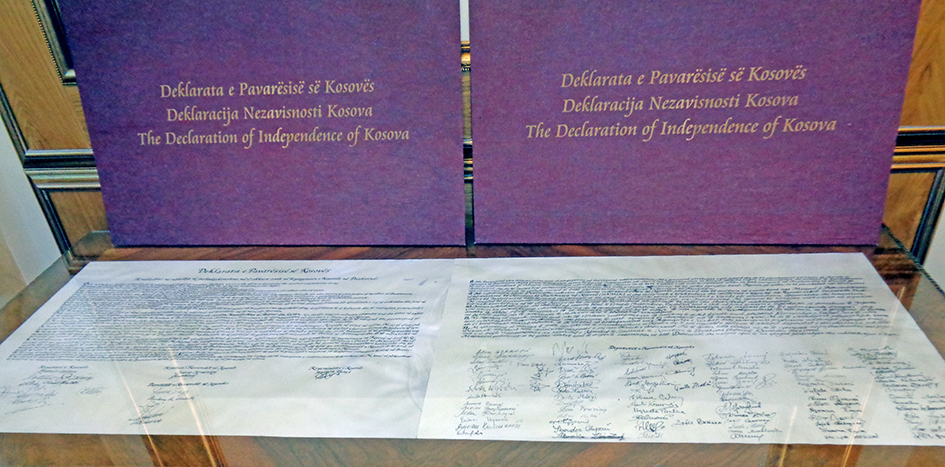
Ten years ago, on 17 February 2008, the Republic of Kosovo declared its independence. A commentary by Karl von Habsburg.
Describing the Republic of Kosovo as Europe’s youngest state is correct in two respects. Firstly, because the declaration of independence took place only ten years ago. Two years prior, in 2006, Montenegro had broken away from its state union with Serbia and declared its independence. Secondly, because the average age of the country’s population, at 28, is significantly lower than the average age in other European countries.
The declaration of independence was preceded by a brutal and bloody war, which began in Slovenia in 1991 following that country’s declaration of independence. Serbia was ruled by Slobodan Milosevic, an old communist who played the nationalist card to the hilt and ultimately lost everything in his attempt to keep Yugoslavia under Serbian rule. Kosovo was both the beginning and the end of his megalomania. On 28 June 1989, the 600th anniversary of the Battle of Kosovo, Milosevic delivered his famous speech at Kosovo Polje. This speech was the political preparation for the subsequent Yugoslav Wars, which are often misinterpreted as a civil war but were, in reality, nothing less than a nationalist war of conquest. Kosovo’s autonomy was revoked by the Milosevic government. Within Yugoslavia, it had guaranteed Kosovo the same rights as the constituent republics. Following the wars against Slovenia, Croatia, and Bosnia-Herzegovina, the Milosevic regime finally began the expulsion of the Albanian population from Kosovo. Only the intervention of the international community, under US military leadership, halted the attempted genocide. The Kosovo War ended in 1999. Initially, a UN administration was established for the country; it was not until 2008 that the logical consequence of this war followed: Kosovo’s declaration of independence.
Both the Paneuropean Union, under the leadership of my father Dr Otto von Habsburg, and Austria, under Foreign Minister Dr Alois Mock, had taken a clear stance from the outset in favour of the right to self-determination for the peoples of the Balkans. My father and Alois Mock shared a close political and personal bond with Kosovo’s founding president, Ibrahim Rugova. In 2004, President Rugova was awarded the Coudenhove-Kalergi Europe Prize. Alois Mock was then President of the Coudenhove-Kalergi European Society; my father, Otto von Habsburg, presented the award in Pristina.
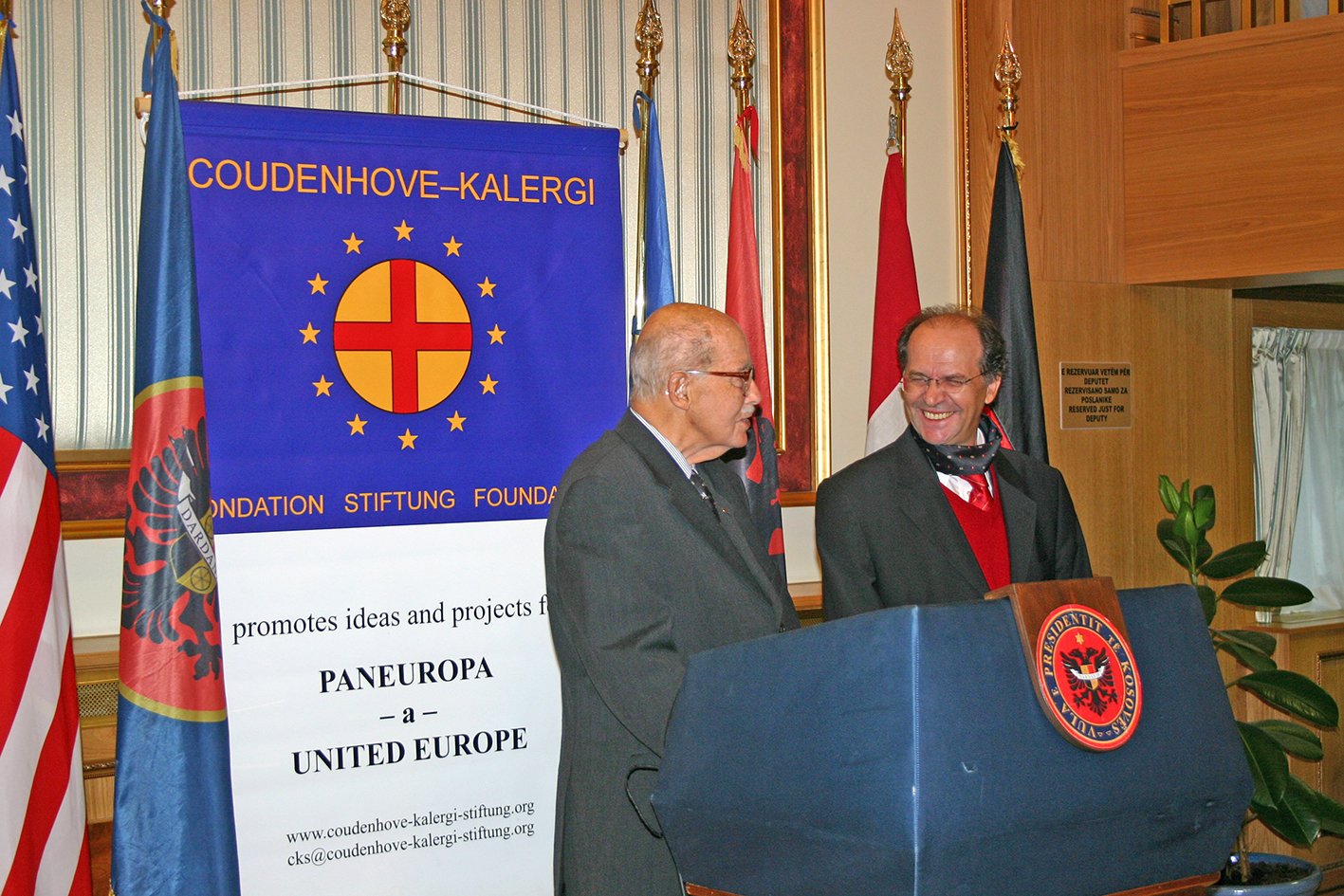
Presentation of the Coudenhove-Kalergi Europe Prize in 2004 to President Ibrahim Rugova (pictured with Dr Otto von Habsburg).
In the so-called “Western Balkans Strategy” (in EU jargon, Western Balkans refers to the six Southeast European countries: Albania, Bosnia-Herzegovina, Kosovo, Macedonia, Montenegro, and Serbia), which was presented just over a week ago, the European Union has once again opened the prospect of EU membership to these countries, as first promised in 2003.
Two facts distinguish the Republic of Kosovo from the other countries in the region. Citizens of Kosovo still require a visa to enter the EU. Significantly more criteria for compliance were imposed on Europe’s youngest state than on the other countries. The final criterion is now the ratification of the border agreement with Montenegro. Relations between the two countries are very good. To date, the signing has failed due to party-political disputes within Kosovo itself.
The second distinguishing factor is the fact that Kosovo is still not a member of the UN (Russia has consistently threatened to exercise its veto during Security Council review), and five EU states (Greece, Romania, Slovakia, Spain, and Cyprus) have also not yet recognised the country’s independence. The most common argument for this non-recognition is the fear of secessionist movements by ethnic groups within these countries. The case of Spain and Catalonia clearly demonstrates that such a policy towards the Republic of Kosovo cannot solve domestic problems. Furthermore, the situations of the minorities are not comparable. None of the aforementioned EU countries is conducting a campaign of annihilation against one of its ethnic groups.
Without doubt, the prospect of accession for the countries of Southeast Europe is a strategically vital option for Europe as a whole. Throughout history, including recent history, extra-European powers have repeatedly attempted to gain influence in the Balkans. All such influences have come at the expense of stability in the region and across Europe. Kosovo is particularly sensitive in this regard, as the Serbian constitution still defines the country as part of Serbia. Belgrade, too, will have to acknowledge the realities. The EU’s Western Balkans Strategy also states clearly that no country in the region, upon being admitted to the EU, may block the accession of another country.
From an Austrian perspective, the connection with the region is significant not only because of history. Many people from all the countries of Southeast Europe have migrated to present-day Austria. Economic ties are highly developed. The accession of these countries to the EU, and thus a further step towards stabilising the region, is therefore clearly in Austria’s interest. The current government will also be judged by its success in advancing the accession of Southeast European countries to the EU through a strategically oriented policy.
The article originally appeared on the website of Karl von Habsburg.



