EU Needs a Clear Strategy on China
Trump conducts foreign policy via Twitter, Russia establishes military facts in the Middle East, and China is rebuilding the Silk Road – where does Europe stand geopolitically? A commentary by Stefan Haböck.
On numerous occasions, we, the Paneuropa Movement Austria, have criticised the fact that there is relatively little to no in-depth reporting and debate on political developments in Eastern Europe or Russia, and that understanding of these regions is often lacking.
While interest in US politics is very high, clearly influenced by strong American pop culture and more easily understandable English, one region of the world completely passes us by: Asia.
As it would be presumptuous to refer to the enormous diversity of Asian states and peoples as ‘one region’, we will focus on the country that is arguably the most powerful player in terms of economic, foreign, and security policy: China.
China Wants to Take the World Stage
The People’s Republic of China – 1.4 billion people, authoritatively governed by the Communist Party and its General Secretary, President Xi Jinping.
China – a nuclear power, the world’s leading exporter, with annual economic growth of around 6–7 per cent. A country with a rich, turbulent, and long history, and ever-growing self-confidence.
This country is preparing to take its place on the world political stage. Since 2009, China has been the largest investor and trading partner for the African continent. In Europe, Africa only appears in connection with colonial history, poverty, refugee waves, and despots. For China, however, African states represent an opportunity for trade and political exchange.
Trade volume has now exceeded 300 billion dollars. China imports iron ore, coal, minerals, and other raw materials (for example, crude oil from Angola) and, in return, supplies machinery and consumer goods. Europe’s influence, apart from military cooperations such as France’s in Mali, is minimal. It is assumed that the coup in Zimbabwe was able to proceed so smoothly due to China’s tacit approval.
The New Silk Road – Economic or Hard-Nosed Power Politics?
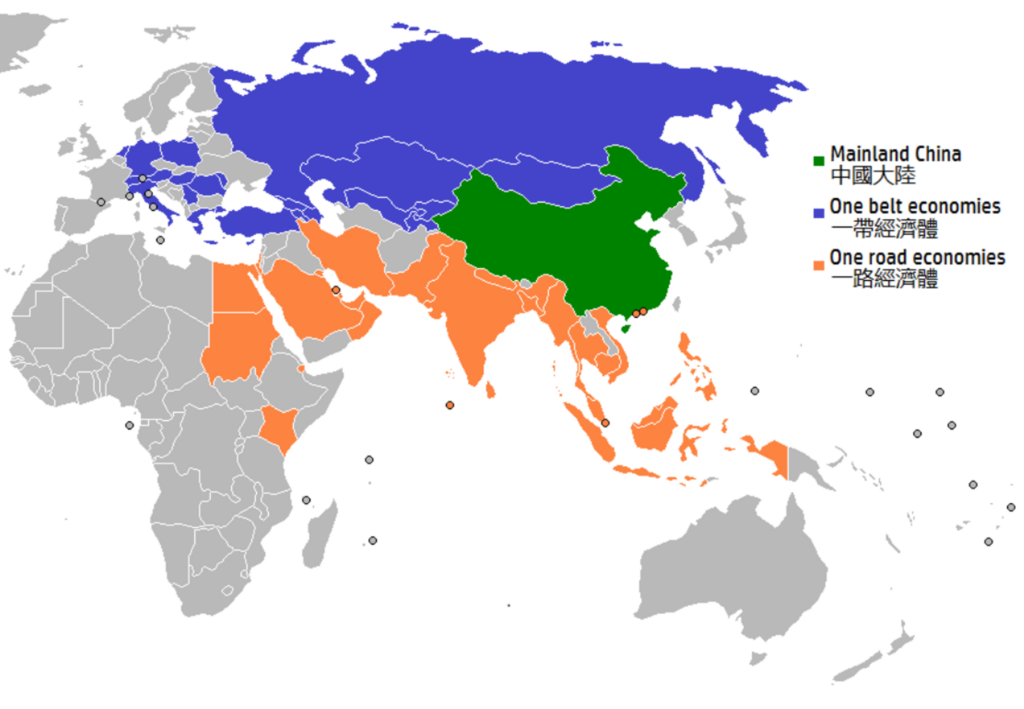
Now China is striving for more and, a few years ago, launched the ambitious project ‘OBOR – One Belt, One Road’ (New Silk Road Project). Or, to put it simply: China wants to revitalise the Silk Road.
65 countries, 70 per cent of the world’s population, three continents, a budget of several hundred billion dollars – the New Silk Road project is set to become the defining factor of China’s – state-controlled – policy. China is already trialling the project in Africa. More than 66 billion dollars have been invested over the past 12 years, creating 130,000 jobs. And this is just the beginning. Investments and stakes in ports, trading posts, and companies are intended to secure and expand China’s influence in Africa. Around 80 per cent of the investments are state investments from China – it is hardly conceivable that these are purely (private) economic interests.
(c) By Tart – This file was derived from: Hong Kong Qatar Locator.png by Xxjkingdom, CC BY-SA 3.0, https://commons.wikimedia.org/w/index.php?curid=50039039
The project One Belt, One Road (abbreviated as OBOR; Chinese 一帶一路 / 一带一路, Pinyin Yídài Yílù, ‘One Belt, One Road’) has, since 2013, consolidated China’s goals for building an intercontinental infrastructure network between China, other countries in Asia, Europe, and some countries in Africa.
Influence on Europe?
Europe, politically paralysed by discussions surrounding the refugee issue, plays a subordinate role in Africa. However, the European Union is now high on China’s priority list and for the New Silk Road project.
After China invested primarily in southern countries (Spain, Italy, etc.) following the financial crisis, the focus is now on Central and Eastern European states. In November, the 16+1 group met in Budapest. 16 Central and Eastern European states and China met to negotiate infrastructure investments.
One of the projects, the Budapest–Belgrade railway line, had to be halted due to potential circumvention of mandatory EU tenders. On the other hand, many of the strict EU regulations do not yet apply in the Western Balkans, which is why Montenegro, Serbia, and Bosnia-Herzegovina are becoming sought-after partners for China.
In principle, the European Union also welcomes states maintaining trade relations. Infrastructure development, in particular, benefits everyone. However, a sense of unease remains. For, naturally, massive investments from authoritarian China also bring political influence. There are also fears that Beijing could use payments to ‘EU-critical’ governments, especially in Central and Eastern Europe, to drive a wedge into Brussels.
European Union Stance: Fair Trade, Fair Competition
The Silk Road summit in May 2017 was dominated primarily by authoritarian states such as Turkey, Russia, Kazakhstan, Belarus, and the Philippines. EU states did not sign the final declaration. Officially, the line is ‘the Silk Road must not become a one-way street’ – a phrase also used by French President Macron during his recent visit to China.
The reasoning is simple but correct: in the interest of fair and free global competition, Europe must absolutely ensure that the Chinese state does not normalise protectionism and overwhelm European companies with dumping, state-controlled economies, and capital, instead of competition based on innovation within a legal framework.
The US withdrawal from the free trade arena has opened an opportunity for the EU to significantly shape the rules of global trade. Agreements with Canada (CETA), Japan (JEFTA), South Korea, and Mexico set a clear direction. China has a strong interest in the European market and European know-how – the (attempted) takeovers of, for example, German industrial companies by Chinese investors clearly demonstrate this. The sticking point, however, is that European companies and investors do not have anywhere near the same opportunities in China. An imbalance that can only be rectified with the strength of the European Union.
For years, negotiations have been ongoing at WTO level regarding the market economy status – eagerly awaited by China – for the People’s Republic’s state-controlled economy. At the end of 2017, the European Union’s new anti-dumping rules finally came into force (see here: http://ec.europa.eu/trade/policy/accessing-markets/trade-defence/actions-against-imports-into-the-eu/anti-dumping/).
China is aware that it must adhere to the rules of market economy, rule of law, and investor protection if it wants to benefit from the European market. Here lies a great opportunity to achieve an opening of the Chinese market towards a truly competitive region through negotiation.
Danger from Short-Sighted Nationalism
It is rightly noted that excessive Chinese influence and a dependence bought through investments by nationalistically acting governments of some EU states could weaken the EU’s position in negotiations with China.
And indeed, purely nationally conceived strategies are short-sighted. Gaining popularity by ‘attracting large investments’ may provide a government with short-term popularity. However, believing that a country can assert itself economically or in terms of power politics against large state investors like China – or Russia in the case of energy supplies – without being embedded in the EU is naive.
Competition Between Rule-of-Law States Must Be the Goal
Europe’s goal, therefore, cannot be to isolate itself from the global market (as many left- and right-wing governments or organisations propagate). This is why a strategic partnership and investment agreement with China are welcome. But it also cannot be Europe’s goal for a protectionist state to dictate the rules. Rule of law, freedom, competition, and investor protection are indispensable for fair global trade. Europe must be strong enough to enforce these principles against China. To torpedo this goal, which offers fair opportunities to all European companies in Asia, would be irresponsible and dangerous.
It is certainly irresponsible and dangerous to completely disregard Asia in the media and political debate. The unstable nuclear power Pakistan, the largest Muslim country Indonesia with 220 million inhabitants, India – the world’s largest democracy with over 1 billion people, or indeed China, may have less entertainment value than the tweets of Trump and co., but in realpolitik terms, they certainly pose a major challenge for Europe and for the economic, security, and geopolitical stability of the world. The USA plays an enormously important role, but: it is a state governed by the rule of law with checks and balances, free elections, free media, and a strong civil society. China is not. This does not yet justify a morally wagging finger, but it does warrant a deep analysis and engagement with this Asian state and its policies.
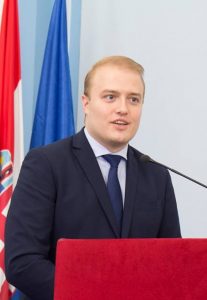
Stefan Haböck is a consultant for European and international affairs on the Presidium of the Paneuropa Movement Austria.
Stefan Haböck is a consultant for international affairs for the Paneuropa Movement Austria.



