EU sanctions against Kosovo are absurd
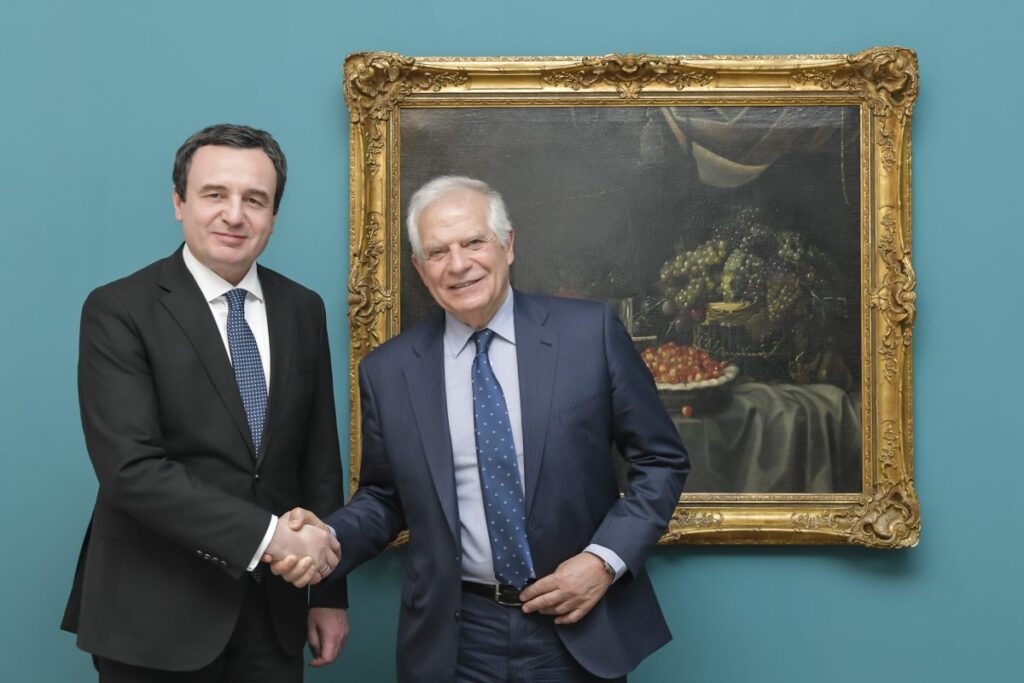
Following unrest in the Mitrovica region (part of Kosovo) after elections boycotted by Serbs, the Republic of Kosovo is now to be hit with sanctions. An absurd idea, says Rainhard Kloucek, Secretary General of the Paneuropa Movement Austria.
The EU, then, intends to impose sanctions against Kosovo. The background to this is the unrest (involving the shooting of KFOR soldiers) following local elections in the Mitrovica region, which belongs to Kosovo. The Serbs living there boycotted the elections on orders from Belgrade, meaning that in a region inhabited by a majority of Serbs, only Kosovars were elected to mayoral offices. Reportedly, there was an agreement with Kosovo before the elections to postpone them in order to still be able to persuade the Serbs to participate. The fact is that the elections had already been postponed once, namely from autumn 2022 to April 2023.
Afterwards, Prime Minister Albin Kurti wanted to install the mayors in the town halls, which led to uprisings by the Serbs. As always with such violent protests, Belgrade’s ‘security apparatus’ had its fingers in the pie this time too.
Now the EU wants to impose sanctions against Kosovo because of this. Admittedly, Albin Kurti has a reputation for being a nationalist, for being unwilling to compromise, and for being stubborn. The stink bomb attacks by his party on the parliament in Pristina have not improved his reputation either. But none of this is a justification for sanctions.
The elections were agreed upon. It was recognised that the elections were conducted fairly and that the results were therefore legitimate. Had the Serbs participated, there would now be Serbian mayors in several municipalities. The Serbs, however, boycotted because they want to disrupt any stability of the state of Kosovo on orders from Belgrade.
Shortly after the unrest, three Kosovo police officers were arrested by Serbian police on Kosovar territory and abducted to Serbia. Even if they are, thank God, free again, such an action can only be seen as a provocation by Serbia. Vucic, a former follower of the war criminal Slobodan Milosevic, is known for his broken promises to Kosovo as well as to the EU and the USA.
Because the EU wants to draw him to its side on the question of sanctions against the terrorist state of Russia, it lets Vucic get away with a lot. It seems as if people in Brussels (and many EU capitals) have learned as little from the wars of Slobodan Milosevic as they have from the Russian games with the Minsk Agreement. Vucic knows how to exploit this weakness in EU policy and repeatedly plays with fire by, among other things, putting the army on alert against Kosovo. The only thing he understands is pressure. Hard political and economic pressure. Should he himself not give in to this and further expand Serbia as a bridgehead for Moscow (Russia’s largest espionage facility, disguised as a humanitarian centre, has been in Nis for years), Serbia could be isolated. Even Viktor Orban could not save him from that.
The EU’s credibility problem
However, the EU has a massive credibility problem in this matter. And the problem has become even greater since the beginning of July because, with Spain, a country has taken over the Presidency of the Council that does not recognise the independence of Kosovo. For flimsy reasons. But as experts on Spain report, a large proportion of Spanish politicians would not even be able to find the Republic of Kosovo on a map. The High Representative of the Union for Foreign Affairs and Security Policy, Josep Borrell, is Spanish. The European Union Special Representative for the Belgrade-Pristina Dialogue, Miroslav Lajcak, comes from Slovakia. A country that has also not recognised the Republic of Kosovo (but is, thank God, less problematic than Spain). The Commissioner for Neighbourhood and Enlargement, Oliver Varhelyi, is in turn Hungarian. He comes from the stable of Viktor Orban, whose sympathy for the system of the Serbian nationalist Vucic is no secret.
Now this EU personnel problem could be completely defused by a corresponding political strategy from the other EU countries. Why weakness is being shown here and why they prefer to hit out at the Kosovars remains a mystery. For appeasement – every politician must know this much history – never leads to political stability.
© Featured image: European Union 2023 Günter Schiffmann: Albin Kurti (left) with Josep Borrell



