Failings of the Left Fuel the Rightward Shift
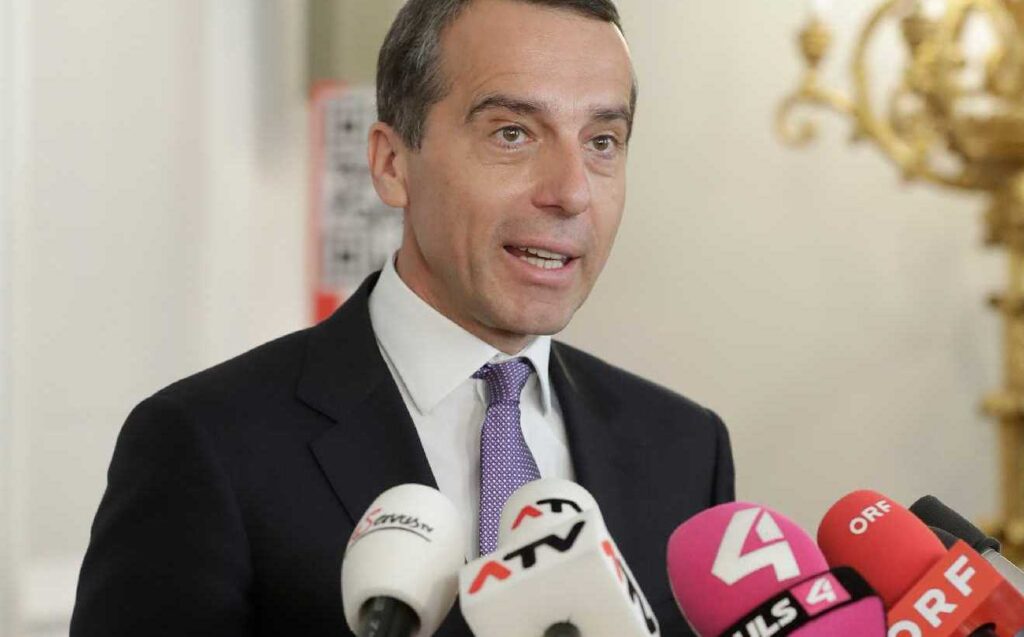
The victors of the National Council election are not just Kurz, Pilz, and Strache. Pollsters, for their part, can boast of having performed far worse in the past. An analysis by Wilhelm Ortmayr.
Almost all forecasts were within a margin of plus or minus two percent, and this for months on end. This proves two things: the empiricists did a good job, and Austrians did not make their decision impulsively at the last minute.
All the more seriously, then, must the parties take these results and discuss them in detail. Initial reactions from the SPÖ and the Greens – somewhere between voter and media bashing – suggest the exact opposite. Yet, these two groups, in particular, urgently need an honest self-assessment – regardless of the Social Democrats’ final position or whether the Greens remain in parliament.
Green Defeat: Detachment from Reality as the Main Reason
The Greens (alongside the defunct BZÖ and Team Stronach parties) are paying the price for this election. Ten months after Alexander van der Bellen’s victory, they are losing everything, to the benefit of almost all others. And no Green should claim they weren’t warned. With an unparalleled resistance to advice, the party has stumbled from one grave error to the next. The often-postulated ‘high conflict resolution potential of women’ was completely absent in a party that has become increasingly female in recent years. Flora Petrik and Peter Pilz send their regards.
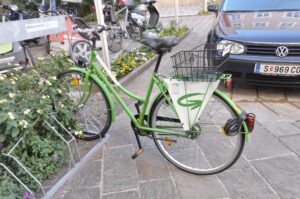
The bicycle has long become a symbol of the attributions of Green politics in Austria. It stands for a fundamentally positive signal, while larger problems are ignored.
From © Photo: Ra Boe / Wikipedia /, CC BY-SA 3.0 at, https://commons.wikimedia.org/w/index.php?curid=23305035
But they alone are not to blame for the disaster. The movement, which set out three and a half decades ago to free Austria from corruption and cronyism and to optimise its ecological awareness and actions, has become a ‘socially romantic bunch of reality deniers’, according to many who this time voted for Pilz or even red/turquoise. With prohibitions, wagging fingers, and the constant demand for even more laws, the Greens have alienated much liberal potential. Diesel tax and road tolls drove away many working people, especially commuters. And with primary issues such as inclusion, integration, and education, one might gain a virtuous profile, but certainly not win elections.
For months, the Green leadership refused to hear any of this. And they vehemently refused to define the primary issue of ‘migration’ in such a way that voters would feel that politics had, firstly, the situation under control and, secondly, a Plan B. Under these circumstances, even the genuinely lived antithesis to the FPÖ no longer served as a good election argument. The consequences are well known. The electorate turned away from the Greens and ‘returned home’. Partially to the movement’s roots in Pilz’s form, partially to the People’s Party, and in the cities, to the SPÖ.
Weakening Social Democracy
The latter, however, should beware of celebrating the retention of the worst election result in its history as a success, or of blaming certain tabloid newspapers. An election in which almost 20 percent of the votes are in flux, without gaining ground,
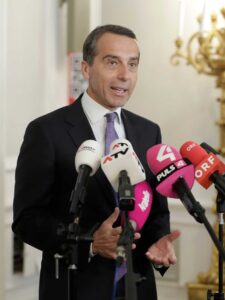
Chancellor Christian Kern presented his performance to the media as a success. However, he had no real gains to show for it.
© Federal Chancellery / Regina Aigner
should be understood as an alarm signal. For the absence of losses is probably only due to Green loan votes, which sought to prevent a conservative chancellor, and by no means to a better or more future-oriented programme. ‘Successful politics must answer people’s question: How will we live tomorrow?’ Bruno Kreisky said, in essence, 50 years ago. ‘As well as yesterday’ is neither a conclusive nor an encouraging answer to this question for the future.
Moreover, it is striking that the Social Democratic gain zones are primarily bourgeois areas, not working-class districts. It is therefore by no means true that the regionally significant gains of the SPÖ indicate that urban agglomerations, where migration and direct contact between cultures truly occur, voted against the right-wing populist mainstream.
The opposite is true. In Vienna, for example, the inner-city districts, and in Salzburg and other provincial capitals, the centres and more affluent parts of the city, shifted from Green to SPÖ. Precisely those districts where migrants are hardly present. It was left-liberal educated citizens and higher earners who strengthened the SPÖ’s back – those whose comfort zone would most likely be threatened by a ‘rightward shift’. Still completely out of touch, the SPÖ is losing ground in rural areas and noticeably among residents of urban ‘hotspot regions’. It is no surprise: Kern scores points in the bourgeois ‘bubbles’ – the public housing estates remain closed to him.
Wilhelm Ortmayr is a freelance journalist. He lives and works in Salzburg and Vienna.
Paneuropa post-election analysis.
Part 1: “The next move?” by Lukas Leitner.
https://pan.thatscommunication.de/der-naechste-zug-versuch-einer-nachwahlprognose/
Part 2: ‘Failings of the Left Fuel the Rightward Shift’ by Wilhelm Ortmayr.
Part 3: ‘Five Winners, One Loser’ by Patrick Minar



