Is the Principle of Blackmail Replacing the Principle of Merit?
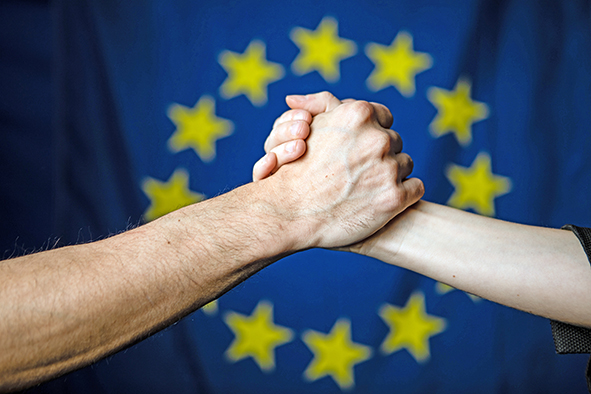
Bilateral conflicts must be resolved before accession takes place. That is beyond question. However, if arbitrary populist blockades prevail, Europe will replace the principle of merit with the principle of blackmail in its enlargement policy. By Stefan Haböck, Vice President of the Paneuropean Movement Austria.
“Why does he do it? – Because he can!” comes to mind when following the latest successful blockade in EU enlargement policy. There, blockades have established themselves as a viable tool of nationalist politics, massively shaking the trust of people in the Western Balkans in a united Europe.
For the second time, North Macedonia has fallen victim to this political strategy. This small country, roughly the size of Lower Austria and Burgenland combined and with fewer inhabitants than Vienna, has been a candidate for accession for 17 years and has now been subjected to a blackmailing blockade by its neighbours for the second time. First, Greece blocked the start of accession talks and pushed for a change to the country’s name. Once this conflict was resolved, Bulgaria exercised a veto, followed by a dispute over the origin and relationship of the Bulgarian and Macedonian languages and a shared (or separate) history.
After the parliament in Skopje – in the absence of the largest opposition party – accepted a compromise proposal, accession talks with North Macedonia and Albania can finally begin. Since both states are linked in the negotiations, the Albanians have had to suffer the consequences of the blockades against North Macedonia. European solidarity, indeed.
Bilateral conflicts must be resolved
It is beyond question that conflicts can exist between neighbouring states. This has occurred in all parts of Europe. But naturally, in a region that only freed itself from dictatorship around three decades ago and was subsequently involved in bloody wars (former Yugoslavia), many historical, cultural, and political wounds remain open. These must be overcome through dialogue, negotiation, and tolerance. In addition to the relevant political bodies, commissions of historians and cultural exchange programmes exist for this purpose.
The EU, in particular, must aspire to be the political space where peaceful cooperation and the overcoming of such conflicts are possible. The protection of minorities in Europe is intended to enable the coexistence of ethnic and cultural groups within a region or a state. Diverse languages and traditions are a cultural treasure of a united Europe.
Blackmail instead of merit
Yet what we have now witnessed is the transformation of enlargement policy – one of the EU’s most important geopolitical levers alongside global agreements – into a plaything for the whims of domestic populism.
There is a fundamental will within the EU to expand to include the six states of the Western Balkans. This should happen once these states fulfil all necessary reforms, defined in various chapters and based on the Copenhagen criteria. That is what accession negotiations are for; there, the fulfilment of criteria must be consistently demanded. Any bilateral conflicts can be resolved through the negotiation process.
However, this principle of merit, where an accession candidate must reform their state to achieve progress, is being weakened by the repeated success of blackmail strategies. First the country’s name, then the language. What will the next nationalist think of that they dislike about their neighbour? Historical references to national borders or languages are highly dangerous here. A European country is currently being destroyed under the (obviously pretextual) justification of “protecting people who speak our language”. “Crimea has only been Ukrainian since 1954” is intended to justify the violent annexation. That this line of reasoning finds fertile ground in a country that was divided until 31 years ago is a cynical irony of history.
However, when criticising blockades in enlargement policy, one does not need to point the finger solely at South-East Europe.
The “old” EU states bear a large share of the responsibility for the frustration in South-East Europe. Kosovo has fulfilled almost 100 conditions and, as the only country, has still not received the promised visa liberalisation.
Europe is squandering trust
European hesitancy is destabilising South-East Europe. Young people are emigrating, populists are exploiting political instability, and since there is never a geopolitical vacuum, non-European powers are using the situation to assert their influence. If, at a time when half of Europe is subject to blackmail by a raw material supplier, we have still not learned that we as Europeans must not make ourselves dependent on other powers, then there is no helping our continent.
The article originally appeared in the Wiener Zeitung.
Statements from the Paneuropean Union Macedonia and the Paneuropean Union Albania regarding the enlargement negotiations can be found here and here.
© Featured image: European Union 2019 Mauro Bottaro



