When good development is not enough – Czechs vote out Prime Minister.
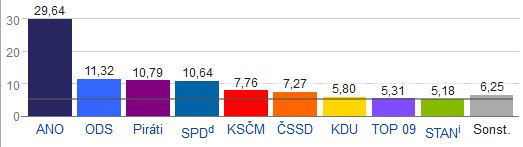
In the Czech parliamentary elections, the head of government was punished. Good figures alone are not enough when uncertainty about a positive future prevails. A commentary by Stefan Haböck, International Officer of the Paneuropa Movement Austria.
The Czech Republic is in good economic shape. Unemployment is low. In contrast to neighbouring countries, there are hardly any asylum seekers. Unemployment in the Czech Republic stands at around 3 per cent; hardly any other country in the European Union boasts such a low figure. Economic growth in recent years has been strong. Instead of a 70 million koruna deficit, a budget surplus of almost 62 billion koruna was achieved.
The government loses – the dismissed Finance Minister triumphs
Now the head of government, Bohuslav Sobotka, has plummeted with his governing Social Democrats. Minus 13.8 percentage points – a debacle. The great election winner is Andrej Babiš, billionaire and corporate boss. Proceedings were recently initiated against him for alleged EU subsidy fraud. He achieved around 30 per cent of the vote with his party ANO (Yes!).
How could it come to this?
There has been much discussion in recent weeks as to how, given the Czech Republic’s good situation, parts of the government could be so severely punished.
Was it the trend “against the elites” observable in many countries? But if a billionaire and corporate boss is not the elite, then why is a not unsuccessful head of government like Sobotka? Is it about integrity in the political system? Criminal proceedings are underway against Babiš. It concerns EU subsidy fraud. This did not harm him in the elections. Or do “the Czechs” (at least that part which did not vote for the traditional parties) simply want to punish “politics”? Possible. But Babiš is a politician himself, held a high ministerial office until May 2017, and was a key part of the very government that has just been punished.
To understand it, one must go back a little further. The defeat of the governing Social Democrats of the ČSSD is not only one in a long series of disastrous collapses of Social Democratic parties in Europe, for example in France, but is also consistent within the Czech Republic. In the previous election, the governing parties were also hit – only then it was the more conservative-liberal ODS and TOP09. The ČSSD was not part of the government at that time. Now they have suffered the same fate.
A clever staging as a reformer – but who wants to join him?
Babiš has managed one thing very well: presenting himself as a reformer within the government. Successes, such as good budget figures and economic growth, were attributed to him as Finance Minister. Any scandals that led to his dismissal as minister, however, were blamed on the Social Democratic or conservative coalition partners. The reformer must go. So it seemed to many Czechs.
Forming a government is now proving more than difficult. It is not so much the ANO party per se, but the person of Babiš who is a thorn in the side of the other parties. Most parties reject a coalition with Babiš as Prime Minister due to the ongoing criminal proceedings. Some would reject any coalition with ANO, even without Babiš in the cabinet. If this dilemma cannot be resolved, the Communists or the right-wing SPD would be available for a minority government.
Why comparisons with the USA are too cheap and pro-European must be defined.
A major debate also flared up around Babiš – is he even “pro-European”? And is he not actually a “Trump” or “Orbán”?
Quite apart from the fact that one descends into intellectual shallows when political analyses only take place based on two or three names of politicians. Babiš is not Trump; he is Babiš. His person, his life, and his political positions provide enough material for discussion and criticism. At the European level, the ANO party is a member of ALDE – the European Liberals. They, who are very critical of populists and EU critics – primarily from the conservative camp, less so among the socialists – must now justify potentially tolerating an “anti-European” in their ranks.
To this, one must clearly state: what is pro-European and what is not is difficult to determine based on pure ideology. Loyalty to treaties, freedom, the rule of law, democracy, subsidiarity – these are Paneuropean values and principles which, in our view, are profoundly pro-European. At the same time, so are the market economy and free trade. On the latter alone, quite a few groups on both the left and the right would fail the “pro-European” attribute. That criticism of “the EU” and “Brussels” is – unfortunately – not a unique selling point of Eastern European politicians, I have already noted in a previous blog post on Eastern Europe.
In election campaigns, things are often not as bad as they seem. Pragmatism is the new style.
Babiš is a pragmatist. An internationally active entrepreneur who knows and appreciates the advantages of the single market and a free Europe. The Czech Republic has grown economically, primarily through the opening and the opportunities within the European Union. It is not a member of the Eurozone, but neither are many other EU states. And: as Finance Minister (embedded in a government with two partners), he rehabilitated and managed the state budget well.
One thing must never be forgotten: opposition and election campaign periods are to be assessed differently from government responsibility. Many a populist has become tamer in government. Robert Fico, a left-wing populist from the very beginning, has not only reformed Slovakia but today describes his country as a “natural part of a core Europe!”. It remains to be seen what coalition will emerge in the Czech Republic. The sticking point will be the outcome of the investigations. Depending on this, there will be a minority government, a coalition, or even new elections. In any case, the signal from the voters was clear.
Stefan Haböck is an officer for International and European Affairs on the board of the Paneuropa Movement Austria. Previously, from 2008 to 2016, he was the Federal Chairman of the Paneuropa Youth Austria. He is also a European local councillor for the city of Wels.



