Five winners, one loser
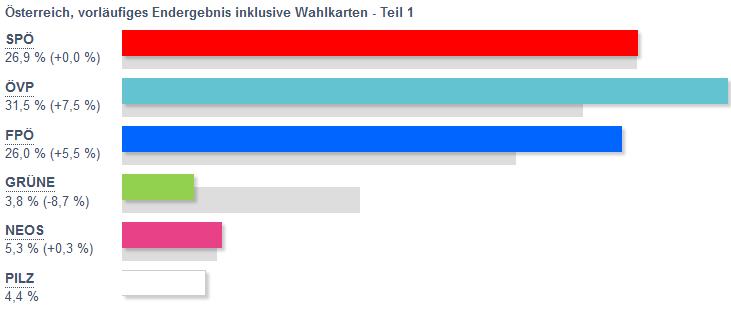
It has become part of the often embarrassing election day ritual for parties to fundamentally declare themselves the winners of the election. A commentary by Patrick Minar.
Smallest increases in votes, a smaller minus than expected, mandates held, polls as a starting point, etc. – no argument is too stupid. This election is different: five parties can be absolutely satisfied with the result, quite rightly so; only for one was the debacle so obvious that even the most cunning spin doctor could probably think of nothing more.
The three “small” ones: From jubilation to disappointment
At the bottom, the story is quickly told. The Greens have had to realise that they are by no means so structurally anchored in society that they would be forgiven for treating the best horse in the stable poorly. Sure-footed and miles away from the issues important to voters, they have brought themselves to the brink of their existence (at the time of writing this commentary, the counting of postal votes was still missing) and will – regardless of whether they ultimately make it into parliament or not – have to reinvent themselves to an extent, finding a raison d’être that goes beyond climate lamentation and anti-FPÖ rhetoric.
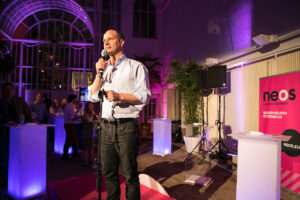
The Neos remained stable at a low level, but could become the tip of the scales.
(cc-by-sa Nicole Heiling)
The old warhorse Peter Pilz, on the other hand, has, as so often in his political career, proven correct political instinct and correctly assessed his own standing, that of the topics associated with him, and that of his former party colleagues. He seized the opportunity and succeeded with a left-wing populist party – the idea of “certainly not founding a new party” was quickly abandoned, at the latest after taking a closer look at the Party Financing Act.
The great fear of the Neos was being crushed by the lost-vote argument in the escalation of the leadership question between the three major parties. Through a well-conceived, largely error-free election campaign, albeit with illegible poster slogans, they succeeded in never entering this disastrous debate, but instead positioned themselves throughout most of the campaign as a small but stable force for substantive renewal in the National Council.
Kurz campaign: Strategically well executed
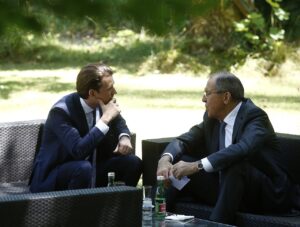
For ÖVP leader Sebastian Kurz, his substantive consistency above all paid off in the election outcome.
By Dragan Tatic, CC BY 2.0, https://commons.wikimedia.org/w/index.php?curid=61063684
Things got heated at times with the domestic political triumvirate of the ÖVP, SPÖ, and FPÖ. The ÖVP, which mutated from black to turquoise under new chairman Sebastian Kurz, introduced a new form of election campaign staging to the domestic stage under the professional leadership of campaign expert Philipp Maderthaner, outshining substantive weaknesses here and there.
However, a key success factor was the consistent “stay on the message”, which earned Kurz criticism in the Twitterati bubble of political junkies but was precisely tuned to the needs of the voters. Post-election analyses show this very clearly. Collateral damage, caused by the SPÖ’s successful expansion of the Silberstein affair to the ÖVP, slightly clouded the campaign finish, but did not change the great success of the ÖVP.
SPÖ: Stable after all despite turbulence
The SPÖ delivered the most exciting result. With around 27 per cent of the vote, party leader Kern naturally confirms the historically worst result for the Social Democrats; however, given the disastrous starting position, respect must be paid. An election campaign can hardly run worse than was the case this time.
A respected campaign professional threw in the towel early, as he apparently smelled a rat; brawling employees, internal party wing fights, and finally the fatal leaks with unflattering internal psychograms of the Federal Chancellor and about the activities of the internationally well-known consultant Tal Silberstein, who organised Facebook pages of questionable taste and other low blows for the SPÖ.
Blame it on the Weatherman
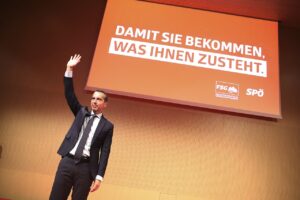
The SPÖ under Christian Kern remained surprisingly stable. The reasons for this, however, were not necessarily their own merits.
© SPÖ/Zach-Kiesling
The subsequent communication strategy of the SPÖ was remarkable, according to which no one was actually responsible, no one knew anything, everyone distanced themselves, but a lot of money was still paid. What remained was a party employee who apparently acted on his own initiative, without coordination with the federal managing director and campaign manager, or even the party leader. A remarkable life of its own…
It is fascinating that this spin worked and the SPÖ actually succeeded in projecting an image where everyone was equally shabby and everyone was equally involved. The question arises: what does a party like the SPÖ have to do to be truly punished by the voter? One does not know. What is certain is that the much-maligned Vienna SPÖ stood like a rock, ensuring a more than respectable result for the battered federal SPÖ. Internally, the result represents a strengthening of the anti-FPÖ faction under the leadership of Vienna Mayor Michael Häupl; those seeking links with the Blues, such as Burgenland’s Hans Niessl, were weakened.
Freedom Party composure
The election campaign ran relatively peacefully for the FPÖ, after the role of the “bad boy”, usually left to them, was taken over by the SPÖ.
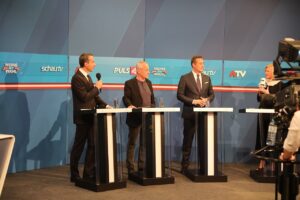
Kern, Pilz, Strache: Three unequal opponents. Will they remain so?
By SPÖ Presse und Kommunikation – CC BY-SA 2.0, https://commons.wikimedia.org/w/index.php?curid=63411766
Under the leadership of the longest-serving party leader Heinz-Christian Strache, the turbulence between the SPÖ and ÖVP came to their aid, as they had been under substantive pressure until then because the Kurz-ÖVP cheekily but consistently snatched their core topics of asylum, integration, and immigration from their plate and presented them to voters in much more measured language.
The result is only just below the historic high of 1999, placing the third camp in the position of kingmaker. A fascinating detail is the realisation that, after the presidential election, the FPÖ is now faltering in Vienna for the second time and is not getting the necessary results onto the streets there to be even further ahead nationwide.
Coalition poker
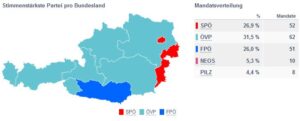
Results by federal state. Source: BMI / wahl17.bmi.gv.at
Which finally brings us to the question of what happens next. All signs point to a Black-Blue coalition. However, a hard-nosed negotiation poker is to be expected, where it remains to be seen who will back down further. The FPÖ has the strategically optimal starting position in its luggage: a strong result itself, plus two options due to third place, both of which are so strong that they can enter negotiations with sufficient self-confidence. For Christian Kern, Blue-Red is the only constellation to remain Chancellor and is simultaneously of the greatest importance for the power-conscious SPÖ, as it is otherwise extremely weakly positioned in most states and levels.
The ÖVP, on the other hand, is also under considerable pressure, because Sebastian Kurz was not made chairman to be leader of the opposition, and a new edition of Black-Red under different conditions would probably not correspond to the will of Kurz supporters; moreover, such a new edition is probably not very realistic given the low blows recently exchanged between the two parties.
What is currently certain is a historic election in which the SPÖ was voted out as the Chancellor’s party, the ÖVP achieved first place – a historically rare result – the Greens have crumbled and must fight for existence, and with the Liste Pilz, a new actor is on the field.
It remains interesting.
Patrick Minar is a partner at the Vienna communications agency Schneider | Minar | Jenewein Consulting. Twitter: @LitigationTweet
Paneuropa post-election analysis.
Part 1: “The next move?” by Lukas Leitner.
https://pan.thatscommunication.de/der-naechste-zug-versuch-einer-nachwahlprognose/
Part 2: “Left-wing deficits as fathers of the right-wing shift” by Wilhelm Ortmayr.
Part 3: “Five winners, one loser” by Patrick Minar



